
Collagen Stimulation for Skin: What It Means and What Supports It in 2026
Collagen stimulation is a biological process, not a promise printed on a skincare label. Searches for “collagen slimulation” often lead to claims that blur an important distinction: a formula may contain collagen, but that doesn’t automatically mean your skin is producing more of it. Knowing what a product is designed to do helps separate plausible skincare benefits from claims that need stronger evidence.
Collagen helps give skin its structure and firmness, but its production and decline are influenced by more than any single cream or at-home tool. Ingredients, consistent habits, and the limits of topical skincare all matter when setting expectations.
This guide explains collagen’s role in skin, what may support its natural processes, and how to assess claims about topical formulas and at-home devices. You’ll learn why collagen-infused skincare isn’t the same as proven collagen stimulation, where ingredients such as peptides may fit, and how targeted tools can complement a routine without being mistaken for clinical treatments. The goal is a clear, measured approach: understand what a product is intended to do, look for evidence relevant to that product, and expect gradual, realistic changes rather than instant or guaranteed transformation.
Key Takeaways
- Learn what collagen contributes to skin’s structure and why supporting its natural processes differs from applying collagen topically.
- Explore how age, UV exposure, lifestyle, and individual biology can shape visible skin changes.
- Compare topical collagen, ingredient-led skincare, at-home tools, and clinician-led procedures by their intended roles and realistic expectations.
- Build a consistent collagen-focused routine with foundational care and targeted products chosen thoughtfully.
- Understand what “collagen slimulation” claims can and can’t tell you, including how to view collagen-infused formulas and skincare wands realistically.
What Does Collagen Stimulation Mean for Skin?
Collagen stimulation means supporting the skin’s own collagen-related processes, rather than simply applying collagen in a skincare formula. An ingredient’s presence on a label doesn’t, by itself, show that it reaches the skin’s supportive structures or prompts them to produce more collagen. If you’re searching for “collagen slimulation,” this distinction is the essential place to start.
Collagen is a structural protein that helps form the skin’s supportive framework. That framework contributes to skin’s strength and firmness, but it isn’t the only factor behind how skin looks. Hydration can affect how plump or supple skin appears, while texture and underlying structure also play a role. A single product can’t be assumed to address all of these factors.
What Does Collagen Do in the Skin?
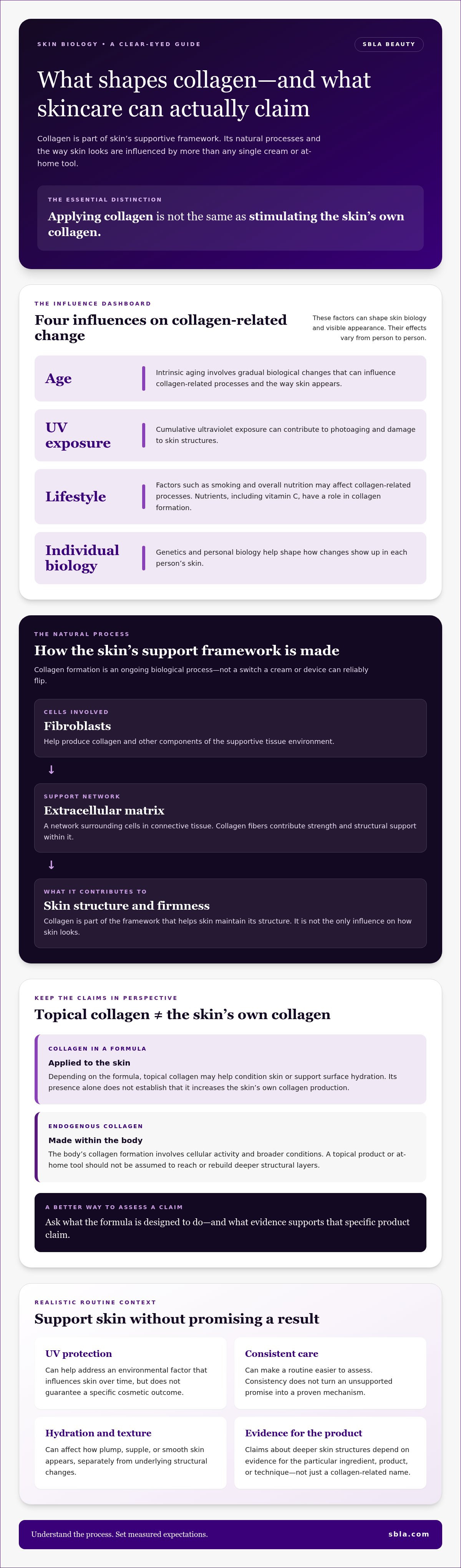
Think of collagen as part of the framework that helps skin maintain its structure. It is a main structural protein in the extracellular matrix, the network surrounding cells in connective tissue. Fibroblasts are among the cells involved in producing collagen and other components of this supportive environment. Their activity is part of a broader biological process, not a switch that a skincare product can simply turn on.
That’s why “collagen support” is best understood as a goal, not a guaranteed result. Skin’s appearance reflects several interacting influences, and visible changes don’t point to collagen alone. Dryness, for example, can make skin look less supple even when the concern isn’t simply a matter of structural support.
Does Collagen in Skincare Stimulate the Skin’s Own Collagen?
Not automatically. Collagen in a topical formula is applied to the skin; endogenous collagen is made within the body. These are not interchangeable. Depending on the formula, topical collagen may help condition the skin or support surface hydration, but its presence alone doesn’t establish that it increases the skin’s own collagen production.
Other skincare ingredients have different intended functions, and their effects depend on the ingredient, formulation, and use. Claims about influencing deeper skin structures require evidence for the specific ingredient and product, not just a collagen-related name or promise. The same distinction applies to at-home tools: using a targeted skincare device doesn’t, on its own, prove collagen stimulation.
Instead of asking only “Does it contain collagen?”, ask “What is this formula designed to do, and what evidence supports that claim?” Check the intended use and directions, and distinguish surface-care benefits from claims about underlying structure. Consistency can make a routine easier to assess, but it doesn’t turn an unsupported promise into a proven mechanism.
How Does the Skin Make Collagen, and What Can Influence It?
Collagen formation is an ongoing biological process, not a switch that a cream or device can reliably flip. Fibroblasts, cells in the skin’s connective tissue, make collagen and other supportive materials. The body processes and organizes these components into the extracellular matrix, the network that helps support skin. This process depends on cellular activity and the body’s broader conditions, so it can’t be reduced to a single ingredient or routine step.
The Role of Fibroblasts and the Extracellular Matrix
Fibroblasts help produce the proteins and other materials that make up the extracellular matrix. Collagen fibers contribute strength and structural support within this network, alongside other components that help maintain the tissue environment. The body needs building blocks and nutrients for collagen formation. Harvard T.H. Chan School of Public Health explains how collagen production works, including the role of nutrients such as vitamin C.
This natural process is different from a product-specific treatment effect. A topical formula applied to the surface shouldn’t be assumed to reach or rebuild deeper structural layers. Likewise, a tool’s use or an ingredient’s presence doesn’t establish that it changes collagen production. Those claims depend on evidence for the particular product or technique.
Why Collagen and Skin Appearance Change Over Time
Skin changes reflect both intrinsic aging, the gradual biological changes associated with age, and environmental influences. Cumulative ultraviolet exposure can contribute to photoaging and damage to skin structures. Lifestyle factors, including smoking and overall nutrition, may also affect collagen-related processes, while genetics and individual biology shape how changes appear. These influences vary from person to person.
Age, cumulative UV exposure, lifestyle factors such as smoking and nutrition, and individual biology can all influence collagen-related processes and the visible appearance of skin. This context is useful when weighing collagen slimulation claims: well-established influences on skin biology don’t prove that a specific product or at-home technique produces a particular structural effect.
In practical terms, protecting skin from UV exposure and supporting general health can help address factors that influence skin over time, but neither guarantees a specific cosmetic outcome. Hydration, texture, and structural changes may affect appearance in different ways. Keep these distinctions in mind when assessing at-home routines and the evidence behind them. If you’re considering targeted application tools, view SBLA BEAUTY’s skincare wands as routine options, not as proof of collagen stimulation.
Collagen Stimulation vs. Topical Collagen: How Do the Approaches Differ?
These approaches aren’t interchangeable. A skincare formula may contain collagen without showing that it increases the skin’s own collagen production. The phrase “collagen slimulation” doesn’t establish a biological effect either. Look for evidence tied to the specific ingredient, device, or procedure and its intended use.
| Approach | Intended role | Evidence to consider | Effort and expectations |
|---|---|---|---|
| Topical collagen | Condition or hydrate the skin’s surface, depending on the formula. | Ingredient presence alone doesn’t demonstrate increased collagen production within skin. | Used as part of regular skincare; expect a surface-care role, not proven structural rebuilding. |
| Ingredient-led skincare | Address specific skincare goals with ingredients such as peptides or retinoids. | Evidence varies by ingredient, formulation, concentration, and use. Claims need support relevant to the product. | Requires consistent use and attention to tolerance; don’t assume guaranteed firming or lifting. |
| At-home tools | Support a skincare routine or targeted application, depending on the tool. | Device-specific evidence matters. A tool’s use alone doesn’t establish collagen stimulation. | Requires following product directions; expectations should match substantiated functions. |
| Clinician-led procedures | Address skin concerns through medical or professional techniques. | Evidence and risks depend on the procedure, protocol, and individual circumstances. | Involves professional assessment and procedure-specific aftercare; outcomes vary. |
Topical Collagen, Peptides, and Retinoids: Different Roles
Topical collagen may function as a conditioning or hydrating ingredient, but applying it is not the same as prompting the body to make collagen. Peptides and retinoids are distinct ingredient categories, and research or claims about one formulation shouldn’t be applied automatically to another. A peptide claim, for example, needs evidence for the particular formula and intended effect. Research on collagen supplements concerns oral supplementation, a separate route from topical skincare, and should be interpreted in that context.
For any ingredient, separate a plausible mechanism from a demonstrated outcome. “Contains collagen” describes a formula; it doesn’t, by itself, prove stimulation of the skin’s own collagen or a visible change in firmness.
At-Home Tools and Professional Procedures Are Not Equivalent
A cosmetic application tool and a medical procedure differ in purpose, use, and evidence. Don’t assume an at-home wand reaches deeper structures or triggers a specific biological response unless product-specific evidence supports that claim. Professional procedures also vary, so their effects and risks shouldn’t be generalized across methods.
If you’re considering a medical procedure or have a skin concern, discuss your options with a qualified healthcare professional. For everyday skincare, choose products and tools for their supported, practical role, then keep expectations measured.
How to Build a Realistic Collagen-Focused Skincare Routine
A considered routine is easier to maintain and assess than a stack of products promising rapid transformation. Use this four-step framework to keep your approach focused:
- Identify your goal. Decide whether you’re prioritizing hydration, texture, or another visible concern. Different goals may call for different products.
- Keep foundational care consistent. Cleanse gently and use broad-spectrum sun protection during the day. These steps support general skincare and help protect against UV exposure; they aren’t collagen treatments.
- Add targeted products thoughtfully. Introduce one new formula or tool at a time, follow its directions, and consider how it fits with products you already use.
- Track tolerance. Pay attention to dryness, stinging, redness, or other irritation. Adjust use according to product directions, and don’t push through a reaction.
A Simple Routine for Supporting Healthy-Looking Skin
Morning: cleanse gently if appropriate for your skin, apply products that suit your goals and tolerance, then finish with broad-spectrum sun protection. Evening: cleanse to remove sunscreen and daily buildup, then use your chosen skincare products as directed. This is a flexible framework, not a universal prescription. Consider sensitivity and compatibility, especially when layering active ingredients. For persistent irritation or a diagnosed skin condition, seek advice from a qualified clinician.
If you’re exploring collagen slimulation at home, keep the aim realistic: a skincare routine can support skincare goals, but a product or tool shouldn’t be treated as proof of a change in the skin’s deeper structure.
How to Track Progress Without Expecting Overnight Results
Choose a consistent way to assess changes. If you take progress photos, use similar lighting, angle, and distance, and leave space between comparisons rather than checking day by day. Note how your skin feels and whether a product remains comfortable to use. Short-term hydration or surface smoothing may affect appearance, but it doesn’t demonstrate collagen remodeling.
Consistency and realistic expectations matter because visible changes depend on the product, how it’s used, individual skin, and time. Quick surface effects don’t establish a deeper structural change. Give a routine enough time to assess tolerance, follow each product’s directions, and avoid adding several new steps at once. If you’re ready to incorporate a targeted application tool into your routine, explore SBLA BEAUTY’s skincare wands as skincare options, not guaranteed collagen-stimulation treatments.
Where SBLA BEAUTY Fits Into a Collagen-Conscious Skincare Approach
SBLA BEAUTY offers collagen-infused and peptide-based formulas, along with targeted skincare wands for the face, eye area, and neck. Its Eye Lift Wand, Liquid Facelift Wand, and Neck, Chin & Jawline Sculpting Wand are options to consider as part of a personal routine. A product’s ingredients or format alone don’t establish that it stimulates the skin’s own collagen production. To assess collagen slimulation claims, focus on what the product is designed to do and what product-specific evidence supports.
How to Evaluate a Collagen-Infused Skincare Product
Start with the details, not just the headline claim. Review the ingredient information, intended use, application directions, and any evidence provided for the specific product. Collagen listed in a formula tells you that it’s an ingredient; it doesn’t prove the product changes collagen production within the skin. Formulas can differ, so don’t assume every collagen-infused product works in the same way.
Next, match the product to your own goal and ingredient tolerance. If hydration or skin conditioning is your priority, consider whether the formula’s stated role aligns with that aim. Introduce unfamiliar products thoughtfully and follow their directions. For a focused example of how to assess claims in the eye area, read the clinical guide to collagen-infused eye treatments. Use it as context for that subject, not as proof that every formula or tool produces the same effects.
When a Targeted At-Home Wand May Fit Your Routine
A targeted wand can be an application tool within an at-home skincare routine. Its role and use depend on the specific product, so follow the directions and don’t assume it delivers ingredients more deeply or stimulates collagen unless product-specific evidence supports that claim. SBLA BEAUTY’s at-home liquid facelift clinical guide addresses a distinct topic and should be considered in that context.
If you have a medical skin concern or persistent irritation, seek advice from a qualified healthcare professional rather than relying on a cosmetic tool to address it. Otherwise, let your goals, comfort, and realistic expectations guide product selection. A collagen-focused routine can include topical formulas and targeted tools without treating either as a guaranteed collagen-stimulation method.
Explore SBLA BEAUTY’s skincare options to see how collagen-infused formulas and targeted wands may fit into your personal routine.
Build a Skin Routine With Confidence
Collagen helps support skin’s structure, but a collagen ingredient in a topical formula isn’t proof that the skin is making more of its own. The distinction is central to understanding collagen slimulation claims. Skin appearance reflects more than collagen alone, and age, UV exposure, lifestyle, and individual biology all play a part.
A thoughtful approach starts with consistent foundational care, then adds targeted formulas or tools according to your goals and skin’s tolerance. Give a routine time, follow product directions, and judge claims against evidence for the specific product rather than its marketing language.
SBLA BEAUTY offers collagen-infused and peptide-based skincare formulas, as well as targeted at-home wands for the face, eyes, and neck. Explore these as skincare options, not guaranteed collagen-stimulation treatments. Explore SBLA BEAUTY’s skincare tools and formulas and choose a routine that feels considered, consistent, and right for you.
Frequently Asked Questions
What does collagen stimulation mean in skincare?
Collagen stimulation refers to supporting processes involved in the skin’s own collagen formation. It’s different from applying collagen in a topical formula, which doesn’t automatically mean the skin is producing more. Assess claims according to the specific ingredient, device, or procedure and its supporting evidence. Skin appearance also depends on hydration, texture, structure, sun exposure, and individual biology, so collagen is only one part of the picture.
Does topical collagen stimulate the skin to produce more collagen?
Not simply because it’s included in a formula. Topical collagen may serve a surface skincare role, such as conditioning or helping skin feel hydrated, depending on the product. That’s distinct from demonstrating increased production of the skin’s own collagen. Look for product-specific evidence behind any deeper structural claim rather than assuming that a collagen-related ingredient name proves stimulation or lasting firming effects.
Can peptides support collagen production in the skin?
Some peptides are used in skincare with the aim of supporting skin-related processes, but effects depend on the specific peptide, formulation, and available evidence. The word “peptide” alone doesn’t establish that a product increases collagen production or visibly firms skin. Review the formula’s intended use and substantiation, introduce it according to directions, and consider your skin’s tolerance. Don’t treat results from one formulation as proof for all peptide products.
How long does it take to see results from collagen-focused skincare?
There’s no universal timeline. It depends on the product’s intended function, how consistently it’s used, the individual’s skin, and what change is being assessed. Hydration or surface smoothing may affect appearance sooner than claims involving deeper structural changes, but those surface effects aren’t proof of collagen remodeling. Follow product directions, track progress under similar lighting, and be cautious of promises of rapid or guaranteed transformation.
Is collagen stimulation the same as collagen production?
They’re related, but the terms aren’t identical. Collagen production is the biological process by which the body makes collagen. Collagen stimulation describes an approach intended to encourage or support that process. Using the term “stimulation” doesn’t prove that a product or tool causes increased production. For collagen slimulation claims, focus on evidence tied to the specific product or method and distinguish demonstrated effects from proposed mechanisms.
Can an at-home skincare wand stimulate collagen?
It depends on the specific device and the evidence supporting its claims. A skincare wand may be designed for targeted application or use as part of a routine, but its use alone doesn’t establish that it stimulates collagen or reaches deeper skin structures. SBLA BEAUTY offers targeted at-home wands for the face, eyes, and neck. Follow each product’s directions, and don’t assume a cosmetic tool replaces medical care.
What can reduce collagen in the skin over time?
Collagen-related changes can reflect intrinsic aging and environmental influences. Cumulative ultraviolet exposure is an important contributor to visible photoaging, while factors such as smoking and overall nutrition can also affect collagen-related processes. Genetics and individual biology influence how these changes appear. Broad-spectrum sun protection helps protect skin from UV exposure, but no single lifestyle step can prevent all age-related changes or guarantee a particular cosmetic result.
What is the difference between collagen stimulation and collagen replacement?
Collagen stimulation generally refers to an approach intended to support the body’s own collagen-forming processes. Replacement refers more broadly to adding or substituting material, though the exact meaning depends on the treatment or product being discussed. These approaches aren’t interchangeable, and neither label guarantees a particular outcome. Medical procedures can involve different mechanisms and risks, so discuss procedure-specific options and concerns with a qualified healthcare professional.

