
Early Signs of Neck Aging: The 2026 Clinical Guide to Prevention and Reversal
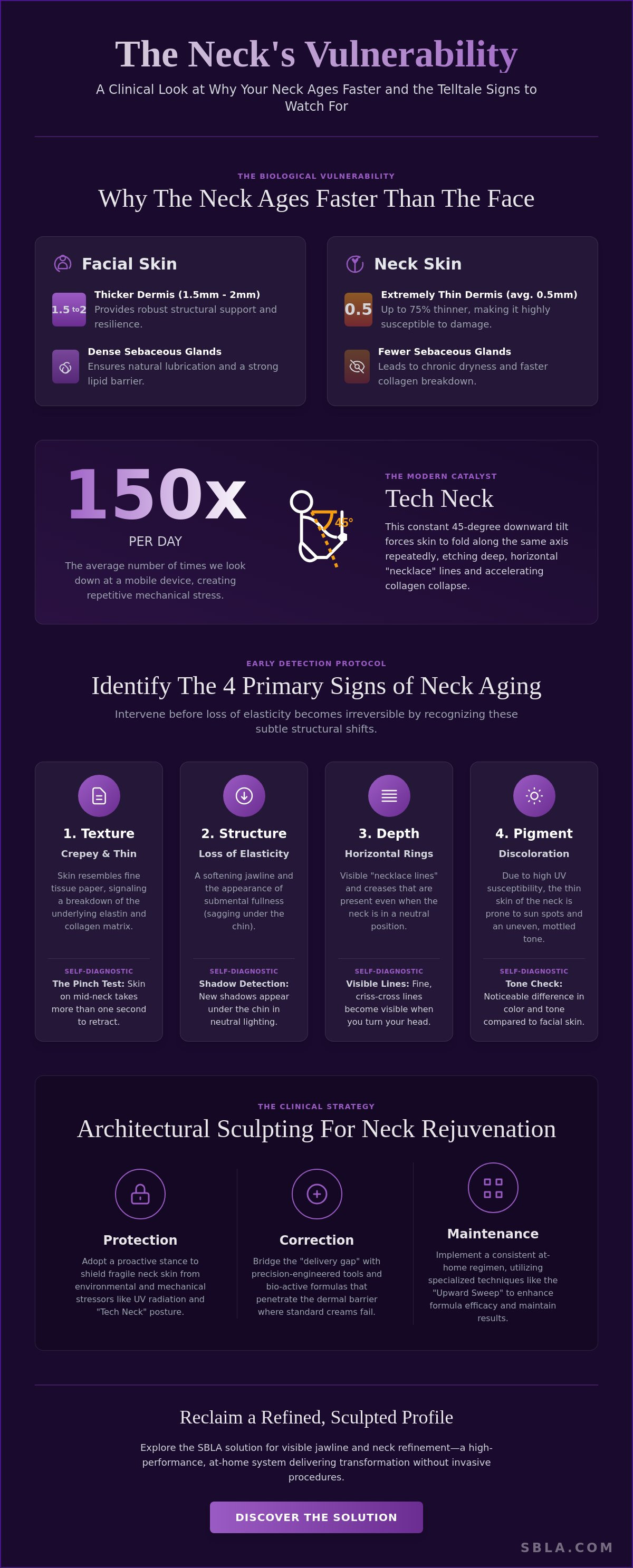
The average person looks down at their mobile device 150 times per day, a repetitive mechanical stress that triggers the premature breakdown of collagen fibers. This phenomenon, combined with the fact that neck skin is significantly thinner and contains fewer sebaceous glands than the face, explains why the area often appears a decade older than your profile. You have likely noticed the sudden appearance of horizontal rings or a crepey texture that resists standard hydration. These early signs of neck aging represent a biological vulnerability that requires a targeted, architectural approach rather than simple topical moisture.
A softening jawline and loss of skin elasticity can compromise your aesthetic confidence. This 2026 clinical guide promises to reveal the precise mechanisms behind dermal thinning and provide the sophisticated tools required to reclaim a refined, sculpted profile. We will examine the unique anatomy of the neck, identify the specific symptoms of structural decline, and present a high-performance at-home solution that delivers visible transformation without the necessity of invasive clinical procedures.
Key Takeaways
- Master the biological reasons the neck remains a vulnerable zone, prone to rapid aging due to a lack of sebaceous glands and supportive fatty tissue.
- Identify the early signs of neck aging across four key categories, texture, structure, pigment, and depth, to intervene before loss of elasticity becomes irreversible.
- Bridge the "delivery gap" by understanding why standard topical treatments often fail to penetrate the sensitive but resilient dermal barrier of the neck.
- Adopt a tiered clinical strategy of protection, correction, and maintenance using the specific "Upward Sweep" application technique for optimal formula efficacy.
- Explore the architectural benefits of precision-engineered tools designed to complement bio-active formulas for visible jawline and neck refinement.
The Biological Vulnerability: Why the Neck Ages Faster Than the Face
The neck is often dismissed as a secondary aesthetic concern, yet it remains the most vulnerable "forgotten zone" of the human profile. Unlike the face, which benefits from a dense network of sebaceous glands that provide natural lubrication and barrier protection, the neck possesses a significantly lower lipid count. This anatomical deficit leaves the skin perpetually susceptible to chronic dryness and accelerated environmental damage. Without the robust fatty tissue support found in the cheeks or forehead, the neck relies on a fragile structural framework that reveals the early signs of neck aging far sooner than other regions.
The platysma muscle serves as the primary architectural foundation for the neck and jawline. This thin, broad sheet of muscle maintains the tension of your profile; however, as it weakens, the overlying skin begins to drape and sag. Dermal thinning is the progressive reduction of the skin's middle layer, resulting in the translucent, parchment-like appearance that characterizes an aging neck. Because this area lacks the internal scaffolding required to resist gravity, the transition from smooth contours to visible creases can feel sudden and irreversible.
The Anatomy of Thin Skin and Low Lipid Production
Precision is key when evaluating dermal fragility. While facial skin typically measures between 1.5mm and 2mm in thickness, neck skin is remarkably delicate, often averaging only 0.5mm. This extreme thinness makes it highly susceptible to Photoaging, where UV radiation penetrates deeper into the dermis to shatter collagen and elastin fibers. Because there are fewer hair follicles to provide structural anchoring, the skin lacks the resilience found on the scalp or face. Lower lipid counts lead to chronic dehydration, which triggers a faster rate of collagen degradation and the formation of fine, vertical lines.
Tech Neck: The 2026 Catalyst for Early Creasing
In 2026, the primary driver of premature structural collapse is the repetitive mechanical stress known as "tech neck." The average individual subjects their neck to a 45-degree downward head tilt approximately 150 times daily to engage with digital devices. This constant flexion creates deep, horizontal "necklace" lines as the skin is forced to fold along the same axis repeatedly. These mechanical indentations eventually become permanent etchings in the skin's surface. To mitigate these structural shifts, you must implement specific postural corrections and targeted treatments. For a detailed protocol on reversing these specific indentations, consult our guide on Tech Neck Treatment at Home.
Identifying the 4 Primary Early Signs of Neck Aging
Clinical detection of dermal decline often occurs too late because most individuals wait for deep, permanent folds before taking action. The early signs of neck aging are far more subtle and manifest as structural shifts rather than obvious wrinkles. To accurately assess your status, you must categorize changes into four distinct physiological pillars: texture, structure, pigment, and depth. Identifying these shifts in their infancy allows for non-invasive architectural correction before surgical intervention becomes the only viable option.
The most common precursor to visible aging isn't a line, but a loss of elasticity. This is often misidentified as simple dehydration. While dehydrated skin lacks water and appears dull, crepey texture indicates a breakdown of the underlying elastin and collagen matrix. If your skin resembles fine tissue paper or fails to "snap back" immediately after a gentle pinch, you're experiencing structural thinning. To reduce premature skin aging, you must address these textural changes with bio-active ingredients that reinforce the dermal-epidermal junction.
Conduct a self-diagnostic in front of a mirror using this clinical checklist:
- The Pinch Test: Skin on the mid-neck takes more than one second to retract.
- Shadow Detection: New shadows appear under the chin in neutral lighting, indicating the start of submental sagging.
- Textural Grain: Fine, crisscross lines become visible when you turn your head laterally.
- Pigment Irregularity: Redness or mottled brown spots appear on the sides of the neck, often sparing the area directly under the chin.
Horizontal Necklace Lines and "Ring" Creases
Static horizontal lines, often referred to as "necklace lines," are no longer exclusive to mature demographics. These creases form from the repetitive folding of thin skin, but their permanence is driven by a lack of structural collagen. It's vital to distinguish these from sleep lines, which are typically diagonal and fade within an hour of waking. Necklace lines remain visible even when the neck is fully extended, creating a segmented appearance that disrupts a youthful profile. Addressing these rings requires a formula that can "plump" the depth of the crease from within while tightening the surface tension.
Loss of Jawline Definition and Early Jowling
A softening mandible edge is a definitive indicator of early-stage laxity. As the platysma muscle loses its supportive tone, gravity pulls the submental area downward, leading to the "disappearing" jawline. This often occurs in tandem with changes in the lower face. For those noticing a synergy between neck sagging and mouth-area folds, reviewing Marionette Lines Before and After results can provide a comprehensive view of lower-face rejuvenation. Utilizing a precision tool like the Neck, Chin & Jawline Sculpting Wand can help re-establish that sharp, architectural border between the face and neck.
The Delivery Gap: Why Standard Neck Creams Often Under-Perform
Investing in high-end skincare often yields disappointing results when applied to the neck. This frustration stems from the "barrier challenge," a physiological paradox where the skin is thin and sensitive yet remarkably resistant to passive topical absorption. While many products claim to reverse the early signs of neck aging, they often lack the sophisticated delivery systems required to penetrate beyond the surface layer. Without a clinical mechanism to bypass the skin's natural defenses, active ingredients remain trapped in the epidermis, providing temporary hydration rather than structural transformation.
The efficacy of collagen peptides is dictated by their molecular weight; only fragments smaller than 500 Daltons can successfully bypass the stratum corneum to reach the fibroblast cells responsible for structural repair. Most standard creams utilize large-molecule proteins that are physically unable to reach the deeper dermal layers where sagging begins. To see a definitive change in skin tension, you must shift from passive topical application to a system that ensures bio-availability at a cellular level.
Moisturization vs. Structural Sculpting
It's vital to distinguish between epidermal hydration and dermal reinforcement. Humectants like hyaluronic acid are excellent for plumping the very top layer of skin, but they don't address the weakening of the dermal matrix. Structural sculpting requires ingredients that can stimulate the production of Type I and Type III collagen. Additionally, mechanical stimulation plays a critical role in this process. By incorporating tools that provide targeted pressure, you can boost lymphatic drainage and improve local microcirculation, which enhances the delivery of nutrients to the skin's architectural foundation.
The Role of Bio-Active Peptides and Retinol
Bio-active peptides serve as molecular messengers that signal the skin to initiate repair protocols. When these peptides reach the dermis, they encourage the synthesis of elastin and fibrillin, the proteins responsible for the "snap back" quality of youthful skin. However, the neck's lack of sebaceous glands means it cannot tolerate the same aggressive concentrations of retinol used on the face. A controlled-release delivery system is essential to provide the benefits of cellular turnover without triggering the inflammation or "retinol burn" that often plagues the delicate decollete. Choosing non-comedogenic, clinical-grade formulations ensures that the skin remains clear and refined while undergoing deep structural rejuvenation.
Clinical Prevention and Treatment Strategies for 2026
Addressing the early signs of neck aging requires a disciplined, tiered methodology: Protection, Correction, and Maintenance. This clinical framework ensures that structural integrity is preserved while existing damage is actively reversed. By shifting from reactive care to a proactive architectural strategy, you can maintain a sharp jawline profile and smooth neck texture without the immediate necessity for surgical intervention. Consistency is the primary driver of visible results in this delicate region.
Daily application of broad-spectrum SPF is the first line of defense. Without it, you risk developing Poikiloderma of Civatte, a condition characterized by reddish-brown mottling and a "plucked chicken" texture on the lateral neck. This sun-induced damage is often permanent once established. The "Upward Sweep" technique is equally vital for all topical applications. Applying products in a downward motion contributes to skin stretching and gravitational sagging. Instead, use firm, upward strokes from the collarbone to the jawline to support lymphatic drainage and counter the mechanical pull of gravity. For those managing more advanced laxity or structural collapse, our guide on How to Get Rid of Turkey Neck Without Surgery offers a deeper analysis of non-invasive clinical protocols.
The Daily Protocol for Neck Preservation
Morning rituals should focus on protection and antioxidant defense. Evening routines must prioritize cellular repair and structural plumping. Integrate a targeted tool like the Neck, Chin & Jawline Sculpting Wand into your regimen after cleansing but before applying heavy occlusives. Use the "Three-Finger Rule" to ensure adequate coverage: apply enough product to cover the width of three fingers for each side of the neck and the decollete. This ensures the thin dermal layers receive a uniform concentration of bio-active ingredients.
Lifestyle Adjustments: Posture and Ergonomics
Modern ergonomics are essential for preventing "crease-setting." Elevate your digital screens to eye level to eliminate the repetitive 45-degree downward tilt that accelerates horizontal ring formation. Sleep position also dictates long-term results; side sleeping often causes deep vertical chest and neck wrinkles that become static over time. Ensure internal hydration is optimal to support the efficacy of your topical formulas. Clinical trial data indicates that copper peptide serums can produce a 23% reduction in wrinkle depth, but these results are significantly enhanced when the skin's internal moisture reservoir is maintained through adequate water intake.
Architectural Sculpting: The SBLA Solution for Neck Rejuvenation
The shift from identifying the early signs of neck aging to implementing a definitive correction requires a tool that mirrors the precision of a clinical environment. Traditional creams are limited by their delivery method, often failing to address the structural sagging discussed in previous sections. The Neck, Chin & Jawline Sculpting Wand is a precision-engineered solution that treats the neck as an architectural unit. By combining a potent, bio-active formula with a targeted mechanical application, this tool provides an immediate lifting effect while fostering cumulative, long-term structural repair. This dual-action approach ensures that the skin’s surface is tightened instantly, providing the visible reward of self-assurance, while the underlying dermal matrix is reinforced over time.
This architectural approach addresses the neck and jawline as a single aesthetic unit, ensuring that the results look natural and cohesive. The instant lift is achieved through surface-tension technology that smooths the epidermis upon contact, while the long-term benefits accrue as the bio-active ingredients stimulate the skin’s natural repair mechanisms. It's a sophisticated bridge between daily maintenance and clinical intervention, offering a way to reclaim a sharp profile without the risks of surgery.
Precision Delivery: How the Sculpting Wand Works
The wand’s stainless steel rollerball ensures that the high-performance formula is distributed with surgical evenness across the delicate skin of the neck and jawline. This mechanical action does more than just apply product; it provides a cooling effect that instantly constricts blood vessels to reduce early morning puffiness and localized inflammation. The cooling effect is immediate. This thermal shift prepares the skin for the absorption of our proprietary peptide blend. These peptides are specifically formulated to bypass the dermal barrier, signaling the fibroblasts to synthesize the structural proteins necessary for a refined, tightened profile.
Clinical Results Without the Downtime
Providing the benefits of a "liquid facelift" without the associated risks of invasive procedures is the hallmark of modern aesthetic innovation. While surgical options offer dramatic changes, they involve significant recovery periods and high costs. The SBLA solution empowers you to maintain professional-grade results from home, utilizing a tool that fits seamlessly into a daily regimen. For those experiencing more advanced symptoms, such as significant volume loss or deeper "necklace" rings, the Neck, Chin & Jawline Sculpting Wand XL offers a concentrated dose of active ingredients to address more stubborn structural concerns. It delivers a higher concentration of the sculpting formula to combat the effects of gravity on more mature skin, making it an essential tool for those who have moved beyond the initial stages of dermal thinning. You don't have to wait for clinical intervention to reclaim your profile. Experience the transformation with the SBLA Neck, Chin & Jawline Sculpting Wand and witness the power of architectural skincare.
Reclaiming Architectural Precision
The transition from subtle laxity to visible structural collapse is not inevitable. By understanding the unique biological vulnerability of the neck, you can intervene before temporary creases become permanent etchings. Identifying the early signs of neck aging allows for the implementation of a precise, tiered strategy that prioritizes dermal reinforcement and mechanical support. Traditional topicals often fail because they lack the necessary molecular weight to penetrate the skin's barrier; however, professional-grade tools bridge this delivery gap with scientific accuracy.
True transformation requires more than hydration. It demands clinically proven peptide formulas and a dermatologist-recommended delivery system that mirrors the efficacy of in-office treatments. You have the power to restore a defined, elegant profile through non-invasive architectural sculpting. It's time to elevate your regimen with a solution designed for the specific demands of the neck and jawline. Sculpt your profile with the SBLA Neck, Chin & Jawline Sculpting Wand and embrace the confidence of a visible, lasting transformation. Your profile is the foundation of your aesthetic identity; protect its future today.
Frequently Asked Questions
What are the first signs of neck aging to look for?
The primary indicators include a noticeable loss of skin elasticity and the emergence of horizontal "necklace" lines. You might also observe a crepey texture that resembles fine tissue paper, which is a hallmark of dermal thinning. Identifying these early signs of neck aging through a simple pinch test or by checking for new shadows under the jawline allows you to intervene before structural damage becomes permanent.
Can neck wrinkles be reversed without surgery?
Early-stage creases and sagging can be significantly improved through non-invasive clinical protocols. Utilizing bio-active peptides and mechanical stimulation encourages the skin to synthesize new collagen and elastin fibers. While deep structural collapse may eventually require surgical intervention, consistent use of precision-engineered tools can refine the jawline and smooth the skin's surface effectively from home.
Why is neck skin different from facial skin?
Neck skin is anatomically more fragile, measuring approximately 0.5mm in thickness compared to the 1.5mm to 2mm found on the face. It contains significantly fewer sebaceous glands, which leads to chronic dryness and a compromised lipid barrier. This lack of natural lubrication, combined with minimal fatty tissue support, makes the area more susceptible to gravity and environmental degradation.
How does "tech neck" affect the aging process in 2026?
Repetitive mechanical stress from looking down at digital devices accelerates the breakdown of collagen along the folding axis of the neck. This 45-degree downward tilt, performed dozens of times daily, creates static horizontal rings that wouldn't otherwise form so early in life. In 2026, this postural habit is the leading cause of premature structural aging in younger demographics.
What ingredients are best for a crepey neck?
Clinical-grade formulations containing bio-active peptides and controlled-release retinol are essential for treating crepey skin. These ingredients signal the dermal matrix to repair itself without causing the irritation common to standard retinoids. For maximum efficacy, look for low-molecular-weight collagen fragments that can actually penetrate the thin but resilient neck skin rather than sitting passively on the surface.
How often should I use a neck sculpting wand for results?
Optimal results require a twice-daily application as part of your morning and evening skincare rituals. Consistency is vital because the benefits of the early signs of neck aging treatments are cumulative. Using the wand in the morning provides an immediate tightening effect and reduces puffiness; the evening application supports the skin's natural circadian repair cycle for long-term structural refinement.
Is it ever too early to start a neck-firming routine?
Preventative care should ideally begin in your 20s or early 30s before visible sagging occurs. A growing trend in 2026 involves using "preventive micro-treatments" to maintain the skin's architectural integrity early on. Starting a routine before the collagen matrix begins its natural decline ensures that the jawline remains sharp and the skin stays resilient for decades longer.
Can I use my regular face moisturizer on my neck?
While a face moisturizer provides basic hydration, it's generally insufficient for the unique structural needs of the neck. Most facial creams lack the specific delivery systems and high-potency peptides required to penetrate the neck's delicate dermal layers. To achieve visible lifting and sculpting, you need a formula specifically engineered to address the lack of oil glands and structural support in this zone.
