
Retinol Skincare Wand: How to Choose and Use One Safely
A retinol skincare wand may mean a topical retinol formula used alongside a skincare wand, rather than a device that contains retinol. Those are two distinct parts of a routine, and combining them without checking their directions could irritate sensitive skin or add too many active products at once.
Start by identifying the formula, the device’s stated function, and your skin’s tolerance. Retinol is a topical ingredient; a wand is a skincare tool or applicator, and its features and directions vary. Don’t assume the two are designed to work together just because they appear on the same product page.
This guide explains how to distinguish a formula from a device, what to assess before combining them, and how to follow product instructions while monitoring your skin’s response. SBLA BEAUTY offers topical retinol and peptide formulas alongside targeted face, neck, and eye wands. Read each product’s ingredients and directions rather than assuming a particular wand contains retinol. The goal is a clear, measured approach with realistic expectations for at-home skincare.
Key Takeaways
- Assess a retinol skincare wand by separating the formula’s ingredients from the device’s stated function.
- Compare product roles, directions, and available evidence before deciding whether a topical formula and a tool belong in the same routine.
- Use each product’s own instructions to guide application order and frequency, then monitor how your skin responds.
- Consider targeted skincare tools and topical formulas as distinct options, with realistic expectations for at-home care.
What Is a Retinol Skincare Wand, and What Does the Wand Actually Do?
Retinol is a topical skincare ingredient; a wand is a device or applicator. The phrase retinol skincare wand can blur those roles, but it doesn’t tell you what a product contains or how it works. A wand might dispense or apply a formula, or it might have a separate device function. Its shape alone doesn’t reveal its technology or purpose.
Retinol is a vitamin A derivative used in topical skincare. The formula’s ingredients and instructions affect how it is intended to be used and how an individual may tolerate it. For a general overview of the ingredient and its forms, see What is Retinol? Check the specific product’s ingredient list and directions to understand the formula in front of you.
Assess the ingredients, product directions, and device function separately. These details, not the word “wand,” determine how a product is intended to be used.
Retinol formula versus skincare wand: two different roles
Retinol is an ingredient in a topical formula, such as a serum or cream. The complete formula matters, and skin response varies from person to person. A wand, by contrast, should be assessed by its stated design and instructions. It may be an applicator or a device with a specified function, but those details cannot be inferred from its appearance.
Neither category automatically includes the other. A retinol serum isn’t necessarily designed for use with a device, and a skincare wand isn’t necessarily retinol-based. They aren’t interchangeable: one describes an ingredient in a formula, the other a tool or applicator.
What “retinol skincare wand” can mean on a product page
On a product page, the phrase may refer to a wand used in a retinol routine or to a product pairing that includes a topical formula and a tool. Read the description to identify which meaning applies. Look for retinol or its listed forms in the ingredients, then check the device information for the wand’s stated features and intended use.
Marketing language doesn’t replace these specifics. Claims about improved absorption, delivery, or results need product-specific support. Don’t assume a device enhances a formula simply because both appear in the same description.
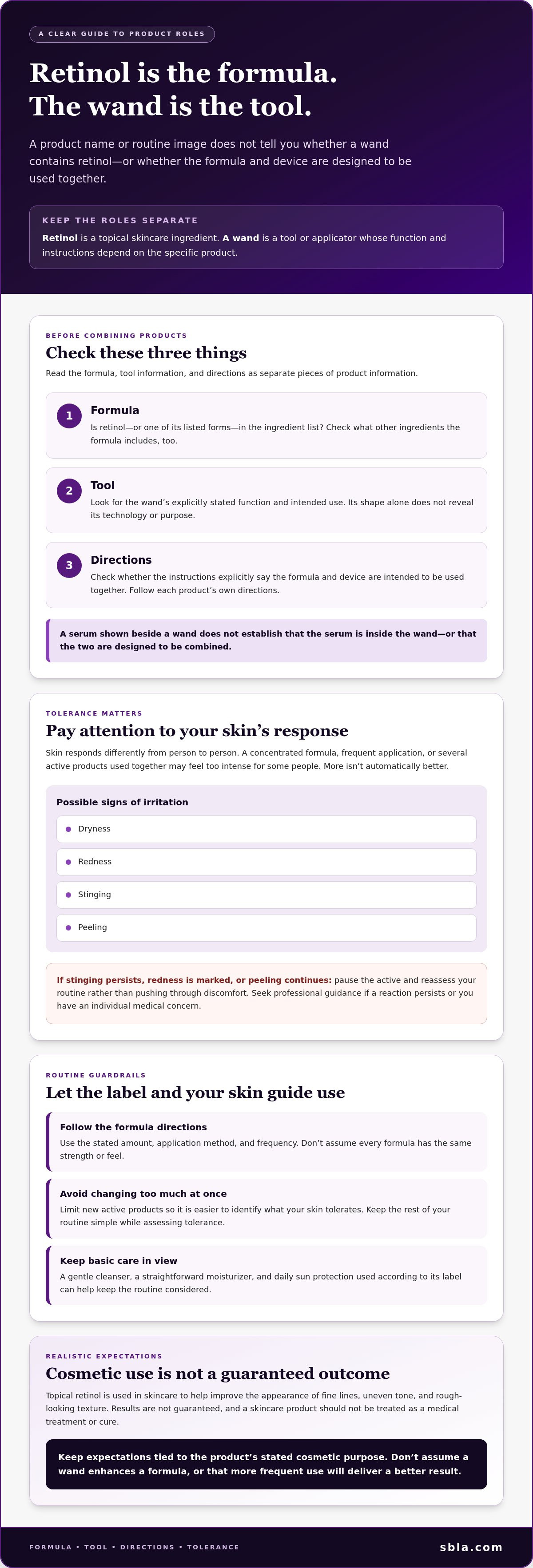
Sort the information on the product page into three categories:
- Formula: Is retinol named in the ingredient list? What other ingredients are included?
- Tool: What function does the product information explicitly state for the wand?
- Directions: Do the instructions explain whether the formula and device are intended to be used together?
For example, a page might describe a retinol serum and show a wand in a routine image. That alone doesn’t establish that the serum is inside the wand or that the two are designed to be combined. Distinguishing the formula from the tool helps you assess the product without reading more into its claims than they say.
How Retinol Works in a Skincare Routine, and Why Tolerance Matters
Retinol can be part of a routine focused on the visible signs of photoaging, such as the appearance of fine lines or uneven texture. Its cosmetic effects depend on the formula and use as directed, and skin responds differently from person to person. A concentrated formula, frequent application, or several active products used together may feel too intense for some people. More isn’t automatically better.
Let the product directions and your skin’s response guide use. Treat the label as your starting point instead of borrowing someone else’s schedule or assuming every formula has the same strength and feel.
What retinol may do, and what readers should not assume
Topical retinol is used in skincare to help improve the appearance of concerns such as fine lines, uneven tone, and rough-looking texture. These are cosmetic expectations, not a promise of a particular outcome. Results aren’t guaranteed, and a skincare product shouldn’t be treated as a medical treatment or cure. The formula, application, and your tolerance all shape the experience.
Keep expectations tied to the product’s stated cosmetic purpose. A retinol formula may suit one routine but not another; don’t assume a higher concentration or more frequent use will deliver a better result. If you’re also considering a retinol skincare wand, let the retinol product’s directions, not the device, guide how often you apply the active. Follow each product’s own instructions, especially if they don’t explicitly describe using the products together.
Recognizing irritation and protecting the skin barrier
Some people may notice dryness, redness, stinging, or peeling with a retinol product; others may not. Pay attention to how your skin feels as well as how it looks. Persistent stinging, marked redness, or ongoing peeling are reasons to pause the active and reassess your routine instead of pushing through discomfort. If a reaction persists or you have an individual medical concern, seek professional guidance.
Keep the rest of your routine simple while assessing tolerance. A gentle cleanser and a straightforward moisturizer can help you avoid layering several potentially irritating products at once. Use daily sun protection according to its label, and be deliberate about sun protection while building a routine that includes active skincare.
- Check the label: Follow the formula’s stated amount, application method, and frequency.
- Limit routine changes: Avoid introducing several new active products at once so it’s easier to identify what your skin tolerates.
- Observe and adjust: If discomfort persists, stop using the product and seek appropriate professional advice.
A measured approach makes it easier to judge whether a formula belongs in your routine without mistaking irritation for progress. SBLA offers topical retinol and peptide formulas alongside targeted tools, including face, neck, and eye skincare wands. Assess each product by its own ingredients and directions rather than assuming a formula and device are paired.
Retinol Wand, Retinol Serum, or Another Skincare Tool: How to Compare Them
Compare products by their role, directions, and evidence, not by the word “wand” or a polished claim. A topical retinol formula and a skincare tool may appear in the same routine, but one doesn’t automatically replace or enhance the other. A retinol skincare wand could mean a device used alongside a retinol product, an applicator, or a paired offering. The product details should clarify which.
| Product type | Stated role | Directions | Evidence to check |
|---|---|---|---|
| Topical retinol formula | Provides retinol as an ingredient in a skincare formula | Use the label’s amount, application method, and frequency | Full ingredient list, intended area, precautions, and support for product-specific claims |
| Applicator wand | Applies or dispenses a topical product, if described that way | Follow instructions for dispensing, application, and cleaning | Product description and directions confirming its role as an applicator |
| Skincare device | Has a stated device function that may vary by design | Follow the device’s own use instructions; don’t assume it pairs with retinol | Named function, intended area, precautions, and substantiation for performance claims |
| Formula-and-tool pairing | Combines or presents a topical formula with a tool | Use together only as the product directions specify | Explicit pairing instructions and evidence for claims about combined use |
How to assess a retinol product’s claims
Start with the ingredient list and instructions. Check the intended application area and any disclosed precautions, then compare those details with the product’s claims. General language about smoother-looking or more refined skin doesn’t establish a specific result. If the concentration or comparative strength isn’t stated, don’t infer it from the product name, packaging, or place in a routine.
How to assess a wand’s stated function
First determine whether the item is a formula, an applicator, or a device. Read its stated function and directions. Its shape alone can’t tell you whether it uses microcurrent or another technology, or whether it’s compatible with retinol. For a closer look at how device categories differ, see this microcurrent versus peptide wand guide.
SBLA’s targeted wand range includes products for areas such as the eyes, face, neck, and jawline. The SBLA Eye Lift Wand clinical guide is a separate example of a targeted wand category, not proof that every wand has the same function or contains retinol.
Before choosing, match your goal to the product’s stated role. Check that the instructions explain how to use it and that any performance claim applies to that specific formula or device. This keeps ingredient claims, device features, and routine decisions distinct.
How to Build a Considered Retinol Skincare Wand Routine
Build your routine around the exact formula and tool you have, not a universal schedule. Before combining retinol with a wand, confirm that each product’s instructions support your intended use. Directions should guide application order, frequency, and device use. If they don’t explain how to combine the products, don’t assume they’re intended to be used together.
- 1. Read the directions. Check the formula and wand instructions separately. Note the intended application area, amount, order, frequency, and precautions. If the device has specific use steps, follow those rather than adapting directions for a different tool.
- 2. Check the ingredients. Review the topical product’s full ingredient list, including other active ingredients. This helps you spot when a routine could involve several new or potentially irritating products at once. Don’t infer a formula’s concentration or strength if it isn’t disclosed.
- 3. Introduce thoughtfully. Follow the retinol product’s label rather than borrowing an application schedule from someone else. Keep the rest of your routine stable as you introduce it. Adding an exfoliating acid, a new retinol formula, and a device at the same time makes it harder to identify what your skin is reacting to.
- 4. Monitor your skin. Pay attention to comfort and visible changes after use. Daily sun protection is a sensible part of a skincare routine; follow the sunscreen label and any precautions listed for your retinol product.
A cautious approach to introducing retinol
Start with the product’s instructions, including any guidance on when and how to apply it. Don’t increase frequency or combine it with a device simply because your skin seems comfortable after one use. Limit other routine changes so you can better identify which product may be affecting your skin. If the formula includes additional actives, consider how the complete product fits with the rest of your routine rather than evaluating retinol in isolation.
When to pause, simplify, or seek professional advice
If persistent irritation develops, stop using the product and reassess your routine. Ongoing or worsening redness, stinging, or peeling is a reason to pause rather than push through. Simplify temporarily by avoiding newly introduced actives, and seek professional guidance if symptoms persist or you have sensitive skin, an existing skin condition, or questions about how skincare products may interact with medication.
Retinoid use also raises individual questions during pregnancy and breastfeeding. If you’re pregnant, breastfeeding, or planning to be, ask a clinician for guidance before using retinol or another retinoid. A clinician can advise based on your circumstances; general product directions can’t replace that individualized advice.
For a routine that includes tools, keep the formula and device instructions distinct and follow both carefully. Explore SBLA’s targeted skincare wands as part of a considered approach to at-home skincare, without assuming every wand is designed to pair with retinol.
Explore SBLA’s Targeted Skincare Wands and Formula Approach
SBLA offers targeted skincare tools and topical formulas, including retinol and peptide formulas. Keep their roles distinct: an ingredient belongs to a formula, while a wand has its own product category, intended use, and directions. Don’t assume a retinol skincare wand contains retinol or is designed for use with a retinol formula unless its product information explicitly says so.
Start with the area you want to address and the role you’re looking for, then assess the formula and tool separately. Ingredient lists, stated purpose, and instructions are more useful than a broad label or a claim that leaves the product’s actual function unclear.
Match the product category to the area and goal
SBLA’s targeted range includes the Eye Lift Wand and the Neck, Chin & Jawline Sculpting Wand, with distinct product categories for different areas. A name identifies the area or purpose the product is presented for; it doesn’t make products interchangeable or establish identical outcomes. Review each item’s stated use and directions, and don’t assume a wand is suitable for an individual skin concern based on its category alone.
Use these four questions to evaluate a product:
- Formula: Is retinol or a peptide named in the ingredient list?
- Intended use: Which area and purpose does the product description identify?
- Directions: What application method and frequency does the product specify?
- Tolerance: How does your skin respond to the formula and tool when used as directed?
SBLA offers both retinol and peptide formulas, but that doesn’t establish that either ingredient is included in a particular wand. Confirm the ingredients in the formula’s product information and follow the separate directions for any device. Don’t infer a pairing, application order, or enhanced performance unless the instructions clearly support it.
A clear next step for exploring SBLA
Explore each product with its category and role in mind. For a topical formula, review its ingredients and precautions; for a wand, read its stated purpose and use instructions. Consider whether the product fits your routine and skin tolerance instead of choosing based only on the words “retinol” or “wand.”
A targeted approach supports an informed choice without promising medical or permanent results. Explore SBLA’s skincare wands and formulas and review each item’s ingredients and directions to find options that align with your skincare priorities.
Make Your Next Skincare Choice With Confidence
Make your next step deliberate, not driven by the promise of a quick transformation. Before adding a retinol skincare wand to your routine, decide what role you want the product to play and what information you need from its label. Keep a simple note of the products you use, follow their directions, and observe how your skin responds before making another change.
This gives you a clearer basis for deciding what to keep, adjust, or pause. It also keeps expectations grounded: an at-home skincare tool is one part of personal care, not a guarantee of a particular or permanent result. Choose products for their stated purpose and how they fit your routine.
Explore SBLA’s targeted tools and topical formulas, then review each product’s ingredients and directions. Explore SBLA’s targeted skincare wands and choose your next skincare product with care.
Frequently Asked Questions
Is a retinol skincare wand the same as a retinol serum?
No. A serum is a topical formula, while a wand may be an applicator or a skincare device. The phrase “retinol skincare wand” can describe different product arrangements, so check the packaging and product details to identify what the wand does. If retinol appears only in a separate serum’s ingredient list, that doesn’t mean the wand contains the ingredient.
Can I use a retinol skincare wand with a retinol serum?
Combine them only if the directions for both products support that use. A wand designed for one function may not be intended for use with every serum, and instructions differ by device. If the product information doesn’t explain whether they’re compatible, don’t assume they should be used together. Follow each item’s instructions and seek professional guidance if you’re unsure how it fits your particular routine.
Is retinol suitable for sensitive skin?
Retinol may not suit everyone with sensitive skin, and individual responses vary. If you’re considering it, review the formula’s precautions and consider discussing it with a dermatologist or other qualified clinician, particularly if you have a skin condition or a history of reactions. A product labeled gentle isn’t proof that you’ll tolerate it; watch for discomfort and follow the label if it occurs.
Can I use retinol around my eyes with a skincare wand?
Use a retinol product near the eyes only if its instructions identify that area as appropriate. The eye area can be delicate, and a wand’s intended use varies by product. Don’t move a facial formula or device onto the eyelids or close to the lash line unless its directions specifically allow it. Avoid eye contact, and follow the product’s precautions if it occurs.
Should I use sunscreen when retinol is part of my skincare routine?
Yes. Daily sun protection is a prudent part of a skincare routine, whether or not you use retinol. Choose a sunscreen labeled for broad-spectrum protection, apply it as directed, and reapply according to its instructions, especially during extended time outdoors. Retinol doesn’t replace sunscreen, and a skincare active shouldn’t be treated as protection from ultraviolet exposure.
Can I use retinol while pregnant or breastfeeding?
Ask a clinician before using retinol or another retinoid during pregnancy or breastfeeding. Recommendations can depend on the ingredient, product, and your individual circumstances, so a general skincare routine isn’t a substitute for personalized advice. Bring the product packaging or ingredient list, including information about any other retinoid products you use, to help your clinician assess the specific formula.
How should I respond if a retinol product causes irritation?
Stop using the product if irritation is persistent or worsening, and simplify your routine while you reassess. Avoid adding other new actives as you determine what may be contributing to the reaction. Check the label for precautions, and seek professional guidance if symptoms continue, become severe, or involve swelling or significant discomfort. If a product gets into your eyes, follow its label’s instructions for what to do.
