
At-Home Crow’s Feet Treatment: 2026 Clinical Guide
Hydration alone is a superficial response to a structural architectural collapse. Most topical eye creams fail because they merely sit on the surface, offering temporary moisture while the underlying collagen network continues to degrade. If you're seeking a definitive at-home treatment for crow's feet, you must move beyond traditional cosmetics and embrace clinical-grade delivery systems. The thin, delicate skin of the periorbital region requires more than just a heavy balm. It demands precision-engineered peptides that can actually penetrate the dermal barrier to rebuild lost elasticity.
We recognize that you're likely tired of seeing "frozen" expressions from invasive procedures or feeling trapped in a cycle of ineffective serums. You deserve a solution that provides a visible lift without the risk of needles. This guide reveals the scientific mechanisms behind lateral canthal lines and how to master an advanced, non-invasive evening routine. We'll explore the latest 2026 innovations in peptide technology and high-tech applicators designed to firm, refine, and transform your appearance from the comfort of your home.
Key Takeaways
- Identify the critical difference between dynamic and static lateral canthal lines to tailor your corrective approach.
- Understand why the "Molecular Barrier" renders traditional eye creams ineffective and how to bypass it for deeper penetration.
- Master the science of Acetyl Hexapeptide-8, a potent signaling peptide that serves as a non-invasive alternative to clinical injections.
- Establish a high-performance at-home treatment for crow's feet by adopting a disciplined three-stage clinical routine over a 12-week benchmark.
- Leverage the precision of the SBLA Eye Lift Wand to deliver collagen-infused formulas directly to the dermal layer without the trauma of needles.
The Anatomy of Crow’s Feet: Understanding Lateral Canthal Lines
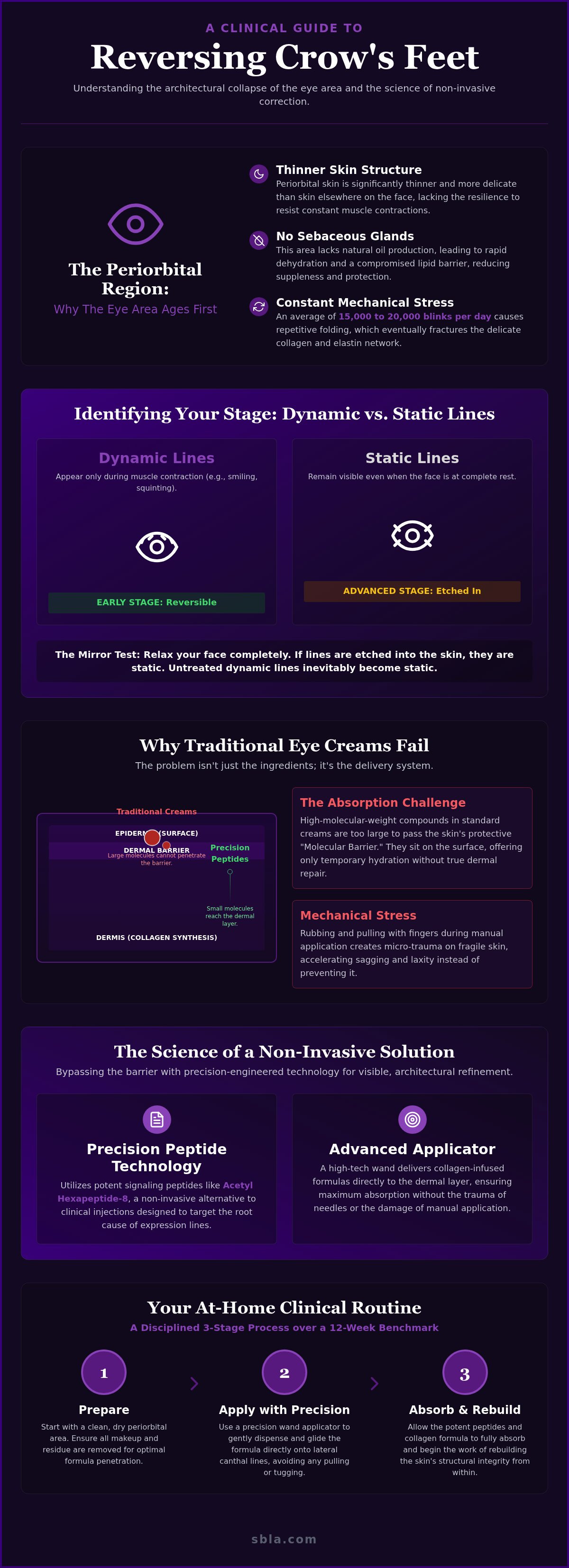
Crow's feet, clinically referred to as lateral canthal lines, are the radiating rhytides that emerge at the outer corners of the eyes. Understanding The Anatomy of Crow’s Feet is essential for anyone seeking a truly effective at-home treatment for crow's feet. These lines aren't merely surface imperfections; they're the physical manifestation of structural changes within the dermal layers and underlying musculature. The orbicularis oculi, a complex sphincter muscle responsible for eyelid closure, serves as the primary driver of these wrinkles. Every time you smile, squint, or blink, this muscle contracts, pulling the overlying skin into repetitive folds. Because the periorbital skin is significantly thinner than the skin on your cheeks or forehead, it lacks the structural resilience to bounce back indefinitely.
Why the Eye Area Ages Faster Than the Rest of the Face
The periorbital region is biologically disadvantaged in the aging process. Unlike the rest of your face, this specific area contains almost no sebaceous glands. This lack of natural oil production means the skin dehydrates rapidly, losing the lipid barrier that maintains suppleness and protection. We blink roughly 15,000 to 20,000 times a day. This constant mechanical stress eventually fractures the delicate collagen and elastin fibers. External factors like UV radiation and high-energy visible (HEV) blue light from digital screens accelerate this degradation, leading to a loss of architectural integrity and premature thinning.
Dynamic vs. Static Wrinkles: Identifying Your Stage
Identifying the current stage of your wrinkles is the first step toward successful correction. Dynamic lines appear only during active muscle contraction, such as when you're laughing or squinting. Static lines, however, remain visible even when your face is completely at rest. You can identify your stage with a simple mirror test.
- The Mirror Test: Relax your face completely in a neutral expression. If you see fine lines etched into the skin at the outer corners, you've developed static wrinkles. If the area remains smooth but lines appear when you smile, they're dynamic.
Untreated dynamic lines eventually become permanent static wrinkles as the dermal memory deepens and the skin loses its ability to repair itself. This progression is why "prejuvenation" has become a standard in 2026 clinical skincare. Younger users now utilize an at-home treatment for crow's feet to reinforce the skin's architecture before these lines become permanent fixtures. By addressing the structural integrity early, you prevent the deep etching that characterizes advanced aging and maintain a lifted, refined appearance.
Why Traditional Eye Creams Fail to Resolve Deep Periorbital Wrinkles
Most consumers invest in premium jars only to see negligible results on lateral canthal lines. The failure isn't always the ingredient list; it's the delivery. Standard formulations often rely on high-molecular-weight compounds that are physically incapable of penetrating the skin's dense architecture. These large molecules sit on the surface, creating a deceptive film that masks issues rather than correcting them. This "Molecular Barrier" problem is the primary reason why even expensive retail products fail to provide a lasting at-home treatment for crow's feet.
The Absorption Challenge: Molecular Weight and Penetration
The skin's primary function is protection, acting as a biological shield against external substances. This barrier is remarkably efficient at excluding large molecules. While surface-level hydration provides an immediate, temporary plumping effect through water retention, it doesn't constitute true dermal repair. Rejuvenation requires active ingredients to reach the deeper layers where collagen synthesis occurs. Without a sophisticated delivery mechanism, these actives simply evaporate or sit inertly on the stratum corneum. While some individuals explore prescription options for aggressive intervention, clinical-grade efficacy at home is dictated by how well a formula bypasses this natural defense system.
The Danger of Mechanical Stress from Manual Application
The method of application is just as critical as the formula itself. Finger application is inherently imprecise and often counterproductive. The repetitive tugging and pulling motion required to "rub in" a heavy cream creates micro-trauma and mechanical stress on already fragile tissue. This aggressive handling contributes to skin laxity, effectively accelerating the sagging you're trying to prevent. A precision applicator eliminates this risk. It allows for controlled, gentle pressure that can aid in lymphatic drainage, reducing puffiness without compromising the skin's architectural integrity.
Heavy, emollient-rich creams also present the risk of milia. These "comedogenic" formulations can trap keratin beneath the surface, resulting in small, hard white bumps that are notoriously difficult to resolve. True clinical success involves a delicate balance: delivering potent actives without suffocating the pores. Transitioning to an advanced delivery system ensures that the formula is absorbed rather than just applied, preventing the waste and irritation common with traditional jars. This shift from manual application to precision technology is essential for those seeking visible, long-term refinement of the eye area.
The Science of Precision: Peptides and Collagen in At-Home Crow’s Feet Treatment
Effective correction of lateral canthal lines requires a sophisticated biochemical approach. We're no longer limited to basic emollients that only offer surface-level hydration. Modern science allows us to target the specific cellular mechanisms that cause skin to fold and fail. By utilizing precise peptide chains, an advanced at-home treatment for crow's feet can mimic the results of clinical interventions without the associated downtime or invasive needles. This shift toward high-performance formulation ensures that your evening routine functions as a genuine technological solution rather than a temporary cosmetic fix.
Signal Peptides vs. Neuro-Peptides: A Dual Approach
Signal peptides act as the primary architects of skin structure. They function by sending specific biological messages to fibroblasts, "tricking" the skin into believing its natural collagen has been depleted. This triggers a massive regenerative response, stimulating the production of new structural proteins. Neuro-peptides, specifically Acetyl Hexapeptide-8, operate on a completely different level. Often referred to as a topical alternative to muscle relaxants, this compound interferes with the protein complex responsible for muscle contraction. By softening the intensity of micro-expressions, we reduce the mechanical stress that etches lines into the skin. This dual-action strategy ensures you're both rebuilding the dermal foundation and preventing future architectural damage.
Collagen Infusion: Restoring the Periorbital Matrix
The "hollow" or sunken appearance at the outer eye corner is a direct result of the periorbital matrix collapsing. As natural collagen production drops, the skin loses its internal scaffolding. Replenishing this area with bio-identical collagen is non-negotiable for structural support. However, the delivery must be precise. Many heavy, traditional creams cause milia or irritation because they're too occlusive for the thin eye area. This is why non comedogenic clinical formulas are essential for mature skin. They provide the necessary building blocks without suffocating the pores or causing secondary issues.
There's a profound difference between "plumped" skin and "repaired" skin. Plumping is often just temporary swelling caused by surface hydration. True repair involves restoring the architectural integrity of the dermal layer. When bio-identical collagen is delivered through a sophisticated system, it integrates into the skin's matrix to provide a firmer, lifted appearance. This structural transformation is the hallmark of a professional-grade routine. By focusing on precision-engineered ingredients, you move beyond the limitations of traditional skincare and achieve visible, long-term refinement of the eye area.
Designing Your At-Home Clinical Eye Routine
Achieving professional-grade results requires a disciplined architectural strategy. A haphazard application of products won't yield the structural refinement necessary to erase deep lines. Instead, you must adopt a "Prep, Treat, Protect" framework that respects the biological rhythm of your skin. This at-home treatment for crow's feet isn't a quick fix; it's a clinical commitment. Clinical benchmarks suggest that while immediate plumping occurs, it takes a full 12 weeks of consistent application to see significant remodeling of the collagen matrix. This timeframe aligns with the natural cycle of cellular turnover and protein synthesis.
Step-by-Step Evening Periorbital Protocol
Your evening protocol is the most critical window for repair. During sleep, the skin's permeability increases, making it the ideal time for high-performance actives to penetrate. Begin with a double cleanse. Use a gentle lipid-based balm followed by a pH-balanced cleanser to remove environmental pollutants without stripping the delicate periorbital barrier. Next, utilize the eye lift wand to deliver concentrated peptides directly to the lateral canthal lines. The wand's applicator ensures precision and eliminates the mechanical stress of finger tugging. Allow the formula to absorb completely for several minutes. Applying a heavy occlusive moisturizer too quickly can interfere with the peptide delivery system.
Complementary Habits: Sun Protection and Sleep
Daytime protection is the defensive counterpart to your evening repair. Even the most advanced at-home treatment for crow's feet will fail if the skin is constantly bombarded by UV radiation. Daily SPF 30+ is mandatory for the eye area. UV rays are responsible for up to 80% of visible skin aging, and the thin skin around the eyes is the first to fracture. High-quality sunglasses are perhaps the most underrated tool in your arsenal. They physically prevent the squinting reflex that drives dynamic wrinkle formation. Additionally, switching to a silk pillowcase reduces mechanical friction and sleep-induced etching that can worsen static lines overnight.
To elevate your results and ensure maximum formula efficacy, integrate the Eye Lift Wand into your daily clinical routine and experience the power of precision delivery.
The SBLA Eye Lift Wand: Architectural Refinement for the Eye Area
The SBLA Eye Lift Wand represents the pinnacle of non-invasive periorbital correction. While traditional methods often force a choice between ineffective topicals and invasive clinical procedures, this device offers a third path: precision-engineered structural refinement. It serves as a definitive at-home treatment for crow's feet by utilizing a proprietary delivery system that bypasses the skin's surface barriers. This ensures that the potent blend of collagen and peptides reaches the dermal layers where they can initiate genuine biological change. By focusing on the architectural integrity of the eye area, the wand provides a needle-free solution that respects the natural movement of the face while delivering visible, high-performance results.
Clinical Results Without the Downtime
One of the most significant advantages of this technology is the elimination of surgical recovery. Unlike blepharoplasty or traditional injections that require days or weeks of downtime, the wand offers immediate gratification. The mechanism behind the at home liquid facelift involves a rapid-acting formula that visibly lifts the eyelids and smooths the outer eye corners upon application. Beyond the chemical efficacy, the wand's antimicrobial steel roller ball provides a cooling sensation that aids in lymphatic drainage. This physical action reduces under-eye puffiness and inflammation, addressing multiple aesthetic concerns with a single, streamlined tool. It transforms the evening routine from a chore into a sophisticated clinical experience.
The Future of Non-Invasive Sculpting
SBLA has established itself as the leader in "Architectural Beauty" by providing tools that empower users to manage their own aging process. The Eye Lift Wand is not an isolated solution; it's part of a broader system designed to refine the face's entire structure. For those seeking comprehensive facial rejuvenation, there is a powerful synergy between the eye area treatment and the Neck, Chin & Jawline Sculpting Wand. Together, these devices address the primary areas where skin laxity is most visible. By choosing a sophisticated at-home treatment for crow's feet, you're investing in long-term cumulative benefits that reinforce the skin's matrix over time. Take control of your aesthetic future with precision tools that deliver the confidence of a professional procedure without the risks of the operating room.
Master the Future of Periorbital Refinement
Transitioning from superficial hydration to structural architectural repair is the only way to achieve lasting results. You've learned that traditional eye creams often fail because their molecular weight prevents dermal penetration. By understanding the distinction between dynamic and static lines, you can now implement a targeted strategy that addresses the root cause of aging. True transformation requires a sophisticated at-home treatment for crow's feet that utilizes clinical-grade technology rather than just heavy emollients.
The SBLA Eye Lift Wand provides this precision through a proprietary collagen-infused formula and a clinically proven peptide delivery system. It offers non-invasive architectural lifting that rivals professional procedures without the associated downtime. You don't have to accept the inevitable etching of lateral canthal lines; instead, you can take control of your skin's structural integrity with advanced biochemical tools. Refine and Lift Your Eyes with the SBLA Eye Lift Wand. Empower your evening routine and witness the visible evolution of your appearance.
Frequently Asked Questions
Can you really get rid of crow’s feet at home?
You can significantly reduce the appearance of lateral canthal lines using an advanced at-home treatment for crow's feet that focuses on dermal remodeling. While lifestyle habits like sun protection are essential, clinical-grade devices like the Eye Lift Wand use precision delivery to bypass the skin's surface barrier. This allows collagen and peptides to reach the underlying matrix. Consistent application over 12 weeks is the benchmark for structural transformation and visible refinement of the outer eye area.
What is the best ingredient for treating crow’s feet?
A combination of signal peptides and neuro-peptides, specifically Acetyl Hexapeptide-8, is the most effective clinical solution for this delicate region. Signal peptides communicate with fibroblasts to stimulate new protein production, while neuro-peptides help soften the mechanical stress of muscle contractions. When paired with bio-identical collagen in a non-comedogenic formula, these ingredients work in synergy to rebuild the skin's architectural foundation, providing a lifted and firmer appearance without the need for needles.
How long does it take to see results from an at-home eye treatment?
Visible results occur in two distinct phases. You'll notice an immediate plumping and lifting effect upon application due to surface hydration and the wand's cooling applicator. However, the clinical benchmark for permanent structural repair is 12 weeks of consistent daily use. This duration allows for a full cycle of cellular turnover and the synthesis of new collagen fibers within the dermal matrix, ensuring that the reduction in fine lines is cumulative and long-lasting.
Is the SBLA Eye Lift Wand safe for sensitive eyes?
The SBLA Eye Lift Wand is engineered for safety and precision on the delicate periorbital skin. Its formula is non-comedogenic and free from the heavy oils that often cause milia or irritation in sensitive individuals. The antimicrobial steel roller ball applicator eliminates the need for messy finger application, which can introduce bacteria or cause mechanical trauma. This controlled delivery system ensures that the potent actives are absorbed precisely where they are needed without migrating into the eyes.
At what age should I start treating crow’s feet?
Clinical experts recommend starting preventative care in your mid-20s, a strategy often called prejuvenation. During this period, natural collagen production begins its gradual decline. By adopting an at-home treatment for crow's feet early, you reinforce the skin's architecture before dynamic expression lines etch into permanent static wrinkles. For those with existing lines, starting a high-performance routine immediately is vital to halt further degradation and initiate the repair of the skin's structural matrix.
Can I use the Eye Lift Wand with my existing eye cream?
You can integrate the Eye Lift Wand into your existing skincare routine, though it functions as a comprehensive standalone solution. For best results, apply the wand first to clean, dry skin to ensure the peptide delivery system isn't blocked by heavier emollients. Once the formula has fully absorbed into the dermal layers, you may apply a traditional eye cream if you desire additional surface-level moisture. This tiered approach ensures that you receive both deep structural repair and topical hydration.
Does the Eye Lift Wand help with hooded eyelids?
The Eye Lift Wand is specifically designed to address the entire periorbital region, including the upper eyelids. Its collagen-infused formula provides an immediate lifting and tightening effect that helps counteract the appearance of hooded or drooping lids. By reinforcing the skin's elasticity and architectural integrity, the device helps restore a more open and youthful look to the eyes. Consistent use strengthens the delicate tissue, providing a non-invasive alternative to more aggressive clinical procedures.
How often should I use the SBLA Eye Lift Wand for best results?
Optimal results require consistent application once or twice daily as part of your morning and evening clinical routines. Daily use is essential because the cumulative benefits of peptide signaling and collagen production rely on a steady supply of active ingredients. Adhering to this disciplined schedule ensures that the skin's repair mechanisms remain active. When used consistently over the 12-week clinical window, the wand delivers a visible transformation that maintains the eye area's lifted and refined appearance.