
Best Eye Lift Product for Aging: How to Choose in 2026
The most convincing “lift” claim isn’t always the most meaningful result. If you’re searching for the best eye lift product for aging, first distinguish temporary smoothing from changes a topical formula or beauty device can realistically deliver. The eye area is delicate, so bold promises deserve a closer look.
It’s easy to feel uncertain when creams and wands use similar language but rely on different ingredients and application methods. Compare them by starting with your main concern, then checking the formula, directions, product-specific evidence, and whether the routine suits your skin’s tolerance. No non-invasive product should be assumed to replicate a surgical lift.
This guide compares eye-area products using those practical criteria. SBLA BEAUTY Eye Lift Wand is one device-based option to assess, but check its current ingredients, directions, and outcome data rather than inferring details from general claims. By the end, you’ll have a more grounded way to decide which approach fits your priorities.
Key Takeaways
- Match an eye-area product to your main concern, whether that’s dryness, fine lines, crepiness, or a tired appearance.
- Compare topical formulas, beauty wands, and other formats by their purpose and limitations; they aren’t interchangeable.
- Assess ingredient transparency, product-specific testing, and clear directions before weighing a product’s claims.
- Choose the best eye lift product for aging by considering your skin’s tolerance and the kind of visible change you expect.
- Review the Eye Lift Wand’s current ingredients and instructions to determine whether a dedicated eye-area device suits your routine.
Best eye lift product for aging: match the approach to your concern
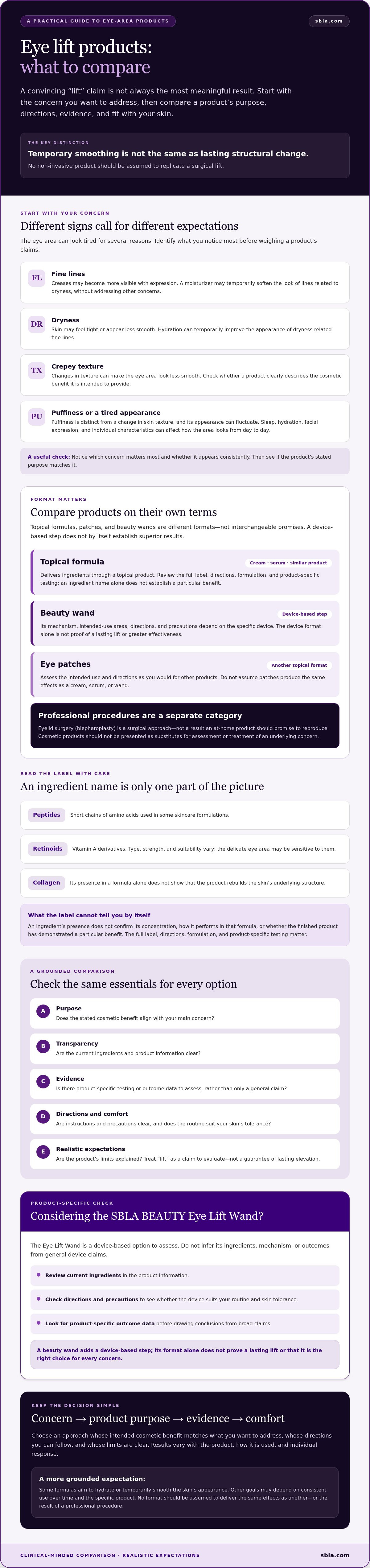
Fine lines, dryness, crepey texture, and puffiness can all make the eye area look tired, but they are different concerns. A moisturizer may temporarily soften the look of fine lines caused by dryness, for example, without addressing puffiness or loose skin. Before comparing claims or formats, identify the change you most want to see.
An eye-lift product is a cosmetic formula or device intended to improve the appearance of the eye area; it doesn’t create permanent structural change or replace surgery. Topical skincare, beauty wands, and eye patches are non-surgical options with different formats and intended uses. Professional procedures are a separate category. For context, eyelid surgery (blepharoplasty) is a surgical approach, not a result an at-home product should promise to reproduce.
Which signs of aging around the eyes are you trying to address?
Fine lines are creases that may become more visible with expression. Dryness can make skin feel tight or appear less smooth, while changes in texture may show up as crepiness. Puffiness is a different concern, and its appearance can fluctuate rather than reflect a lasting change in skin texture.
Sleep, hydration, facial expression, and individual skin characteristics can affect how the eye area looks from day to day. Notice which concern matters most and whether it appears consistently. This helps you judge whether a product’s stated purpose matches what you want to address.
What can non-invasive eye products realistically do?
Some formulas aim to hydrate or temporarily smooth the skin’s appearance. Other skincare goals may depend on consistent use over time and the specific product. Patches offer another topical format, while a beauty wand adds a device-based step. Don’t assume these formats produce the same effects or match the results of a professional procedure.
Results vary with the product, how it’s used, and individual response. Treat words such as “lift” as claims to evaluate, not guarantees of lasting elevation. The best eye lift product for aging is one whose intended cosmetic benefit aligns with your concern, whose directions you can follow, and whose limits are clearly explained.
How eye lift products work: formulas, beauty wands, and their limits
Eye-area products come in different formats and should be assessed on their own terms. A topical formula delivers ingredients through a cream, serum, or similar product. A beauty wand is a device-based format, and its mechanism and intended use depend on the specific product. Neither category is automatically more effective. A device’s presence alone doesn’t establish that it creates a lasting lift.
What should you know about eye-area ingredients?
Ingredient names can help you assess a formula, but they don’t tell the whole story. Peptides are short chains of amino acids used in some skincare formulations. Retinoids are vitamin A derivatives; their type, strength, and suitability vary, and the delicate eye area may be sensitive to them. Collagen may appear as an ingredient, but its presence alone doesn’t show that a product rebuilds the skin’s underlying structure.
Look beyond a headline ingredient. The full label, formulation, directions, and any product-specific testing all matter. An ingredient’s presence doesn’t confirm its concentration, how it performs in that formula, or whether the finished product has demonstrated a particular benefit. If your skin is reactive, review the instructions carefully. Don’t assume a product suitable elsewhere on the face is appropriate near the eyes.
What does a beauty wand add to an eye-care routine?
A wand may add a device-based step alongside topical skincare or serve as an alternative to a topical-only routine. That describes its format, not proof of superiority. Mechanisms, intended-use areas, directions, and precautions vary by device. Check the current product information for SBLA BEAUTY’s Eye Lift Wand before drawing conclusions about its ingredients or how it works.
A cosmetic claim describes an intended improvement in appearance; it isn’t, by itself, evidence of a lasting structural lift. This distinction matters because a drooping eyelid can have causes beyond surface skin changes. Harvard Health Publishing discusses drooping eyelids as a normal occurrence of aging, while also explaining that causes and treatment options vary. A cosmetic product shouldn’t be presented as a substitute for assessment or treatment of an underlying concern.
For a closer look at the brand’s discussion of the device and its evidence, read the clinical deep dive on the SBLA Eye Lift Wand. Assess any results against the testing details provided. You can also review the SBLA Eye Lift Wand product information for current ingredients and directions.
Eye lift product comparison: how to assess claims, evidence, and comfort
Compare formats by their intended purpose, the evidence for the specific product, and whether the routine feels comfortable and practical. A cream, wand, patch, and professional procedure aren’t interchangeable. Non-invasive products may improve the appearance of the eye area, but they shouldn’t be presented as delivering a permanent eyelid lift.
| Format | Potential role | What to keep in mind |
|---|---|---|
| Topical formula | Provides skincare ingredients in a cream, serum, or similar format. | Assess the full ingredient list, directions, and evidence for the finished formula. Ingredient presence alone doesn’t establish benefit. |
| Beauty wand | Adds a device-based step to an eye-care routine. | Mechanism, intended-use area, directions, and precautions vary by device. Don’t assume a wand’s claims or operation apply to another model. |
| Eye patch | Offers a targeted topical format that may suit a short, dedicated routine. | Check its ingredients and instructions, and distinguish temporary appearance claims from longer-term skincare goals. |
| Professional option | May address concerns beyond the scope of over-the-counter cosmetics. | Procedures are distinct from skincare products. Discuss suitability, risks, and expected outcomes with a qualified professional. |
How can you tell whether an eye-lift claim is well supported?
Start with evidence for the exact product, not just an ingredient commonly used in skincare. If a brand cites testing, look for the study method, participant details, outcome measures, and time frame. These details help you understand what was assessed and whether the result relates to your concern.
Brand language and testimonials can describe impressions, but they don’t replace product-specific clinical evidence. Claims of permanent lifting, guaranteed results, or clinical outcomes should be backed by clear, relevant substantiation or treated cautiously. If the available information doesn’t explain how a result was measured, it’s difficult to evaluate the claim.
Which eye product format fits your priorities?
Choose based on your routine preferences, ingredient needs, and tolerance. A topical-only approach may suit someone who prefers applying skincare directly; a wand may appeal to someone seeking a device-based step. Patches offer another format. If your concern may require a procedure, seek qualified professional advice rather than relying on an over-the-counter product comparison.
For a closer look at how device approaches differ, read SBLA BEAUTY’s microcurrent versus peptide wand comparison. Use it to assess the specific product’s mechanism and evidence. The best eye lift product for aging isn’t a universal winner; it’s the option whose claims, directions, and comfort fit your priorities.
How to choose and use an eye lift product for aging safely
A careful routine starts with a clear concern, not a dramatic promise. Before choosing the best eye lift product for aging, confirm that its intended benefit matches what you want to address. Then assess the formula, directions, and your skin’s response. Even products designed for the eye area require careful use.
How should you assess a product before adding it to your routine?
Read the complete ingredient list and product label before use. Check the intended-use area, warnings, and application directions, including any instructions specific to a device. If information is unclear, don’t guess about where or how often to apply it. Keep products out of the eye itself and never use them beyond labeled directions.
Introduce one new product at a time. This makes it easier to identify which product may be associated with a change in comfort or appearance. If the label permits, consider a cautious patch test on an appropriate area of skin first. A patch test can’t guarantee that a product won’t irritate the eye area. Don’t apply product inside or immediately next to the eye unless the directions specifically say to do so.
Use this simple sequence:
- Identify the main concern you want to address.
- Review the full ingredients, intended-use area, warnings, and directions.
- Follow the exact instructions for application and use.
- Assess comfort before adding another product or device to your routine.
- Track changes over the product’s directed use period.
Stop using a product if you notice a concerning reaction, and follow its labeling for what to do next. Persistent irritation, sudden changes around the eyelid or eye, or other medical concerns warrant advice from a qualified clinician. Cosmetics and at-home devices aren’t substitutes for medical evaluation.
How can you evaluate results without expecting an instant lift?
Set a realistic baseline before starting. If you choose to take photographs, use consistent lighting, distance, and facial expression so ordinary changes in the image aren’t mistaken for product effects. Photos can help you compare your own observations, but they aren’t clinical proof of efficacy.
During the product’s specified period of use, note both comfort and appearance. Record whether your original concern seems different and whether the routine is tolerable. Don’t increase use or change application to accelerate a result. If irritation develops, discontinue use and seek appropriate advice rather than trying to push through it.
Before deciding whether the SBLA BEAUTY Eye Lift Wand fits your routine, review its current instructions and ingredient information.
Is the SBLA Eye Lift Wand the right product for your aging concerns?
SBLA Beauty offers a dedicated Eye Lift Wand, an option to investigate if you prefer a device-based step intended for the eye area. It may be less suitable if you want a topical-only routine, aren’t comfortable using a device near the eyes, or need an approach for a concern beyond cosmetic care. The right fit depends on the product’s verified details and how they align with your priorities, not the word “lift” alone.
Check current official product materials for the Eye Lift Wand’s ingredients, operating details, directions, and outcome data. Don’t infer them from the brand’s wider range or general claims about skincare devices. Treat the wand as one option to assess, not a guaranteed solution or substitute for medical advice.
What should you verify about the SBLA Eye Lift Wand?
Check the current product information for the formula, intended-use area, how the device operates, application directions, warnings, and any contraindications. If the brand cites testing, look for evidence on the finished product and details explaining how results were assessed. A general ingredient study or testimonial doesn’t establish that this specific wand produces the same result.
Compare those details with your main concern and routine preferences. If directions or safety information are unclear, don’t guess about use. If your concern involves a sudden change, persistent irritation, or a possible medical issue, an at-home cosmetic product may not be the right next step.
What is the next step if the product fits your priorities?
Review the product information, then decide whether its device format and instructions feel practical for your routine. SBLA’s Eye Lift Wand clinical guide offers product-focused context. Read any evidence presented carefully, noting what was tested, how outcomes were measured, and what limitations apply. A guide can inform your assessment, but it shouldn’t replace complete product directions or substantiation for specific claims.
If you’re still comparing options, return to the same criteria: relevance to your concern, transparent product details, clear directions, and realistic expectations. Explore SBLA Beauty’s Eye Lift Wand offering and review its current official information to decide whether it belongs in your eye-care routine.
Choose an eye-care approach with confidence
The best eye lift product for aging depends on the concern you want to address, the format that suits your routine, and the evidence behind the specific product. Ingredient names alone don’t prove a formula’s benefit, and cosmetic claims shouldn’t be mistaken for permanent structural lifting. Check directions and warnings, introduce products cautiously, and set expectations around appearance rather than dramatic transformation.
SBLA Beauty offers a dedicated Eye Lift Wand alongside anti-aging skincare devices and topical formulas sold online. Before deciding whether the wand fits your needs, review its current ingredients, intended use, directions, and any product-specific evidence. Choose an approach that feels appropriate for your skin and priorities, not simply the one with the boldest claim.
Explore the SBLA Eye Lift Wand and review its product information as you decide whether it suits your routine.
Frequently Asked Questions
What is the best eye lift product for aging?
There isn’t one best eye lift product for aging for everyone; the right choice depends on your main concern, such as dryness, fine lines, puffiness, or texture. Compare product formats, complete ingredient information, directions, and evidence for the finished product. SBLA Beauty offers a dedicated Eye Lift Wand, but check its current official product materials for specific ingredients and outcome data before deciding whether it suits your routine.
Can an eye lift product actually lift aging eyelids?
Cosmetic eye products may improve the appearance of the skin, but you shouldn’t expect them to create a permanent structural lift. A topical formula or wand is not equivalent to surgery or a medical procedure. If an eyelid droops suddenly, changes noticeably, or affects your vision, seek advice from a qualified clinician rather than relying on a cosmetic product to address the cause.
Do eye lift wands work better than eye creams?
Neither format is automatically better. An eye cream delivers a topical formula, while a wand adds a device-based step. Their ingredients, mechanisms, directions, and evidence can differ from product to product. Compare claims for the specific finished product, not just the format or a featured ingredient. Your routine preferences and skin tolerance matter too; the more suitable option is one you can use as directed.
Are peptides or retinol better for aging around the eyes?
Neither ingredient category is universally better; the right choice depends on the formula, your concern, and your skin’s tolerance. Peptides are used in some skincare formulas, while retinoids are vitamin A derivatives that can be irritating for some people. Check the product’s full ingredient list and directions rather than assuming every formula has the same properties. Use eye-area products only as labeled, and discontinue use if you develop a concerning reaction.
How long does an eye lift product take to show results?
There’s no single timeline that applies to every eye product. Some products may temporarily hydrate or smooth the skin’s appearance, while other stated skincare goals depend on consistent use and individual response. Follow the product’s own directions and assess changes over its specified period of use. Avoid increasing application to speed results, and remember that photographs or personal impressions don’t establish clinical effectiveness.
Is an eye lift wand safe for sensitive skin?
Safety depends on the specific wand, its formula, directions, warnings, and your individual sensitivity. Check the manufacturer’s current instructions and intended-use area; don’t assume device features or precautions are the same across products. If the label permits, consider a cautious patch test, while recognizing it can’t guarantee that irritation won’t occur near the eyes. Stop use if you experience a concerning reaction and seek appropriate advice.
What should I look for when buying an eye lift product?
Look for a clear ingredient list, a stated intended-use area, precise directions, and warnings you can follow. Check whether evidence relates to the finished product and explains how results were assessed, rather than relying only on testimonials or general ingredient research. Match the product’s purpose to your main concern, consider your tolerance and routine, and be cautious of promises of guaranteed or permanent eyelid lifting.

