
Droopy Eyelid Non-Surgical Fix: What Can Help and When to Seek Care
What if the eyelid that looks droopy isn’t caused by a weak eyelid muscle? The right droopy eyelid non-surgical fix depends on what’s creating the appearance. Excess upper-eyelid skin can cause hooding, while ptosis occurs when the eyelid itself sits lower. It’s understandable to look for an option that avoids surgery or downtime, but topical products and in-office treatments don’t address every cause in the same way.
This guide explains how hooded eyelids differ from ptosis, compares realistic non-surgical options, and outlines a safe next step. You’ll learn what prescription drops may offer in certain cases, where cosmetic options such as the SBLA Eye Lift Wand fit, and why a beauty device shouldn’t be assumed to treat medical ptosis. New or sudden eyelid drooping, especially with vision changes, pain, or other new symptoms, warrants prompt medical evaluation. Identifying the cause first helps you compare options with clearer expectations.
Key Takeaways
- Use the cause, not appearance alone, to guide your search for a droopy eyelid non-surgical fix.
- Compare options by their intended target, professional oversight, likely limitations, and the questions you should ask before proceeding.
- Before choosing a treatment, clarify its evidence, risks, expected duration, aftercare, and who should avoid it.
- Consider the SBLA Eye Lift Wand only as an at-home cosmetic option, and check its official directions and substantiated claims before use.
- Follow a step-by-step decision process to identify a safe next move without assuming every option suits every concern.
Droopy Eyelid or Hooded Eye? Start by Identifying What You See
An upper eyelid can look heavy for more than one reason. A fold of skin may overlap the natural crease or rest near the lashes, creating a hooded appearance. Skin laxity means the skin has lost some firmness and may gather more visibly over the lid. Ptosis, by contrast, describes an upper eyelid that sits lower than expected. These concerns can look similar in a mirror, but they aren’t interchangeable diagnoses.
Notice what has changed and when. Comparing your current appearance with older photos may help you describe whether the change is longstanding, gradual, or sudden. Photos can’t establish the cause, but they may help you explain what you’ve noticed to a clinician. Consider a droopy eyelid non-surgical fix only after clarifying what concern it is meant to address.
What is the difference between hooded eyelids and ptosis?
With hooding, skin may fold over the crease and make the lid look covered. With ptosis, the edge of the upper eyelid itself sits lower. Appearance alone can’t reliably distinguish the two or explain why a lid has changed. The overview of Ptosis describes possible causes and mechanisms, but it doesn’t replace an individual assessment. If lid position or vision is affected, consult an eye-care professional.
Cosmetic hooding and medical eyelid droop are not interchangeable diagnoses. An option intended to improve the appearance of skin may not address a change in eyelid position. A clinician can assess the lid and help clarify what may be contributing to the appearance before you choose an approach.
When should a drooping eyelid be medically assessed?
Seek prompt medical evaluation if drooping begins suddenly, affects one side unexpectedly, interferes with vision, or comes with pain or other new symptoms. Don’t try to resolve a new or unexplained change with a cosmetic product first. Arrange professional assessment for persistent or worsening drooping, too, especially if the lid obstructs your view.
Match the next step to the change. A stable appearance that concerns you cosmetically can be discussed with a qualified professional; a sudden or symptomatic change needs timely medical attention. Once the cause and urgency are clearer, compare options by their intended purpose, oversight, and limitations rather than relying on the word “lift” alone.
How Non-Surgical Droopy Eyelid Options Work, and What They Cannot Do
Non-surgical options aren’t interchangeable. Some may create a temporary visible change in eyelid position; others are intended to address the appearance of loose skin. Topical products and beauty devices are cosmetic care. A treatment’s mechanism and intended target determine which concern it may address. The word “lift” alone doesn’t tell you whether an option affects eyelid position, skin appearance, or neither.
Non-surgical options differ in target, oversight, duration, and evidence. Keep those four factors in view when considering a droopy eyelid non-surgical fix. A temporary change in appearance isn’t the same as lasting structural correction, and a cosmetic claim shouldn’t be taken as evidence that a product treats ptosis.
Prescription drops and clinician-led procedures serve different purposes
Prescription eye drops are a medical option that requires assessment and prescribing by an appropriate healthcare professional. Harvard Health Publishing discusses non-surgical treatment of ptosis, including prescription drops. Ask the prescriber about the intended use, safety information, possible side effects, and whether the option fits your circumstances. Don’t use someone else’s prescription or assume drops are suitable for every cause of drooping.
Clinician-led skin-tightening procedures are a separate category. They may be considered for selected concerns involving skin laxity, but candidacy, risks, and expected results depend on an individual assessment. Ask what tissue or appearance the procedure is intended to affect, and whether it addresses your specific concern. A skin-focused procedure shouldn’t be presumed to reposition a low eyelid or provide a permanent correction.
What can at-home skincare and beauty devices realistically address?
At-home skincare and beauty devices belong in a cosmetic-care discussion, not as substitutes for evaluating medical ptosis. Claims, directions, warnings, and evidence are specific to each product. Without verified product materials, it isn’t possible to responsibly state how a particular device works, what result to expect, or who should avoid it.
The SBLA Eye Lift Wand is an at-home cosmetic option for the eye area. Available product information confirms the offering, but doesn’t establish specific mechanisms, outcomes, or usage instructions. Review current official directions and substantiated claims before use. If you’re uncertain whether the issue is cosmetic or medical, seek professional evaluation before relying on a product. For an appearance concern already assessed as cosmetic, you can review the Eye Lift Wand and its available product information.
Comparing Non-Surgical Eyelid Fixes: Match the Option to the Cause
A useful comparison starts with the concern each option is designed to address, not how dramatic its name sounds. Prescription drops, clinician-performed procedures, and at-home cosmetic care differ in purpose and oversight. None is a universal answer. A change in skin appearance isn’t the same as a change in eyelid position or function.
| Option | Concern targeted | Professional oversight | Limitations | Questions to ask |
|---|---|---|---|---|
| Prescription eye drops | Acquired ptosis in appropriate patients | Requires evaluation and prescription from a qualified healthcare professional | Suitability, potential risks, and results depend on the individual; not intended for excess skin | Is this appropriate for my diagnosis? What risks, directions, and expected duration should I understand? |
| Clinician-performed procedures | Selected cosmetic concerns, such as skin laxity, depending on the procedure | Clinician assessment is needed to determine candidacy and discuss risks | Procedures vary; a skin-focused approach shouldn’t be assumed to reposition the eyelid or address every cause | What tissue or concern does this target? What are the risks, aftercare, and realistic limits? |
| At-home cosmetic care | Cosmetic care for the eye area, according to verified product claims | Follow official product directions; seek professional advice if suitability is unclear | Not a medical treatment for ptosis; claims, directions, and individual tolerance need checking | Is it intended for the eye area? What evidence, warnings, and directions apply? |
Which non-surgical option may suit a cosmetic concern?
For a mild appearance concern assessed as cosmetic, compare options using their stated purpose and supporting evidence. Prescription drops are a medical category: the American Academy of Ophthalmology discusses the first FDA-approved drug for acquired ptosis. That doesn’t make prescription drops appropriate for every droopy-looking lid or for excess skin.
The SBLA Eye Lift Wand is an at-home cosmetic option for the eye area. Available product information confirms the offering, but doesn’t establish specific directions, mechanisms, outcomes, or suitability. Check current official product materials before use, including eye-area directions and warnings. Don’t infer a medical effect from a cosmetic product name.
Which signs call for a clinician rather than a beauty product?
Sudden, persistent, worsening, or vision-affecting drooping calls for professional assessment, not trial and error with a beauty product. A clinician can evaluate eyelid position and skin changes alongside other possible causes. Mirror checks and photographs may help you describe what you’ve noticed, but they can’t replace an examination. The right droopy eyelid non-surgical fix depends on that assessment and the option’s intended target.
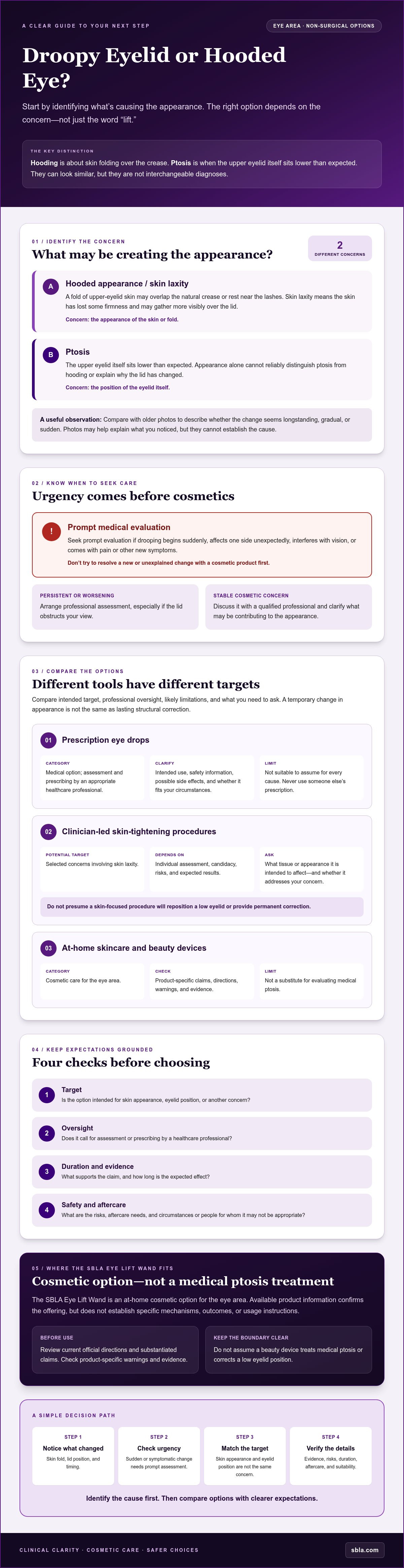
How to Choose a Safe Non-Surgical Eyelid Approach
A safe choice starts with the reason for the change, not a product claim or promise of lift. Use this decision path to organize your next step. It can guide a conversation, but it can’t diagnose an eyelid concern.
- Note the change. Record when you first noticed it, whether it has changed, and whether one or both eyelids are affected.
- Assess urgency. Sudden drooping, new symptoms, or vision interference calls for prompt medical evaluation rather than cosmetic experimentation.
- Clarify the concern with a professional. Ask whether the appearance may relate to skin, eyelid position, or another cause. Don’t use photos or mirror checks as a substitute for an examination.
- Compare suitable options. Consider the intended target, evidence, oversight, risks, expected duration, and aftercare. There isn’t one droopy eyelid non-surgical fix that suits everyone.
- Verify directions before proceeding. Follow the clinician’s instructions or the product’s official directions. Stop use and seek appropriate advice if irritation or another adverse reaction occurs.
Questions to ask before choosing a treatment
Ask the clinician or product provider what concern the option is intended to address and what evidence supports the expected result. Clarify how long a result may last, what risks or contraindications apply, whether recovery or aftercare is needed, and when to seek follow-up care. For a medical treatment, confirm who will assess your suitability and explain its safety information. For cosmetic care, distinguish substantiated claims from general promotional language.
How to assess an at-home eye-area product
Review official instructions, ingredient information, warnings, and intended use before applying anything near the eye. Don’t assume a product is suitable for eyelid skin unless its directions explicitly allow that use. If the instructions are unclear, pause and seek guidance rather than improvising. The supplied information for the SBLA Eye Lift Wand confirms it as an at-home cosmetic option, but doesn’t establish specific directions, ingredients, results, or suitability.
For more context on the device approach, read the clinical guide to at-home eyelid lifting and the microcurrent and peptide wand comparison. Check any product-specific claims against current official materials before relying on them. If you’re exploring cosmetic care for the eye area, review the Eye Lift Wand information, and consult an eye-care professional if you’re unsure whether the concern is cosmetic or medical.
Where the SBLA Eye Lift Wand Fits in a Non-Surgical Routine
Once you’ve clarified whether your concern is cosmetic or needs medical assessment, evaluate at-home care on its own terms. The SBLA Eye Lift Wand is SBLA BEAUTY’s eye-area beauty device. It may be considered as a cosmetic option, but it shouldn’t be presented as a cure for droopy eyelids or as a substitute for evaluating a medical concern.
How to describe the Eye Lift Wand accurately
Available product information confirms the Eye Lift Wand as an offering, but doesn’t establish its specific mechanism, ingredients, usage instructions, or substantiated outcomes. Avoid claims that it treats ptosis, changes eyelid muscle position, removes excess skin, or provides a particular degree or duration of lift. Before describing any formula, directions, safety warning, or cosmetic benefit, verify the statement against current official product materials.
This distinction protects expectations as well as safety. A cosmetic device for the eye area and a medical treatment for eyelid drooping have different purposes. A product name alone doesn’t demonstrate that it addresses eyelid position or function. When comparing a droopy eyelid non-surgical fix, assess each option by its verified intended use and evidence, not by broad promises of lifting.
A clear next step for readers
New drooping, a persistent or worsening change, or an eyelid that interferes with vision should be discussed with an eye-care professional. Don’t delay assessment to try a beauty device, and don’t use cosmetic care to manage symptoms that may have a medical cause. A qualified clinician can help determine what kind of concern needs attention.
If you’re considering cosmetic care for the eye area, review the Eye Lift Wand’s current directions, warnings, ingredient information, and stated suitability before deciding whether it belongs in your routine. Follow only verified instructions; if the information doesn’t answer a safety question, pause and seek appropriate guidance. Keep expectations aligned with the claims that official materials actually support.
For verified product details, Explore SBLA BEAUTY’s Eye Lift Wand. Medical concerns belong with a qualified clinician.
Choose Your Next Step With Confidence
The right droopy eyelid non-surgical fix depends on what’s behind the appearance. Hooded skin and ptosis can look alike, but they aren’t the same concern, and treatments intended to affect skin appearance may not address eyelid position. Match any option to its intended purpose, evidence, oversight, and limitations.
Sudden, worsening, persistent, or vision-affecting drooping deserves professional assessment. For cosmetic care, check official directions, warnings, and substantiated claims before using an eye-area product. The SBLA Eye Lift Wand is a confirmed SBLA BEAUTY offering, but verify current product information rather than assuming specific results or suitability.
If you’re exploring at-home cosmetic care, explore SBLA BEAUTY’s Eye Lift Wand and review its current product details. Keep medical concerns with a qualified clinician. An informed next step can help you care for your eye area with greater clarity and confidence.
Frequently Asked Questions
Can you fix a droopy eyelid without surgery?
Sometimes, but the right option depends on the cause. Prescription eye drops may temporarily improve eyelid position for some adults with acquired ptosis, while clinician-performed procedures may target selected skin concerns. At-home cosmetic care is not a medical treatment for ptosis. A droopy eyelid non-surgical fix isn’t suitable for every person or every cause, so seek professional assessment for new, worsening, persistent, or vision-affecting drooping.
Is a droopy eyelid the same as a hooded eye?
No. A hooded appearance often comes from upper-eyelid skin folding over the crease, while ptosis describes the upper eyelid sitting lower. These can look similar, and appearance alone can’t reliably identify the cause. The distinction matters because an approach aimed at skin appearance may not address eyelid position. If the lid’s position has changed or affects your vision, ask an eye-care professional for an assessment.
Can eye drops lift a droopy eyelid?
Some prescription eye drops can temporarily raise the upper eyelid in certain adults with acquired ptosis. In the United States, Upneeq is an FDA-approved prescription option for this condition, and its effect may last approximately six to eight hours after a dose. It isn’t appropriate for everyone or for every cause of drooping. A healthcare professional must assess suitability and explain current prescribing instructions, risks, and precautions.
Do non-surgical eyelid treatments work permanently?
Don’t assume a non-surgical option will provide a permanent change. Prescription drops offer a temporary effect, while cosmetic products and procedures differ in their intended targets, evidence, and duration. Even a visible improvement doesn’t necessarily mean the eyelid’s underlying structure has changed. Before choosing an option, ask what result is realistic, how long it may last, what evidence supports it, and whether follow-up or ongoing care may be needed.
Can an at-home beauty wand treat ptosis?
No. An at-home beauty wand should not be used or described as a treatment for ptosis, a condition involving the position of the upper eyelid. SBLA BEAUTY’s Eye Lift Wand is a confirmed eye-area beauty device, but available product information doesn’t establish that it treats ptosis or changes eyelid muscle position. Verify current directions, warnings, and substantiated cosmetic claims, and seek professional assessment for possible medical concerns.
When should I see a doctor about a drooping eyelid?
Seek prompt medical evaluation for sudden drooping, an unexpected one-sided change, vision interference, pain, or other new symptoms. Arrange professional assessment for persistent or worsening drooping as well, particularly if it obstructs your view. Don’t rely on photographs, mirror checks, or a cosmetic product to determine the cause. If symptoms appear suddenly or are accompanied by other concerning changes, prioritize medical care over trying an at-home approach.
What is the difference between eyelid skin tightening and ptosis treatment?
Eyelid skin tightening is intended to address selected concerns involving the appearance of loose or lax skin. Ptosis treatment addresses a low position of the upper eyelid, which may have a different cause. The approaches aren’t interchangeable: improving skin appearance doesn’t necessarily change eyelid position or function. Ask a qualified clinician what a proposed treatment targets, what evidence supports it, and whether it matches the concern identified in your assessment.

