
Can You Use Neck Cream on Your Face? What to Know Before Applying It
A cream made for the neck isn’t automatically right for the face. If you’ve wondered, “can you use neck cream on your face,” the answer is sometimes yes, but the formula and directions matter more than the label. A richer texture may feel nourishing on dry skin, yet too heavy for an oilier or breakout-prone face.
Products for neighboring areas aren’t necessarily interchangeable. Their textures, ingredients, and directions can differ, which may affect how they feel on your skin. Before applying a neck cream to your face, check its stated application area and instructions, consider any ingredients your skin tends to react to, and test it cautiously if facial use is permitted. This guide explains how to compare products, what to watch for, and when a separate face or neck product may better suit your routine.
Key Takeaways
- Whether can you use neck cream on your face has a yes-or-no answer depends on the formula, its directions, and your skin’s tolerance, not the label alone.
- Review the ingredient list and directions, especially when a formula contains retinoids or exfoliating acids.
- Compare products by their instructions, ingredients, and how your skin responds. Don’t assume all neck or face creams have the same strength or texture.
- Introduce an unfamiliar cream cautiously: patch-test first, apply gradually, and watch for changes. A patch test can’t guarantee you won’t react later.
- Keep your face and neck routine aligned with each product’s intended use and the needs of each area.
Can You Use Neck Cream on Your Face? The Short Answer
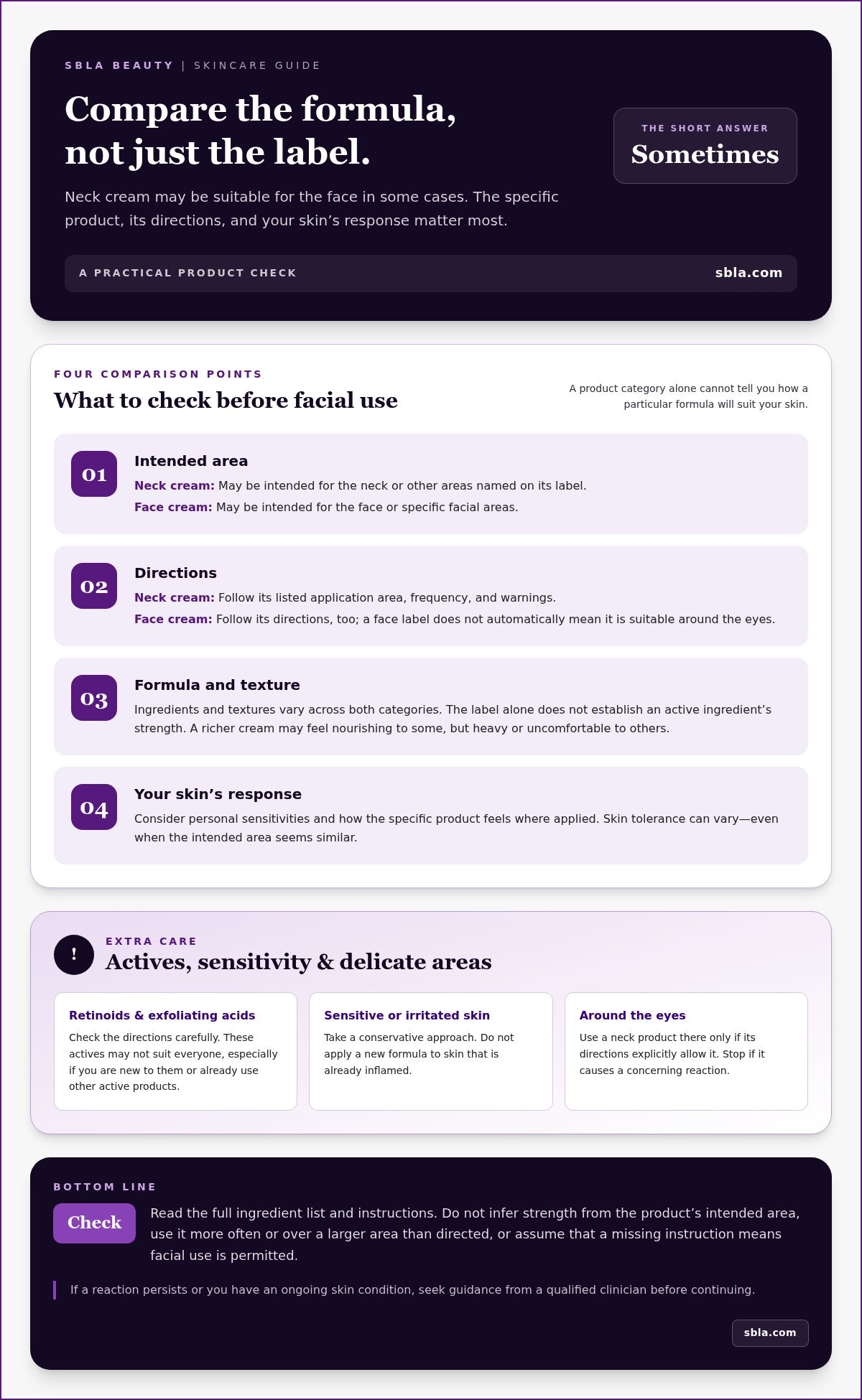
Can you use neck cream on your face? Sometimes, but it depends on the specific formula, its directions, and how your facial skin responds. A neck label alone doesn’t prove a product is suitable or unsuitable for facial use. Check the stated application area and instructions, then consider your skin’s usual sensitivities and how it responds to skincare.
Face and neck creams can differ in texture, ingredients, and intended use. One neck cream may be formulated for a particular area or application feel; another may feel too rich on your face. The category name doesn’t tell you the full formulation. For a broad overview of skincare products and other cosmetic categories, see Cosmetics.
This is general product-use guidance, not personalized medical advice. The right choice can depend on your skin’s condition and sensitivities, as well as the product’s complete directions. If the label doesn’t address facial use, don’t assume the product is intended for your face. Consider the formula and proceed cautiously rather than treating the two areas as interchangeable.
Why neck creams are made for a different area
Brands may tailor a cream’s texture, intended concerns, or application preferences to the area named on its packaging. That doesn’t mean every neck formula is alike, or that everyone’s face and neck have identical needs. A richer feel may suit dry skin but feel uncomfortable to someone else. Use the product’s directions to guide where and how you apply it.
When facial use may call for extra caution
Take extra care if your skin is sensitive, reactive, or already irritated. Strong or unfamiliar actives, including retinoids or exfoliating acids, may not suit everyone. Follow the label’s directions and consider your skin’s tolerance when using other active products. Stop using a product if it causes a concerning reaction. If reactions persist or you have a skin condition, seek guidance from a qualified clinician before continuing.
Neck Cream Ingredients: What Matters for Facial Skin
To decide whether a product suits your face, look beyond the area named on the jar. The ingredient list, directions, and your own skin’s response offer more useful clues than the words “neck cream” or “face cream” alone. The complete formula and its instructions matter because an ingredient’s presence doesn’t reveal its strength, how it interacts with the rest of the formula, or how your skin will tolerate it.
This is the practical answer to can you use neck cream on your face: assess the specific product rather than assuming every formula in the category behaves the same way.
Check active ingredients and directions
Read the full ingredient list and application instructions before trying a neck cream on your face. Pay particular attention to retinoids and exfoliating acids, which may come with specific directions and may be too much for some people’s skin. Take extra care if you’re new to an ingredient or already use other active products.
An ingredient name alone doesn’t tell you its concentration or predict your individual tolerance. Don’t infer strength from the product’s intended area, and don’t use it more often or over a larger area than the label directs. If the instructions don’t address facial use, don’t treat that omission as permission to apply it anywhere on your face.
Consider facial sensitivity and product texture
A formula that feels comfortable on the neck may feel different on facial skin. Fragrance and other ingredients can bother some users, though their presence doesn’t mean everyone will react. If your skin is sensitive or tends to become irritated, take a conservative approach and don’t apply a new formula to skin that’s already inflamed.
Texture matters, too. A rich cream may feel nourishing to some people, while others find it heavy or notice congestion. Responses vary, so pay attention to how your skin looks and feels instead of assuming a thicker formula is inherently unsuitable.
Use particular care near the eyes. The eye area can be sensitive, and a product intended for the neck shouldn’t be applied there unless its directions explicitly allow it. If a product causes persistent irritation, stop using it and seek qualified clinical guidance, especially if you have an ongoing skin condition.
For a routine built around distinct areas, explore targeted face and neck skincare while keeping ingredient suitability and product directions central to your choice.
Neck Cream vs. Face Cream: How to Compare Them
The label tells you where a product is intended to be used, but it doesn’t tell the whole story. Compare the stated application area, directions, ingredient list, and your own skin response. The category name alone doesn’t guarantee a particular active ingredient or its strength, so don’t assume every neck cream is stronger, richer, or more effective than every face cream.
| What to compare | Neck cream | Face cream |
|---|---|---|
| Intended area | May be designed for the neck or other areas named on its label. | May be designed for the face, or for specific facial areas. |
| Directions | Follow the listed application area, frequency, and warnings. | Use according to its stated directions; don’t assume it’s suitable around the eyes. |
| Formula considerations | Ingredients and texture vary by product. The label doesn’t establish active strength. | Formulas vary too; a face label doesn’t guarantee a specific ingredient profile. |
| User tolerance | Consider whether your skin responds comfortably to this particular formula. | Assess your personal sensitivities and how the product feels on the area used. |
Which label details should guide your decision?
Start with the stated application area, directions, and warnings. Then check the active ingredients against any known sensitivities and the other products in your routine. If a label says a product is for both face and neck, it gives clearer guidance about where it’s intended to be applied. Follow any area-specific cautions, such as avoiding the eye area.
“Face cream” and “neck cream” are product categories, not reliable measures of ingredient concentration. Two products with similar ingredient names may differ in formulation, and a label can’t tell you exactly how your skin will respond. For can you use neck cream on your face, compare the actual directions and formula, not just the names on the containers.
Does a richer neck cream work differently on the face?
A richer texture describes how a cream feels and fits into a routine; it doesn’t prove how well it works. On one person’s face, it may feel comfortable. On another’s, it may feel too heavy, depending on skin type, preference, and other products used alongside it. Richness alone doesn’t mean a cream will clog pores or cause irritation.
A face product isn’t automatically a better choice for every neck concern, either. Its label may not include the neck, so read the stated application area before extending use. Let the product’s intended use and your own tolerance guide your decision, rather than choosing by category alone.
How to Try Neck Cream on Your Face More Cautiously
If you’re weighing up whether can you use neck cream on your face, don’t make a full-face application your first test. A gradual approach helps you notice how your skin responds while keeping the product’s directions central. Follow these steps:
- Read the label. Check the stated application area, instructions, warnings, and any guidance about frequency. Don’t use the cream on your face if the directions advise against it.
- Patch-test a small area. Follow the product’s directions for testing, choosing a discreet area of facial skin if facial use is consistent with the label. If the instructions don’t clarify where to test, don’t assume the neck is an equivalent substitute for the face.
- Observe your skin. Watch the test area for changes over an appropriate period, guided by the product instructions. A patch test can help you assess initial tolerance, but it can’t guarantee the product won’t cause a reaction after broader or repeated use.
- Introduce it gradually. If the test area remains comfortable and the directions allow facial use, begin with a limited application and follow the label’s frequency guidance. Add only one unfamiliar product at a time; avoid introducing multiple new active products together.
- Monitor and respond. Pay attention to how your skin looks and feels after use. Stop applying the cream if notable irritation, persistent discomfort, or another concerning reaction develops. Don’t try to diagnose the cause yourself.
Patch-test before broader application
A small-area test is a cautious first step, not a guarantee or a substitute for professional advice. If you have a skin condition, a history of significant reactions, or uncertainty about using an active ingredient, seek guidance from a qualified clinician before trying the product on your face. Don’t test a new cream on skin that’s already irritated.
Introduce the product without overloading your routine
Keep the rest of your skincare routine stable while you assess an unfamiliar cream. Adding another new formula at the same time can make it harder to identify which product may be linked to a reaction. Stop use if discomfort persists or a concerning change appears, and seek clinical guidance if the reaction doesn’t settle.
For an area-specific routine, explore SBLA BEAUTY’s face and neck skincare and choose products according to their directions and your skin’s needs.
Choose Skincare by Area, Formula, and Routine
Choose a routine guided by product directions, formula, and your skin’s individual tolerance. The answer to “can you use neck cream on your face” isn’t determined by the label alone, so keep each product on the areas its instructions permit and introduce unfamiliar formulas thoughtfully.
Build a face-and-neck routine around product directions
A streamlined routine can make it easier to understand what suits your skin. More steps don’t automatically mean better results. Use each cream or serum as directed, and don’t extend a product to another area simply because the face and neck are adjacent.
For broader context on area-specific care, explore a guide to the early signs of neck aging. If you’re considering a distinct face-focused tool rather than a cream, the at-home liquid facelift guide offers a separate topic to explore. Devices and topical products serve different roles, so one shouldn’t be treated as a substitute for the other.
Explore targeted skincare options
Area-specific options can help you organize a routine around where you want to focus. SBLA BEAUTY offers targeted skincare devices for the face, neck, and eye areas, including the Neck, Chin & Jawline Sculpting Wand, alongside topical formulas. Consider these as distinct options and follow the directions provided for each product.
Keep your decision anchored in the details that matter: where the product is intended to be used, how it should be applied, and how your skin responds. If a formula or device doesn’t align with your needs or routine, choose an option that does. Explore SBLA BEAUTY’s face and neck offerings as you consider an area-specific approach that fits your preferences.
Make Your Next Skincare Step With Confidence
Can you use neck cream on your face? Sometimes, if the formula and directions suit facial use and your skin tolerates it. The label alone isn’t enough to decide. Review the ingredients and application guidance, and introduce an unfamiliar product cautiously rather than assuming face and neck formulas are interchangeable.
Keep your routine focused. Use products only on areas permitted by their directions, and pay attention to how your skin responds. If a cream doesn’t feel right for your face, choosing a separate area-specific option is a practical alternative.
For another way to approach targeted skincare, SBLA offers devices for the face, neck, and eye areas, including the Neck, Chin & Jawline Sculpting Wand. These devices are distinct from topical creams and can be considered separately as you shape your routine. Explore SBLA’s targeted face and neck solutions to find an area-specific option for your routine.
Frequently Asked Questions
Can you use neck cream on your face every day?
Sometimes, but daily use depends on the product’s directions and how your skin tolerates it. If you’re asking, “can you use neck cream on your face,” don’t assume the label means it’s suitable for frequent facial application. Check the stated application area and recommended frequency. If facial use is allowed, introduce the cream cautiously and stop if irritation or persistent discomfort develops.
Is neck cream stronger than face cream?
No, the product category doesn’t establish ingredient strength. Neck creams and face creams can contain different formulas, and the label alone doesn’t tell you the concentration of an active ingredient. Compare the full ingredient list and directions instead of assuming one type is more potent. If you’re considering a product with retinoids or exfoliating acids, follow its specific instructions and account for your skin’s tolerance.
Can neck cream clog pores on your face?
It can feel too rich for some people, but a neck cream won’t necessarily clog pores just because it has a thicker texture. How your skin responds depends on the particular formula and your individual skin. If you’re prone to congestion, introduce the product cautiously and watch for changes. Stop using it if you notice a concerning reaction rather than assuming the texture alone predicts the outcome.
Should you patch-test neck cream before using it on your face?
Yes, patch-testing is a sensible precaution before broader facial use, provided the product’s directions allow it. Apply it to a small area as instructed, then observe your skin for changes over an appropriate period. A patch test can’t guarantee you won’t react after repeated or wider use, and it doesn’t replace professional guidance if you have a skin condition or a history of significant reactions.
Can you use retinol neck cream on your face?
Only if the directions permit facial use and the formula suits your skin’s tolerance. The word “retinol” doesn’t reveal the product’s strength or guarantee that it will be comfortable on your face. Follow the label’s instructions, avoid adding multiple unfamiliar active products at once, and introduce the cream cautiously. If you’re unsure about using retinol, or your skin is reactive, seek guidance from a qualified clinician.
What happens if neck cream irritates your face?
Stop applying the cream if you develop notable irritation or persistent discomfort. Avoid adding other unfamiliar products while your skin settles, and don’t try to diagnose the cause based on the reaction alone. If symptoms persist, worsen, or concern you, seek guidance from a qualified clinician, particularly if you have an existing skin condition. A previous patch test doesn’t rule out a reaction with later use.
Is face cream okay to use on your neck too?
It may be, if the product’s directions include the neck and your skin tolerates the formula there. Don’t assume every face cream is intended for the neck; check the stated application area and any warnings. If you try a product on your neck for the first time, introduce it cautiously and monitor your skin. Keep products within the areas permitted by their directions.

