
How to Get a Non-Surgical Brow Lift: A Practical Guide
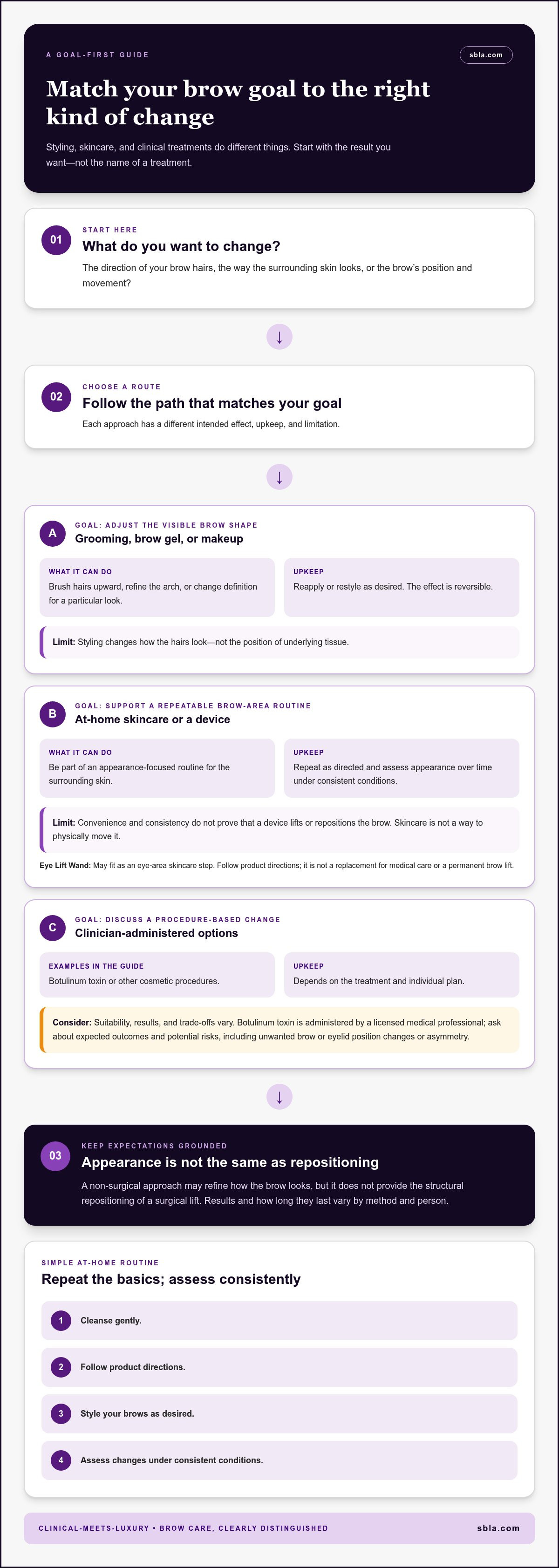
If you’re looking up how to get a non-surgical brow lift, first decide what you want to change: the direction of your brow hairs, the way the skin around your eyes looks, or the position and movement of the brow itself. These are different goals, and the approaches used to address them aren’t interchangeable. A cosmetic routine can alter appearance, but it isn’t the same as surgery.
Brow gel and makeup can reshape the visible brow line. Skincare and at-home devices can be part of a consistent beauty routine, while injectables and other procedures are clinical treatments with distinct considerations and risks. The right starting point depends on the result you’re looking for, how much upkeep you prefer, and whether you’re considering a professional procedure.
This guide compares common approaches, explains their limits, and offers practical ways to build a brow-focused routine. It also covers where SBLA BEAUTY’s Eye Lift Wand may fit as an eye-area skincare step, without treating it as a replacement for medical care or a permanent brow lift.
Key Takeaways
- For how to get a non-surgical brow lift, start by identifying your goal: styling brow hairs, refining their appearance, or discussing a clinical treatment.
- Compare options by their intended effect, upkeep, and limitations. A styling method won’t reposition tissue, and an at-home routine isn’t a clinical procedure.
- Keep an at-home routine simple: cleanse gently, follow product directions, style your brows as desired, and assess changes under consistent conditions.
- Convenience and repeatability can help you maintain a routine, but they don’t prove that a device lifts or repositions the brow.
- SBLA’s Eye Lift Wand can be considered as part of an eye-area routine. Use it according to its product directions and keep expectations realistic.
What a Non-Surgical Brow Lift Can, and Cannot, Do
A non-surgical brow lift is a broad phrase for approaches that aim to make the brow look more elevated without an operation. Grooming can direct brow hairs upward, skincare can be part of caring for the surrounding skin, and clinician-administered procedures may affect facial movement or contour. These approaches create different kinds of changes. A change in appearance is not the same as repositioning tissue. For background on the surgical procedure the term references, see this overview of the brow lift.
What you see depends on more than the method. Natural brow position, skin characteristics, facial expression, and individual anatomy all affect the appearance of the area. A posed photo may also be influenced by lighting, camera angle, makeup, or raised brows. When comparing before-and-after images, look for similar expressions and conditions, and don’t assume that another person’s result predicts yours. Begin with a specific goal, such as making brow hairs appear more lifted or considering a procedure-based change.
Brow lift versus eyelid lift: what is the difference?
The brow is above the eye; the eyelid is the skin that covers it. A low-looking brow and excess eyelid skin can create a similar impression, but they are different areas and concerns. A beauty routine may change appearance, but it cannot determine the cause of a change or treat an eye or eyelid condition.
If an eyelid change is sudden or new, affects vision or eye function, or makes it difficult to use the eye normally, seek medical assessment rather than relying on styling or skincare.
Set realistic expectations before choosing an approach
Match the method to the effect you want. Brow grooming and makeup can create an immediate visual change by shaping or defining the hairs. Skincare is best viewed as part of an appearance-focused routine, not a way to physically move the brow. Clinician-administered procedures are separate medical or cosmetic interventions to discuss with a qualified professional. Results and how long they last vary by method and person, so a dramatic image should not set your expectations.
A non-surgical approach may refine how the brow looks, but it does not provide the structural repositioning of a surgical lift. That distinction is central to deciding how to get a non-surgical brow lift that suits your goals. Consider the type of change you want, your comfort with upkeep or procedures, and what each approach can realistically do.
How to Choose a Non-Surgical Brow Lift Approach for Your Goal
Start by naming the change you want. For a more defined arch or a different look for a particular occasion, grooming and makeup offer direct, reversible control. If you want a repeatable skin-care habit, an at-home routine may be a better fit. A clinical treatment discussion is a different path for someone considering a procedure rather than a styling adjustment. The American Society of Plastic Surgeons describes a surgical brow lift as raising sagging brows and addressing forehead lines. Surgery provides a useful point of contrast, though this guide focuses on non-surgical options.
| Goal | Approach | General upkeep | Important limitation |
|---|---|---|---|
| Adjust the visible brow shape | Grooming, brow gel, or makeup | Reapply or restyle as desired | Changes presentation, not the position of underlying tissue |
| Support a consistent brow-area routine | At-home skincare or a device used according to its directions | Repeat as directed and assess appearance over time | Convenience and consistency don’t prove that a brow has been lifted or repositioned |
| Discuss a procedure-based change | Clinician-administered options, including botulinum toxin or other cosmetic procedures | Depends on the treatment and individual plan | Results and trade-offs vary; an assessment is needed to determine suitability |
Which option suits a subtle, temporary brow enhancement?
Choose grooming or makeup if you want to experiment with visible shape without committing to a procedure. Brush hairs upward, refine the arch, or use makeup to adjust definition. These techniques can change how the brow reads, and the effect is reversible. There is no single ideal brow shape, so choose a style that feels balanced with your features and suits your preference. Keep in mind that styling changes the hairs’ appearance, not the brow’s underlying position.
When should readers consider a clinical treatment discussion?
Botulinum toxin is administered by a licensed medical professional. Whether it may create a brow-area effect depends on individual anatomy and treatment planning, so it is not a universal solution. Possible trade-offs include an unwanted change in brow or eyelid position, asymmetry, or other effects. Ask the clinician to explain the potential risks and expected outcome before treatment. Online images cannot predict your result.
For broader context on non-surgical facial rejuvenation at home, read the at-home Liquid Facelift clinical guide. If you prefer a repeatable home routine, explore SBLA’s at-home skincare devices as one part of an appearance-focused approach, not a substitute for clinical assessment or surgery.
How to Create a Brow-Focused At-Home Routine
A useful routine is simple enough to repeat and careful enough for the delicate eye area. It can help you style and care for the brow area consistently, but it should not be treated as a way to reposition the brow. The surgical brow lift techniques described by Mayo Clinic involve a different level of intervention from at-home grooming or skincare.
- Cleanse gently. Start with clean skin and a cleanser that doesn’t leave the eye area feeling irritated or tight.
- Follow product directions. Apply each formula or use each device according to its label or instructions, especially around the eyes.
- Style the brows. After skincare, groom or define the hairs to suit your preferred look.
- Track your appearance. Use consistent photos and notes rather than relying on one image or your memory to judge a change.
Build a simple routine without irritating the eye area
Introduce new products one at a time so it’s easier to identify what may be causing a reaction. Keep products away from the eye itself unless their directions specifically say otherwise. Don’t layer active formulas or combine a product with a device unless the directions support using them together. If irritation develops, stop use and follow the product’s safety guidance. A few careful steps are more useful than adding products without a clear reason.
For any device, follow its own instructions for where and how to use it. Don’t assume that a method intended for another part of the face is appropriate near the brows or eyelids. A measured routine makes it easier to use products consistently and avoid unnecessary experimentation.
Use progress photos to assess appearance consistently
Take a baseline photo before changing your routine, then repeat under similar conditions. Keep the camera at the same distance and angle, use comparable lighting, and hold a neutral expression. Don’t lift your brows in one photo and relax them in another. Small differences like these can change how the brow appears.
Compare the full set of photos rather than judging by one flattering image. A simple note about products used or styling choices can help explain visible differences. Photos document appearance; they don’t establish that a product or device caused a change or prove treatment efficacy.
Consistency helps you assess whether a routine fits your preferences. If you’re exploring how to get a non-surgical brow lift at home, set an appearance-focused goal, follow product directions, and keep expectations grounded. Grooming can change presentation, while an at-home routine is not a surgical lift.
What to Know About Brow-Lift Wands, Skincare, and Other At-Home Methods
At-home methods can serve different goals, but they are not equivalent to one another or to a clinical procedure. A wand is a device to use according to its specific directions. Topical skincare is part of caring for the skin, while grooming and makeup change how the brow hairs and visible brow line appear. Clinical treatments involve an individual assessment and a different level of intervention.
Convenience and repeatability may make a home routine easier to maintain, but they don’t establish that a method lifts the brow. Claims about permanent elevation, facial restructuring, or specific ingredients and mechanisms should be supported by product-specific information. Don’t assume a formula contains peptides or retinol, or that a device works through a particular mechanism, unless the brand’s current product materials say so.
How to evaluate an at-home wand responsibly
Before using a wand, read its intended use, application directions, and safety information. Make sure the directions cover the area where you plan to use it, and don’t extend the treatment area or frequency based on assumptions. If irritation occurs, stop use and follow the product’s safety guidance. A product is not a medical assessment. New changes around the eye, especially those that affect function, need appropriate medical attention.
SBLA’s Eye Lift Wand clinical deep dive focuses on eyelid lifting. The eyelid and brow are adjacent but distinct areas, so information about eyelid appearance should not automatically be taken as a claim about brow repositioning. Follow the product’s stated purpose and use it only as directed.
Where topical formulas and brow styling fit
Topical formulas can be included in a skincare routine when used as directed; they should not be presented as a substitute for repositioning tissue. Grooming or makeup can temporarily alter the visible brow line by changing the direction, definition, or apparent shape of the hairs. Choose a style based on your own features and preferences, not a universal ideal.
Styling changes presentation, skincare supports a routine, and neither is the same as structural change. Keep that distinction in view when comparing ways to get a non-surgical brow lift. For a device-based step at home, explore SBLA’s at-home skincare devices and follow the directions for the product you choose.
How the SBLA Eye Lift Wand Fits Into a Non-Surgical Brow Routine
The SBLA Eye Lift Wand is an at-home product that may fit into a broader eye-area routine. Think of it as a repeatable care step, not a surgical substitute or a promise of structural brow repositioning. Its role in your routine should be guided by the product’s stated purpose and directions, as well as your goals and comfort with regular use.
Keep the distinction clear: the brow sits above the eye, while the eyelid covers it. Information about eyelid appearance doesn’t automatically describe brow effects. If your concern is specifically about the eyelid, read the Eye Lift Wand clinical deep dive for context, and use the product only as its current materials direct.
How to incorporate the Eye Lift Wand into a routine
Follow the current product directions for application, frequency, and placement. Don’t infer a technique from another device or extend use to an area the instructions don’t cover. If you already use topical formulas or other tools, follow each product’s safety information and avoid combining methods unless the directions support doing so.
Set a practical goal before you begin. For example, you might want a consistent eye-area care step rather than a guaranteed change in brow position. Notice how the routine feels and whether it’s comfortable to maintain. Individual appearance and experience can vary. An at-home product is not a medical diagnosis or a replacement for medical assessment when symptoms or changes in function are present.
Choose a next step that matches your brow concern
For a temporary change to visible brow shape, grooming or makeup offers direct styling control. An at-home routine provides a consistent approach to caring for the area, while a clinician-administered treatment discussion is more appropriate if you’re considering a procedure-based change. A sudden eyelid change, or one that affects vision or eye function, calls for medical assessment, not an at-home beauty step.
If you’re deciding how to get a non-surgical brow lift, match the method to the outcome you want and keep its limits in view. The Eye Lift Wand can be part of a repeatable at-home routine, but it should not be expected to provide the same effect as a clinical procedure or surgery.
Explore the SBLA Eye Lift Wand and review its product information to decide whether it fits your routine.
Choose a Brow Routine That Fits Your Goals
The right approach depends on the kind of change you want. Grooming and makeup can refine the visible brow shape, while a consistent at-home routine supports skincare without repositioning tissue. Clinical procedures are a separate category, with individual considerations that call for guidance from a qualified medical professional.
For a realistic plan, follow product directions carefully, keep eye-area use within those directions, and track your appearance under consistent conditions. Convenience can make a routine easier to maintain, but it isn’t proof of a lifting effect. Understanding these limits is central to deciding how to get a non-surgical brow lift that suits your goals and comfort level.
SBLA BEAUTY offers at-home skincare devices and topical formulas, including the Eye Lift Wand. Consider it as one possible step in a repeatable routine, not a substitute for medical assessment or a surgical lift. Explore the SBLA Eye Lift Wand and review its product information as you shape a thoughtful brow-care approach.
Frequently Asked Questions
Can you lift your eyebrows without surgery?
Some non-surgical approaches can make the brows look more elevated, but they work in different ways. Grooming and makeup temporarily alter the visible shape; skincare and at-home devices can be part of a repeatable routine; clinician-administered treatments require individual assessment. None should be presented as equivalent to surgical repositioning. If you’re considering how to get a non-surgical brow lift, begin with your specific goal and keep expectations realistic.
How can I lift my brows naturally at home?
Start with reversible options, such as brushing brow hairs into your preferred shape or using makeup to refine their appearance. You can also follow a consistent skincare routine and consider an at-home device if its directions suit your needs. These approaches may affect appearance, but shouldn’t be expected to reposition tissue or create permanent results. Follow each product’s instructions, keep use away from the eye unless directed, and stop if irritation develops.
Do brow lift wands really work?
An at-home wand may fit into a regular beauty routine, but its effects depend on the specific product, its directions, and individual response. Don’t assume a device creates a permanent lift or changes facial structure. Review product information, use the wand only as directed, and compare your appearance under consistent lighting and angles. A single flattering image or an unverified before-and-after claim can’t establish that a device caused a change.
What is the difference between a brow lift and an eyelid lift?
A brow lift concerns the position or appearance of the brow above the eye, while an eyelid lift concerns the eyelid itself. Brow heaviness and excess eyelid skin can look similar, but they involve different areas. An at-home beauty routine can’t diagnose the cause. Seek medical assessment for a sudden change, a concern that affects vision or eye function, or other new symptoms around the eye.
How long does a non-surgical brow lift last?
There isn’t one duration that applies to every non-surgical approach. Makeup and grooming change appearance while they’re in place; skincare routines depend on continued use and individual response. The timing and duration of clinician-administered treatments also vary by treatment and person. Be wary of universal timelines that don’t specify the method. For a clinical option, discuss expected results and duration with a licensed medical professional.
Is a non-surgical brow lift the same as Botox?
No. “Non-surgical brow lift” can refer to styling, skincare, at-home devices, or clinician-administered procedures. Botulinum toxin is one clinical treatment category, not a synonym for every non-surgical approach. Whether it’s suitable, what effect to expect, and what risks may apply require individualized assessment by a licensed medical professional. At-home products, including skincare devices, shouldn’t be treated as equivalent to injections.
Can an at-home brow routine fix drooping eyelids?
An at-home routine may support grooming or care for the surrounding skin, but it can’t identify why an eyelid looks droopy or promise to correct eyelid position. Brow and eyelid concerns may look alike, so appearance alone doesn’t establish the cause. If the change is sudden, affects your vision or eye function, or raises a health concern, seek medical assessment rather than relying on cosmetic products or devices.

