
Collagen Boosting Skincare Tools: The 2026 Clinical Guide to Non-Invasive Sculpting
The era of relying solely on topical serums to reverse structural aging has ended; true facial sculpting now requires a synergy of biochemical precision and clinical-grade delivery. You've likely experienced the frustration of premium creams that promise a "lift" but only hydrate the surface. It's common to feel hesitant about invasive needles or confused by the noise of competing LED and microcurrent technologies. You deserve a routine that offers more than a temporary glow.
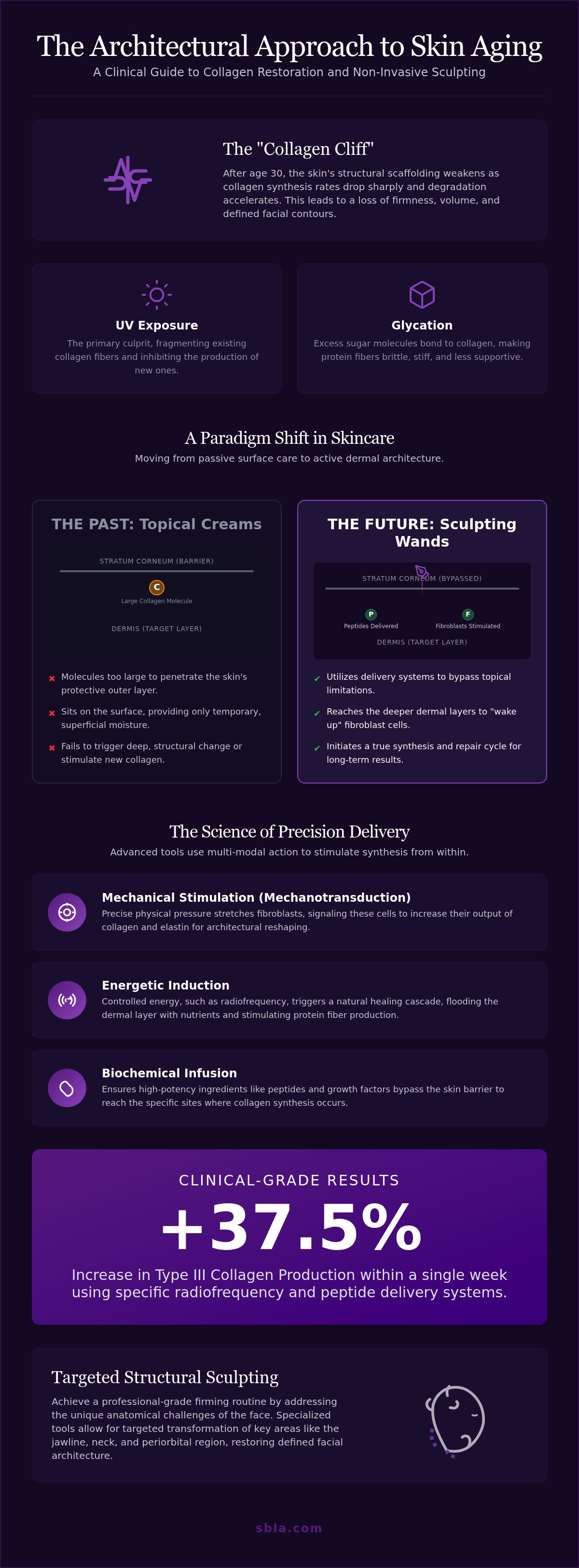
This clinical guide explores the scientific mechanisms behind advanced collagen boosting skincare tools and how to select the precise instruments required for visible structural transformation. We'll examine the 2026 standards for non-invasive sculpting, focusing on the architectural benefits of multi-modal wands. You'll discover how specific radiofrequency and peptide delivery systems can stimulate type III collagen production by up to 37.5% within a single week. By understanding the distinction between surface-level care and deep-tissue refinement, you can finally achieve a professional-grade firming routine from the comfort of your home.
Key Takeaways
- Understand the biological "collagen cliff" that occurs after age 30 and why addressing the dermis's structural scaffolding requires more than surface-level hydration.
- Discover how advanced collagen boosting skincare tools utilize precision delivery and controlled micro-trauma to trigger rapid synthesis and cellular repair.
- Compare the clinical efficacy of at-home sculpting wands against traditional professional treatments to determine the most effective path for non-invasive lifting.
- Learn to navigate the unique anatomical challenges of the neck and jawline by utilizing specialized tools designed for targeted structural transformation.
- Design a professional-grade regimen that focuses on cumulative results through the strategic pairing of high-performance formulas and architectural delivery systems.
The Architectural Decline: Understanding Collagen Loss in 2026
Collagen is the essential scaffolding of the face. It provides the tension and resilience that define a youthful profile. Without this dense network of proteins, the skin loses its structural integrity. This decline isn't a slow, linear process. Most individuals experience a "collagen cliff" after age 30, where synthesis rates drop sharply while degradation accelerates. This biological shift is often exacerbated by external "collagen-killers" that accelerate the aging process.
UV exposure remains the primary culprit, as it fragments existing fibers and inhibits the production of new ones. Similarly, glycation occurs when excess sugar molecules bond to collagen proteins. This process makes the fibers brittle and less able to support the skin's surface. When this structural foundation fails, the result is visible sagging and a loss of the defined contours that characterize a healthy appearance.
The Biological Mechanism of Dermal Thinning
At the cellular level, specialized cells called fibroblasts are responsible for producing new collagen and elastin. As we age, these cells become dormant or less efficient. This reduction in activity leads to dermal thinning, which manifests as a "crepey" texture and visible loss of volume. Structural symptoms often include a softening of the jawline and the appearance of fine lines in the periorbital region. Addressing these concerns requires more than topical hydration; it demands active intervention to re-awaken fibroblast activity and restore the skin's architectural density.
Why Passive Skincare Is No Longer Sufficient
Traditional creams often fail because of a fundamental molecular weight challenge. Most collagen molecules are simply too large to penetrate the stratum corneum, the skin's protective outer layer. These ingredients sit on the surface, providing temporary moisture but failing to trigger any structural change. By 2026, the industry has shifted toward active delivery systems that solve this penetration problem. Advanced collagen boosting skincare tools bypass these topical limitations by using precise mechanisms to ensure formulas reach the deeper dermal layers.
Investing in high-performance collagen boosting skincare tools represents a strategic move from superficial care to dermal architecture. These devices use mechanical or energetic stimulation to "wake up" the skin's natural repair systems. This transformation ensures that potent ingredients like peptides and growth factors actually reach the sites where synthesis occurs. It is the difference between painting a crumbling wall and reinforcing the foundation itself.
The Science of Precision Delivery: How Skincare Tools Stimulate Synthesis
Beyond at-home tools, professional clinics like Luz Lounge Houston offer medical-grade aesthetic services that provide a high-intensity foundation for structural skin health, utilizing advanced modalities to trigger the same biological repair signals.
Effective collagen induction requires more than surface-level application. It demands a sophisticated understanding of how the skin responds to external stimuli. In 2026, the most advanced collagen boosting skincare tools utilize three primary modes of action: mechanical stimulation, energetic induction, and biochemical infusion. These modalities don't just sit on the epidermis. They penetrate the structural layers to initiate a biological response that traditional creams cannot achieve alone.
Central to this process is the concept of controlled micro-trauma. While the term sounds aggressive, it refers to a precise, non-invasive signal that tricks the skin into thinking it needs to repair itself. This triggers a natural healing cascade, flooding the area with fresh nutrients and stimulating the production of new protein fibers. By using precision tools, you can harness this response without the downtime or risks associated with traditional surgery or needles.
Mechanical pressure also plays a vital role through a process called mechanotransduction. When a tool applies specific pressure to the skin, it physically stretches the fibroblasts. This movement acts as a cellular alarm, signaling these cells to increase their output of collagen and elastin. This is the evolution of the facial roller; where older tools merely moved fluid for temporary depuffing, modern delivery wands provide the architectural pressure needed to reshape facial contours.
Mechanical Stimulation vs. Biochemical Signaling
Mechanical stimulation refers to the physical movement and pressure applied by a tool to awaken cellular activity. Biochemical signaling involves the infusion of high-potency peptides and collagen molecules into the skin. When used in isolation, each method has limitations. However, their synergy is transformative. The physical tool prepares the dermal environment, while the formula provides the essential building blocks for new tissue growth. This dual-action approach ensures that the skin isn't just stimulated, but actively rebuilt.
Optimizing the Dermal Absorption of Peptides and Collagen
Precision tools are designed to "drive" formulas past the skin's natural barrier. Without this mechanical assistance, most clinical-grade ingredients are too large to be effective. It's critical to use non-comedogenic, medical-grade formulas that can withstand this deep delivery without causing irritation. The delivery wand serves as a high-performance bridge between traditional topical applications and invasive injectable results. For those seeking immediate refinement, the Liquid Facelift Wand offers a sophisticated example of this precision technology in action.
Comparative Analysis: Collagen-Boosting Wands vs. Traditional Modalities
Selecting the right collagen boosting skincare tools requires a discerning eye for clinical efficacy. Many consumers mistake manual techniques, such as Gua Sha, for structural remodeling. While stone tools provide excellent lymphatic drainage and temporary depuffing, they lack the energetic or biochemical capacity to trigger fibroblast signaling. To rebuild the dermal matrix, you must look beyond surface-level massage toward technologies that actively induce protein synthesis through targeted delivery.
The "Liquid Facelift" approach represents a significant shift from traditional fillers. Injectable fillers provide immediate volume by occupying space, but they don't necessarily improve the quality of the overlying skin. In contrast, precision wands focus on long-term dermal thickening. By delivering potent peptides directly to the site of collagen loss, these tools offer a non-invasive alternative for those who prefer to avoid needles or the "over-filled" aesthetic. It's a move from camouflage to genuine structural repair.
Wands vs. LED Light Therapy: A Clinical Perspective
- Penetration Depth: LED therapy uses specific wavelengths to stimulate cellular ATP. While effective for overall skin health, light often lacks the mechanical force required for visible lifting and immediate structural refinement.
- Response Time: Clinical LED protocols often require months of daily use for noticeable change. Mechanical delivery wands typically provide more immediate visual results by combining physical sculpting with high-potency formulas.
- Modality Synergy: The most effective 2026 routines combine light for cellular energy with wands for architectural delivery, ensuring the skin is both energized and structurally reinforced.
The Limitation of Microcurrent for Structural Support
Microcurrent is frequently marketed as a natural facelift, yet its primary mechanism is muscle stimulation. It functions like a workout for the face, tightening the underlying musculature to create a temporary lift. However, muscle tone does not equate to dermal thickness. You can have toned facial muscles beneath skin that remains thin, crepey, and collagen-depleted. Muscle stimulation alone cannot replace the lost density of the skin's architectural layers.
True transformation requires addressing the skin's quality, not just its position. This is where high-performance collagen boosting skincare tools diverge from standard microcurrent devices. By prioritizing the delivery of collagen-infused formulas, these wands ensure the dermis has the raw materials needed for remodeling. Professional microcurrent sessions can cost between $100 and $250 per visit, while full skin tightening packages often reach $5,000. A sophisticated at-home delivery system offers a more efficient investment for cumulative, structural results without the recurring clinical overhead.
Targeted Sculpting: A Strategic Approach to Facial Architecture
The face is not a singular anatomical plane. It is a complex landscape of varying dermal thicknesses and muscle densities. Consequently, a one-size-fits-all approach to sculpting is clinically insufficient. To achieve visible structural transformation, you must deploy collagen boosting skincare tools designed for specific facial zones. The requirements for the delicate periorbital region differ vastly from the heavier, gravity-prone tissues of the neck and jawline.
Reversing the Trajectory of Neck and Jawline Aging
The neck is often the first area to betray one's age. This is largely due to the "Tech Neck" phenomenon, where constant downward flexion accelerates the fragmentation of collagen fibers. This repetitive movement creates deep horizontal creases and a softening of the mandibular line. Addressing this requires more than just hydration. The Neck, Chin & Jawline Sculpting Wand is engineered to combat these specific anatomical challenges.
By combining mechanical pressure with formulas that include fat-burning and skin-tightening ingredients, these tools provide a dual-action effect. They work to refine the subcutaneous fat layer while simultaneously reinforcing the dermal scaffolding. This results in a sharper, more defined jawline that resists the downward pull of gravity. It is a strategic intervention that targets the structural causes of laxity rather than just the surface symptoms.
Non-Invasive Periorbital Rejuvenation: The Eye Lift Protocol
The periorbital region is uniquely vulnerable. Skin here is significantly thinner than on the rest of the face, making it the primary site for visible depletion. While many products focus on "depuffing" by moving lymphatic fluid, true rejuvenation requires "lifting." This involves the restoration of structural proteins to support drooping lids and smooth fine lines. Professional results depend on this distinction between fluid management and architectural repair.
The Eye Lift Wand utilizes a precision mechanism to deliver peptide-rich formulas exactly where they're needed. This targeted approach ensures that the delicate eye tissue receives the necessary stimulus for repair without the risk of irritation. By focusing on collagen synthesis rather than temporary drainage, you can achieve a more permanent, youthful architecture through the use of zone-specific collagen boosting skincare tools.
Precision is the hallmark of professional results. If you're ready to target your specific concern zones with clinical accuracy, explore the full collection of architectural sculpting tools.
The Clinical Ecosystem: Designing Your Professional-Grade Sculpting Regimen
Integrating an at home liquid facelift into your lifestyle involves a strategic "build-up" phase. During the first four to six weeks, daily application is typically required to saturate the tissue with active peptides and initiate the repair cascade. This initial period is critical for "waking up" dormant fibroblasts and establishing a new baseline for skin density. Once your structural goals are met, such as a more defined jawline or a visibly lifted periorbital region, you can transition to a maintenance phase. This long-term strategy ensures that the structural foundation remains resilient against the natural aging process.
Designing Your Targeted Sculpting Regimen
A professional-grade routine follows a logical progression to maximize the efficacy of your collagen boosting skincare tools. Follow these four essential steps for optimal dermal remodeling:
- Step 1: Clinical cleansing and preparation. Start with a clean canvas. Remove all environmental pollutants and surface oils that might impede the tool's delivery mechanism. Skin should be slightly damp to facilitate the glide of the wand.
- Step 2: Targeted wand application for the lower face and neck. Utilize the Neck, Chin & Jawline Sculpting Wand to address areas of high laxity. Focus on upward, architectural strokes along the mandible and the length of the neck to counteract gravity.
- Step 3: Precision periorbital lifting. Deploy the Eye Lift Wand specifically for the delicate tissues around the eyes. Target the orbital bone and the brow line to address drooping lids and smooth out periorbital fine lines.
- Step 4: Post-treatment sealing and protection. Finish with a lightweight, non-comedogenic barrier protector. This locks in the delivered nutrients and shields the newly stimulated skin from external stressors like UV rays and glycation-inducing pollutants.
Designing this regimen isn't about adding more steps; it's about adding more precision. By layering these wands into your existing routine, you bypass the limitations of passive skincare and embrace a high-performance, active protocol. The reward is a visible transformation that reflects the sophistication of the technology you've chosen to employ, resulting in a face that looks as firm and resilient as it feels.
The Future of Structural Beauty and Dermal Resilience
The transition from passive hydration to active architectural repair marks a new era in personal care. True facial sculpting is no longer reserved for the clinical setting; it's a reality achievable through the strategic use of collagen boosting skincare tools. By prioritizing precision delivery and zone-specific treatments, you've moved beyond surface-level fixes to address the very foundation of your skin's health. The synergy of mechanical stimulation and potent peptide formulas provides the structural support necessary to counteract the biological "collagen cliff" that occurs after age 30.
SBLA Beauty remains at the forefront of this evolution, offering Red Dot Design Award-winning technology designed for the discerning individual. Our clinically proven peptide delivery systems provide non-invasive, needle-free results that honor your natural features while enhancing their definition. It's time to elevate your routine with a commitment to scientific excellence and visible transformation. Discover the SBLA Beauty Clinical Collection and take command of your aesthetic future. You possess the tools to maintain a timeless, sculpted profile with absolute confidence.
Frequently Asked Questions
Do collagen-boosting skincare tools really work?
Yes, provided they utilize delivery mechanisms that reach the structural layers of the dermis. Clinical research confirms that tools using mechanical induction or radiofrequency lead to statistically significant improvements in skin thickness and elasticity over 12 weeks. These devices work by triggering a natural healing cascade through controlled micro-trauma. Effectiveness depends on the synergy between the tool's physical action and the potency of the infused formula.
How often should I use a face sculpting wand to see results?
Consistency is the primary driver of visible structural transformation. For the initial "build-up" phase, you should use your sculpting wand once daily for four to six weeks. This frequency ensures that your fibroblasts remain in an active state of protein synthesis. Once you achieve your desired contours, you can transition to a maintenance schedule of two to three times per week to preserve the architectural integrity of the skin.
Can I use a neck sculpting wand if I have sensitive skin?
Most advanced delivery wands are engineered for all skin types, including sensitive complexions. Because the mechanism is non-invasive and needle-free, it avoids the aggressive inflammatory response often triggered by chemical peels or surgery. It's essential to use formulas that are non-comedogenic and dermatologically tested. If you experience mild reactivity, reduce the frequency of use while your skin barrier adapts to the increased cellular activity and nutrient delivery.
What is the difference between a microcurrent device and a peptide wand?
The distinction lies in the target tissue. Microcurrent devices utilize low-level electrical currents to stimulate facial muscles, providing a temporary lift through improved muscle tone. In contrast, collagen boosting skincare tools like peptide wands focus on the skin's structural quality. They deliver high-potency molecules directly to the dermis to rebuild the protein scaffolding. While microcurrent works on the muscle foundation, wands refine the skin's thickness and architectural density.
Is it possible to stimulate collagen without needles or surgery?
Non-invasive technology has advanced to a point where needles are no longer the only option for rejuvenation. Tools that utilize mechanical pressure or energetic induction can significantly increase collagen production within a short period. These methods trigger the same biological repair signals as more invasive procedures without the associated downtime or risk of scarring. It's a precise, architectural approach to aging that prioritizes long-term skin health and structural resilience.
What ingredients should I look for in a collagen-boosting wand formula?
Focus on high-performance signal peptides and growth factors that communicate directly with dormant fibroblasts. Look for formulations containing proprietary peptide complexes designed for deep dermal penetration. These ingredients serve as the essential building blocks for new tissue growth. Additionally, components like caffeine can be beneficial in jawline-specific formulas to help refine contours while the collagen-stimulating agents work to tighten the skin's surface and improve overall texture.
Can I use multiple skincare tools in the same routine?
You can certainly combine tools, but you must do so strategically to avoid over-stimulating the skin. Using an LED mask for cellular energy followed by collagen boosting skincare tools for structural lifting creates a powerful multi-modal effect. This "clinical ecosystem" approach ensures that different layers of the skin receive specialized treatment. Always start with the tool that requires clean skin and layer your routine based on the complexity of the delivery system.
How long does it take for collagen synthesis to show visible results?
While some immediate tightening occurs due to the physical application, true collagen synthesis is a biological process that requires patience. You'll typically observe initial improvements in skin radiance and texture within 14 days. Significant structural changes, such as reduced fine lines and firmer jawline contours, generally manifest after 12 weeks of consistent use. This timeline reflects the natural rate at which your body reorganizes and strengthens its underlying protein scaffolding.
