
How to Treat a Crepey Neck: The 2026 Clinical Guide to Restoring Structural Integrity
Most neck treatments fail because they treat the skin as a surface to be hydrated rather than a biological structure in need of architectural repair. You have likely spent years applying expensive creams only to find that your crepey neck remains stubbornly thin and fragile. It is disheartening to feel the urge to hide behind scarves or high necklines because your skin has lost its ability to snap back. We understand the frustration of seeing surface-level hydration fail to address the deeper reality of rapid dermal thinning and lost elasticity.
This clinical guide reveals the biological mechanisms behind structural collapse and provides a professional-grade protocol to restore your skin's integrity. You will discover how to achieve a visibly smoother texture and a defined jawline without the invasive risks of a surgical lift. We will examine the 2026 advancements in precision delivery systems and biochemical actives that finally bridge the gap between standard topicals and medical-grade results. It is time to move beyond temporary fixes and invest in a high-performance solution that delivers a refined, lifted profile.
Key Takeaways
- Distinguish between surface-level dehydration and the structural collapse of Collagen I and III that defines a crepey neck.
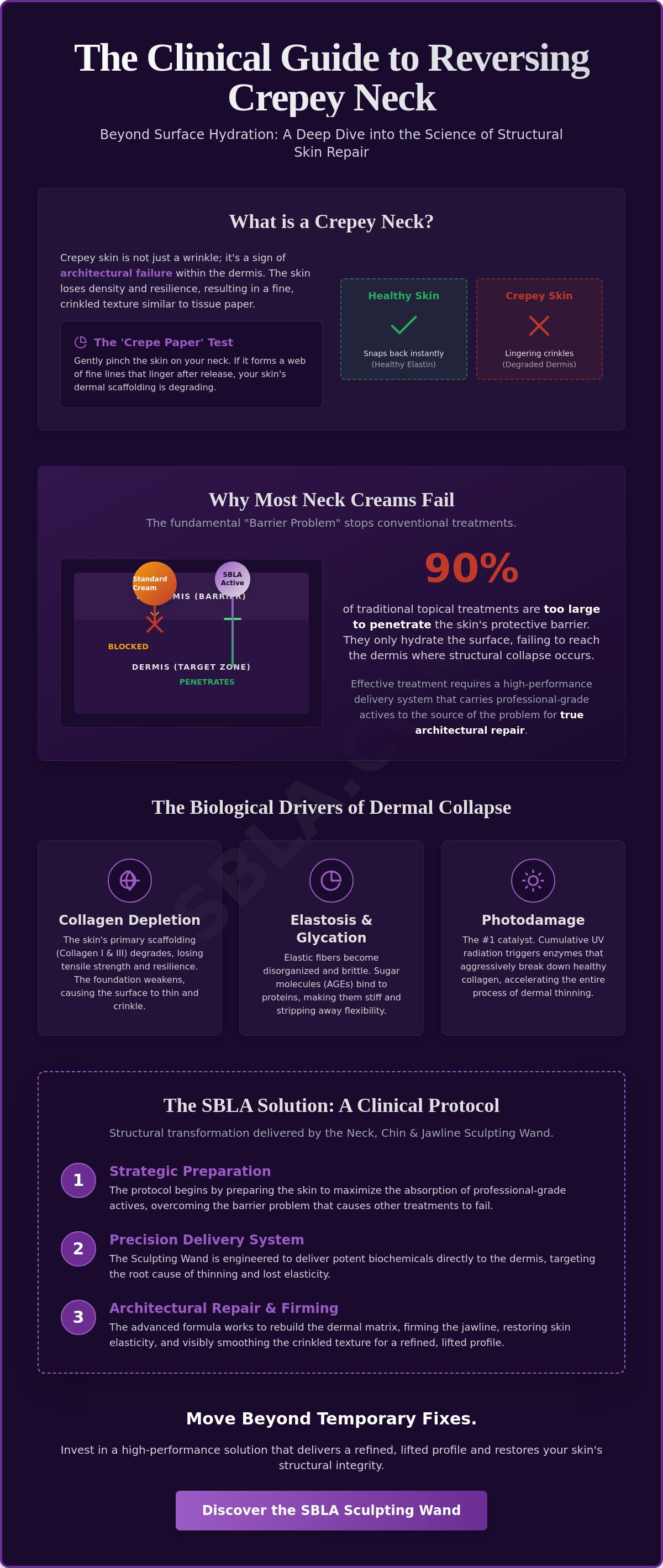
- Understand the "barrier problem" that prevents 90% of traditional topical treatments from reaching the deeper layers of the dermis where repair is required.
- Implement a clinical-grade at-home protocol that utilizes strategic preparation to maximize the absorption of professional-grade actives.
- Discover how the SBLA Neck, Chin & Jawline Sculpting Wand facilitates architectural repair to firm the jawline and restore skin elasticity.
What is Crepey Neck? Defining the Crinkled Skin Phenomenon
Crepey skin is not merely a sign of chronological aging; it is a specific architectural failure where the skin loses its density and bounce. Unlike dynamic wrinkles, which form from repetitive muscle movement, or static wrinkles that appear as deep, permanent folds, a crepey neck is characterized by a fine, translucent, and crinkled texture. It resembles the fragile surface of tissue paper. This condition indicates a profound loss of resilience within the dermis, where the skin can no longer hold its shape or hydration effectively.
Perform the 'crepe paper' test to assess your skin's current structural integrity at home. Gently compress a small patch of skin on the side of your neck using your thumb and forefinger. If the surface forms a web of fine, lattice-like lines that linger for several seconds after release, the dermal scaffolding has begun to degrade. Skin that snaps back instantly possesses healthy elastin levels, while skin that remains wrinkled lacks the necessary tension to maintain a smooth profile.
The neck is a high-risk zone for this type of degradation due to its unique anatomy. It possesses a significantly lower concentration of sebaceous glands compared to the face, which leads to chronic lipid deficiency and a compromised moisture barrier. Furthermore, neck skin is among the thinnest on the body. This leaves it exceptionally vulnerable to environmental stressors and the biological process of photoaging, which accelerates the breakdown of the skin's internal support system.
Crepey Skin vs. Sagging: Knowing the Difference
While often used interchangeably, crepiness and sagging represent two distinct clinical concerns. Crepiness describes the fragile, parchment-like texture of the epidermis itself. Sagging, frequently called 'turkey neck,' involves the downward descent of the platysma muscle and submental fat. You must distinguish between these issues because a treatment that only hydrates the surface won't fix structural laxity. If your primary concern involves heavy folds or a loss of jawline definition, you should explore how to get rid of turkey neck without surgery to understand the mechanics of non-invasive lifting. A comprehensive restoration protocol addresses both the surface texture and the underlying architecture.
The Visual Markers of Dermal Thinning
Visual markers of this condition typically begin as a subtle 'cross-hatching' pattern. This lattice of fine lines indicates that the skin's basement membrane is no longer providing adequate support to the layers above. Because the neck is frequently exposed to UV radiation without the same level of protection we afford our faces, it succumbs to damage much faster. It's common to see a stark contrast between a smooth jawline and a weathered neck. Ultimately, a crepey neck is the symptomatic thinning of the skin's basement membrane.
The Biological Drivers: Why the Neck Skin Crinkles
A crepey neck is the result of a coordinated collapse within the skin's dermal matrix. This architectural failure begins with the depletion of Collagen I and III, the primary proteins responsible for the skin's structural scaffolding. While Collagen I provides tensile strength, Collagen III offers the youthful resilience found in abundance during our earlier years. As these proteins degrade, the skin loses its underlying support, causing the epidermis to drape loosely over a thinning foundation. This isn't merely a surface issue; it's a deep-seated loss of biological density.
Elastosis further complicates this structural decline. This process occurs when elastic fibers, which typically allow the skin to snap back after stretching, become disorganized and brittle. Chronic exposure to environmental stressors triggers this degradation, replacing supple fibers with dysfunctional, thickened masses. Simultaneously, a process called glycation introduces Advanced Glycation End-products (AGEs) into the tissue. These sugar-derived molecules bond to collagen and elastin fibers, hardening them and stripping away their flexibility. This internal "stiffening" is what transforms smooth skin into a crinkled, fragile texture.
Photodamage remains the most aggressive catalyst for these changes. Over decades, cumulative UV radiation deconstructs the dermal matrix by triggering enzymes that chew through healthy collagen. Healthline explains crepey skin as a direct consequence of this long-term solar assault, which effectively hollows out the skin's middle layer. To combat this, you need more than simple hydration; you require a clinical intervention that targets these specific biochemical pathways. Utilizing the Neck, Chin & Jawline Sculpting Wand can help deliver the precise actives needed to support these failing structures at home.
The 'Tech Neck' and GLP-1 Factors
Modern lifestyle habits have introduced new stressors to the neck area. "Tech neck" refers to the constant flexion of the neck while using digital devices, which creates repetitive mechanical fatigue. This constant folding of the skin accelerates the formation of horizontal lines and deepens the appearance of a crepey neck. Additionally, the rise of GLP-1 medications has introduced the "Ozempic neck" phenomenon. Rapid volume loss from weight loss often leaves behind a surplus of skin that lacks the elasticity to retract, resulting in sudden, severe crinkling. You can find targeted strategies for these modern concerns in our guide to tech neck treatment at home.
Dermal-Epidermal Junction (DEJ) Failure
The Dermal-Epidermal Junction (DEJ) is the vital "glue" that anchors the epidermis to the dermis. In youthful skin, the DEJ is wavy and robust, providing a large surface area for nutrient exchange and structural cohesion. As we age, the DEJ flattens. This flattening reduces the communication between skin layers and leads to the characteristic sliding and crinkling of the surface. Addressing the health of this junction is essential for reversing early signs of neck aging and restoring a taut, smooth appearance to the profile.
Why Standard Neck Creams Fail (and the Science of Targeted Delivery)
Most consumers believe that a thicker cream equates to better results for a crepey neck. This is a fundamental misconception. The primary obstacle in skincare isn't a lack of active ingredients; it's the "Barrier Problem." Your skin is biologically engineered to keep foreign substances out. Consequently, approximately 90% of traditional topical creams never penetrate the stratum corneum to reach the target dermis. They remain on the surface, providing a fleeting sense of moisture while the underlying structural collapse continues unabated.
Heavy jars often contain occlusive agents like petrolatum or thick waxes that sit on the surface. While these provide a temporary feeling of hydration, they frequently cause "congestion" rather than "correction." These heavy formulations can trap dead skin cells and interfere with natural cellular turnover, which sometimes makes fine lines appear more pronounced over time. True structural transformation requires biochemical precision, not heavy-handed occlusion. We must focus on how ingredients are delivered, not just what is in the formula.
Molecular weight is the invisible gatekeeper of skin health. Large collagen molecules found in standard creams are physically too massive to pass through the skin's pores. They simply dry on the surface, offering no biological benefit. Effective clinical formulations utilize low-molecular-weight peptides and fragmented collagen—the same types of high-purity materials developed by research specialists like Biomod Peptides—that can navigate the microscopic gaps between skin cells. This allows the actives to reach the fibroblasts responsible for building new scaffolding.
Mechanical delivery systems provide a decisive advantage over manual fingertip application. A precision wand applicator uses controlled pressure to bypass the initial resistance of the skin barrier. This mechanical action ensures that clinical ingredients are pushed deeper into the tissue, maximizing the contact between the active formula and the dermal layers. It transforms the application from a surface-level smear into a targeted clinical treatment.
Retinol vs. Peptides: Choosing the Right Actives
High-concentration retinol is often the gold standard for facial rejuvenation, but it's frequently too aggressive for the thin, lipid-poor skin of the neck. Excessive irritation can trigger inflammatory responses that actually accelerate collagen degradation. Signal peptides offer a more sophisticated alternative by "tricking" the skin into accelerating elastin production without the risk of retinoid dermatitis. Encapsulated delivery systems are superior for neck rejuvenation because they release potent actives slowly to ensure maximum efficacy without compromising the delicate skin barrier.
The Myth of Instant Firming
Many luxury products rely on "film-formers"—synthetic polymers that shrink as they dry to create a temporary tightening sensation. This effect is purely cosmetic and disappears the moment you wash your face. It does nothing to address the underlying biological collapse described in the science of neck firming. To achieve lasting transformation, you must learn to identify "filler" ingredients like mica or high-silicone blends that merely blur imperfections. Real structural restoration depends on ingredients that trigger long-term cellular repair and restore the skin's basement membrane.
The Clinical Protocol: How to Treat a Crepey Neck at Home
Successful restoration of the neck's structural integrity depends on a disciplined, five-step clinical protocol. Treating a crepey neck requires more than a casual application of product; it demands a systematic approach that addresses cellular turnover and dermal density simultaneously. This is not about surface hydration. It is about a methodical reconstruction of the skin's basement membrane through precision delivery and mechanical stimulation.
- Step 1: Preparation. Begin with gentle, non-stripping exfoliation. Removing dead cell buildup ensures that your active ingredients aren't wasted on the surface layer of the skin, allowing them to reach the deeper layers that drive collagen synthesis.
- Step 2: Precision Delivery. Use a controlled applicator to distribute signal peptides and fragmented collagen across the target area. This method ensures uniform coverage and forces the formula to interact with the skin's internal architecture.
- Step 3: Structural Stimulation. Employ firm, upward strokes to encourage lymphatic drainage and blood flow. This mechanical action stimulates the underlying tissue and improves microcirculation, which is essential for nutrient delivery.
- Step 4: Moisture Lock. Apply a non-comedogenic lipid barrier to seal in the treatment. This prevents trans-epidermal water loss and maintains the skin's suppleness throughout the day.
- Step 5: Daily Defense. Broad-spectrum SPF is your most critical tool. In the 2026 climate, UV radiation remains the primary driver of dermal collapse, making daily protection non-negotiable for maintaining results.
Experience the precision of a clinical treatment by integrating the Neck, Chin & Jawline Sculpting Wand into your morning routine.
Advanced Application Techniques
The "Upward Sweep" method is vital for architectural repair. You should always work against gravity to stimulate the platysma muscle, which provides the underlying support for the neck profile. Don't stop at the base of the neck; incorporate the jawline into your routine to create a cohesive, lifted appearance. We have found that consistency beats intensity. Daily micro-dosing of high-performance actives is far more effective than intermittent, high-intensity treatments that can overwhelm the skin barrier.
Monitoring Progress: What to Expect
You will notice immediate hydration and a subtle smoothing effect, but true biological repair takes time. Expect to see significant improvements in skin density and a visible reduction in crepey neck texture over a 12-week period. This window allows for a full cycle of collagen synthesis and dermal remodeling. Document your journey with high-resolution photos in consistent lighting to track these subtle architectural changes. If you don't see visible progress after three months of diligent home care, you may consider escalating to a professional consultation for energy-based treatments.
The SBLA Solution: Structural Transformation via the Sculpting Wand
While many brands rely on surface-level marketing, SBLA focuses on biochemical precision. The SBLA Neck, Chin & Jawline Sculpting Wand is engineered to solve the delivery gap that renders most neck creams ineffective against a crepey neck. It isn't just a topical; it's a mechanical delivery system designed to bypass the skin's natural resistance and drive clinical actives directly into the dermis. This tool allows you to perform professional-grade structural repair in the privacy of your own home, bridging the gap between standard skincare and clinical procedures.
The efficacy of the wand lies in its proprietary formulation of collagen-infused peptides and balanced retinol. As established in previous sections, the neck requires a specific concentration of actives to avoid irritation while still triggering repair. This blend works in tandem with the wand's antimicrobial rollerball technology. The rollerball ensures a hygienic application while providing the exact amount of pressure needed to stimulate the tissue and maximize penetration. For those experiencing more advanced stages of dermal thinning or rapid volume loss due to age or weight fluctuations, the Neck, Chin & Jawline Sculpting Wand XL provides a more intensive structural intervention for profound results.
Clinical Results without the Needle
One of the most significant advancements in modern skincare is the ability to achieve a "liquid lift" without invasive procedures. The SBLA formula mimics the skin-smoothing effects of professional injectables by flooding the tissue with the building blocks of Collagen I and III. Unlike a syringe, which can be painful and require significant downtime, the wand utilizes a measured dosage system to deliver consistent results every day. This daily micro-dosing maintains the skin's tension and prevents the "snap-back" failure that defines aging. It's a non-invasive alternative that respects the skin's biological limits while pushing its aesthetic potential to the forefront.
Architectural Beauty: Redefining the Profile
Restoring the neck is a matter of architectural beauty. The SBLA protocol specifically targets the "V-line" of the face and neck, refining the jawline and smoothing the profile to create a more youthful, energized appearance. Addressing a crepey neck provides an emotional reward that goes beyond the mirror. It's about the self-assurance that comes from knowing your skin's structural integrity has been restored. You don't have to settle for the limitations of traditional cosmetics when scientific innovation offers a clear path to transformation. It is time to reclaim a profile that reflects your inner vitality.
Experience the transformation with the SBLA Neck, Chin & Jawline Sculpting Wand.
Reclaim Your Profile with Precision Science
Restoring a crepey neck requires moving beyond traditional hydration to embrace structural reconstruction. We have established that the "barrier problem" is the primary reason standard creams fail and why a clinical-grade delivery system is essential for biological repair. By focusing on the dermal-epidermal junction and supporting collagen synthesis through a disciplined protocol, you can achieve a visibly smoother and firmer profile. It's time to stop settling for surface-level fixes and start investing in the architecture of your skin.
SBLA provides the advanced technology needed to bridge the gap between at-home care and professional results. Our clinical-grade peptide delivery system ensures that potent actives reach the layers where they're needed most. With over 1,000 5-star reviews and recognition in Vogue and Harper's Bazaar, our wands are the trusted choice for those seeking visible transformation without the needle. You deserve to feel empowered by your reflection and confident in your skin's resilience.
Shop the SBLA Neck, Chin & Jawline Sculpting Wand and begin your journey toward a refined, youthful profile today.
Frequently Asked Questions
Can you really reverse crepey skin on the neck?
You can significantly improve the structural integrity and appearance of the skin through targeted clinical interventions. Reversing the signs of a crepey neck requires stimulating Collagen I and III while repairing the dermal-epidermal junction. While basic topical hydration offers temporary relief, biological reversal depends on precision delivery systems that reach the fibroblasts to rebuild the skin's internal scaffolding and restore lost density.
What is the best ingredient for a crepey neck in 2026?
Low-molecular-weight signal peptides combined with encapsulated retinol represent the gold standard for neck restoration in 2026. These ingredients work synergistically to signal the skin to accelerate elastin production without the inflammatory response often triggered by traditional retinoids. This dual-action approach addresses both the surface texture and the deeper architectural collapse that causes the characteristic crinkled appearance of aging skin.
How long does it take to see results from a neck sculpting wand?
Visible surface hydration occurs immediately, but structural remodeling typically requires 12 weeks of consistent daily application. This timeline aligns with the natural biological cycle of collagen synthesis and dermal repair. While many users report a noticeable "lift" within the first month, the most profound changes in skin density and snap-back resilience occur after the 90-day mark of disciplined micro-dosing.
Is crepey skin on the neck caused by weight loss?
Rapid weight loss is a primary driver of skin laxity because the skin often lacks the elasticity to retract once the underlying volume is lost. This phenomenon, frequently observed with GLP-1 medications, results in a surplus of thin, fragile skin that appears severely crinkled. Addressing this requires intensive structural support to firm the profile and restore the health of the skin's basement membrane.
Can I use my face retinol on my neck?
You should exercise extreme caution when applying high-concentration facial retinols to the neck area. The neck has fewer oil glands and thinner skin than the face, making it highly susceptible to retinoid dermatitis and chronic irritation. Using a formula specifically engineered for the neck's unique anatomy ensures you receive the benefits of cellular turnover without compromising the delicate skin barrier.
What is the difference between SBLA's standard and XL sculpting wands?
The standard Neck, Chin & Jawline Sculpting Wand is designed for preventative care and early-stage skin thinning, whereas the XL version provides a more intensive structural intervention. The XL wand features a higher concentration of active peptides and is specifically formulated for those experiencing advanced laxity or significant volume loss. Both tools utilize the same antimicrobial rollerball technology for precise, hygienic delivery.
Does 'Tech Neck' make crepey skin worse?
Constant neck flexion from digital device usage accelerates dermal fatigue and deepens horizontal lines. This repetitive mechanical stress breaks down collagen fibers more rapidly than natural aging alone. By creating permanent folds in the skin, "tech neck" provides a foundation for crepiness to set in, making targeted lifting and firming protocols essential for modern profile maintenance and architectural repair.
Are neck exercises effective for crepey skin?
Neck exercises can tone the underlying platysma muscle, but they do not repair the structural collapse of the epidermis or dermis. While a stronger muscle provides a better foundation for the profile, it cannot rebuild lost collagen or fix the crinkled texture of a crepey neck. True restoration requires a clinical-grade topical intervention that addresses the biological health and density of the skin itself.

