
Natural-Looking Anti-Aging Results: A Practical Guide to a Refined, Realistic Routine
The most convincing anti-aging change is often the one that still looks like you. If you want natural looking anti-aging results, gradual, consistent care is a more grounded starting point than dramatic promises or an aggressive routine.
Skincare may improve the appearance of certain concerns, but products and at-home devices have limits. Results vary, and visible changes take time. A refined routine should support your priorities without compromising comfort or making your features feel obscured.
This guide explains how to set realistic expectations, compare skincare approaches, and build a consistent routine around your goals and tolerance. It also covers how to assess an at-home option as one possible part of care, not a substitute for clinical guidance. The aim is measured improvement, informed choices, and a routine you can sustain.
Key Takeaways
- Define natural looking anti-aging results by what feels realistic for your features, priorities, and comfort level.
- Assess skincare claims by checking whether the evidence, methods, and reported outcomes match what a product promises.
- Compare topical care, at-home devices, and professional procedures by concern, expected pace, tolerance, and maintenance needs.
- Build a routine in stages: identify your priorities, establish the basics, add one targeted option, and review how it fits.
- Consider at-home options, including targeted skincare wands, as potential parts of a consistent routine, not guaranteed solutions.
What Natural Looking Anti-Aging Results Actually Mean
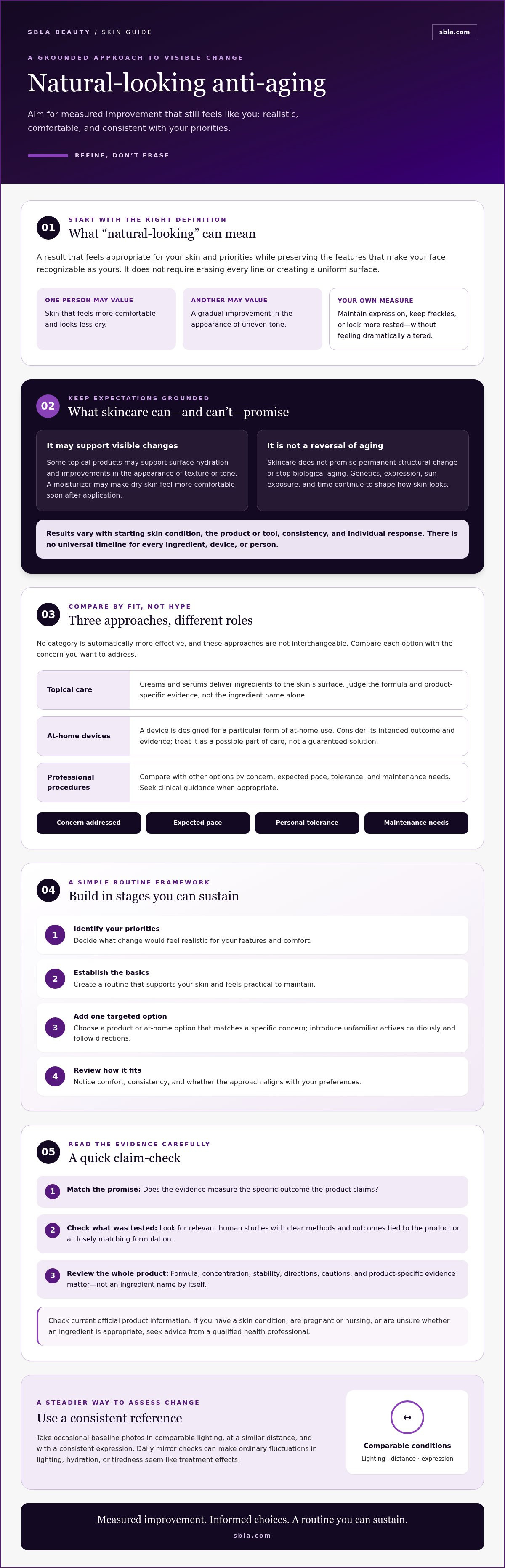
Natural-looking results are changes that feel appropriate for your skin and priorities while preserving the features that make your face recognizable as yours. They don’t require erasing every line or creating a uniform, polished surface. For one person, progress may mean skin that feels more comfortable and looks less dry. For another, it may mean a gradual improvement in the appearance of uneven tone.
Skincare can support visible changes, but that isn’t the same as reversing or stopping biological aging. It may help address some signs on the skin’s surface, while genetics, expression, sun exposure, and time continue to shape how skin looks. Learn more about what photoaging is, a term for skin changes associated with chronic exposure to ultraviolet radiation.
Realistic cosmetic improvement can refine the appearance of skin, but it doesn’t promise permanent structural change or a reversal of aging. Outcomes vary with your starting skin condition, the product or tool, how consistently it fits into your routine, and your individual response. Assess compelling claims against evidence relevant to that specific product and outcome.
Which visible changes can a skincare routine realistically support?
Some topical products can increase surface hydration, helping skin look temporarily smoother or feel more supple. That short-term effect is different from a lasting change in fine lines. With an appropriate, consistent routine, some products may support improvements in the appearance of texture or tone. Results depend on the formulation, the concern being addressed, and personal response, so don’t treat a broad claim as a guaranteed outcome.
Separate an immediate change in feel from a difference that may take longer to assess. A moisturizer can make dry skin feel more comfortable soon after application. A more durable visible difference, if a product supports one, needs to be evaluated over time. There’s no universal timeline for every ingredient, device, or person.
Why subtle progress often looks more natural
Gradual changes can preserve familiar expressions and individual features because the goal is refinement, not transformation. “Natural” is subjective, though. Decide what it means to you before choosing an approach. You might want to maintain visible expression, keep freckles, or simply feel that your skin looks rested rather than dramatically altered.
Track progress with occasional baseline photos taken in comparable lighting, at a similar distance, and with a consistent expression. Daily mirror checks can make small fluctuations in lighting, hydration, or tiredness seem like treatment effects. Consistent images offer a steadier reference point and help you judge whether a routine suits your preferences without demanding perfection.
How Skincare Ingredients and At-Home Tools Can Support Visible Improvement
Topical formulas and at-home devices serve different roles. A cream or serum delivers ingredients to the skin’s surface, while a device is designed for a particular form of at-home use. Neither category is automatically more effective, and they aren’t interchangeable. Evaluate each option against its specific purpose and the concern you want to address.
An ingredient name alone doesn’t establish a finished product’s effectiveness. The formula, concentration, stability, directions, and evidence for the product as a whole all matter. Stronger support comes from relevant human studies with clear methods and outcomes that match the exact claim, not simply a theoretical explanation or a study on a different formulation. Check current official product information for ingredients, directions, cautions, and substantiated claims before deciding whether an option fits.
What to look for in topical anti-aging formulas
Retinoids, peptides, and other active ingredients are discussed for different cosmetic purposes, but evidence for an ingredient category doesn’t prove that every formula containing it produces the same effect. Look for a relevant, observable outcome and evidence that tests the product or a closely matching formulation. Review the full ingredient list and directions on the product’s current official page.
If a formula contains an unfamiliar active, introduce it cautiously and follow its directions. Skin tolerance affects whether a routine is practical enough to maintain. If you have a skin condition, are pregnant or nursing, or aren’t sure whether an ingredient is appropriate for you, seek advice from a qualified health professional. For foundational habits that support skin health, consult the American Academy of Dermatology’s dermatologist-recommended anti-aging tips.
How to assess a skincare wand without overreading its claims
Start with the intended outcome: what is the wand designed to do, and what evidence supports that specific result? Look for clear information about how the product was evaluated, who or what was studied, and whether the reported outcome matches the claim. A brand description explains its positioning, but it isn’t the same as independent substantiation. Don’t assume a device works through a particular mechanism unless reliable product-specific evidence supports that explanation.
Directions and tolerability matter, too. A tool that doesn’t suit your preferences or routine may be difficult to use consistently. For another perspective on evaluating targeted facial tools, read this at-home liquid facelift clinical guide. You can also explore SBLA’s targeted skincare wands and topical formulas as options to assess, not guaranteed routes to a particular result.
How to Compare Anti-Aging Options Without Chasing an Overdone Result
A more intensive approach isn’t automatically a better match for your goals. Compare options by the concern they address, the quality of evidence for that outcome, the expected pace, your tolerance, and the maintenance involved. Skincare, at-home devices, and professional procedures are distinct choices with different purposes and limits.
At-home care may support the appearance of skin, but it can’t promise outcomes equivalent to a professional procedure. Don’t judge a topical product or wand by dramatic language alone, and don’t treat procedures as interchangeable with everyday skincare. Start with what you want to address and the approach you’re comfortable maintaining. For general guidance on planning care, review the American Academy of Dermatology’s dermatologist-recommended anti-aging plan.
| Approach | May suit | Compare carefully |
|---|---|---|
| Topical routine | People prioritizing regular skin care and product-based support | Evidence for the specific claim, directions, tolerance, and consistency required |
| Targeted at-home wand | People interested in a focused device as part of their routine | Intended use, product-specific evidence, directions, and whether the routine feels manageable |
| Professional procedure | People considering an intervention that calls for individualized assessment | Suitability, expected outcome, aftercare, and maintenance with a qualified clinician |
Topical routine, targeted wand, or professional consultation?
A topical routine may suit someone who wants a familiar, repeatable approach. A targeted wand may appeal if you prefer a device focused on a particular area, but it remains an at-home option, not a substitute for individualized medical assessment. If you’re researching eye-area tools, review the Eye Lift Wand’s current product information. A qualified clinician can assess specific skin concerns. Seek advice if irritation persists or a concern needs medical attention.
A decision framework for realistic expectations
Before choosing, name one priority concern and define what a modest improvement would look like to you. Then check the evidence for that exact outcome, the product or device directions, your likely tolerance, the consistency required, and your personal preferences. This keeps your comparison anchored to your needs rather than a promise of transformation.
Be cautious with claims of dramatic, guaranteed, or permanent results. Such language isn’t proof of effectiveness; it’s a reason to investigate the evidence and limitations more closely. This measured approach gives you a clearer basis for pursuing natural looking anti-aging results without equating intensity with success.
How to Build a Consistent Routine for Natural-Looking Progress
A considered routine is easier to follow when it has a clear sequence. Start with one priority, establish dependable basics, add one targeted product or tool, then review how it fits your skin and daily habits. Changing several things at once makes it harder to tell what’s helping, what’s irritating, or what you can realistically maintain.
Keep sun protection foundational. UV exposure contributes to visible skin changes, so choose an approach that suits your day and follow current authoritative guidance and the product’s directions. Steady protective habits are more useful than adding multiple targeted products while overlooking the basics.
- Identify one priority. Choose a specific concern, such as dryness or uneven-looking tone, rather than expecting an overall transformation.
- Establish your basics. Keep cleansing, moisturizing, and sun protection manageable and suited to your skin.
- Add one targeted option. Check its intended use, evidence, directions, and cautions before introducing it.
- Review before changing course. Track comfort, consistency, and the selected concern under comparable conditions.
A measured approach to introducing products
Read verified product directions and introduce unfamiliar products deliberately. Avoid starting several new active products at once. Spacing changes makes it easier to notice how your skin responds. Record whether the routine feels comfortable and practical, whether you’re following it consistently, and what you observe over a reasonable period. The appropriate observation period depends on the product and the claim, so don’t assume a universal timeline or guaranteed outcome.
Irritation isn’t proof that a product is working. If you develop discomfort, follow the product’s cautions and stop using it when appropriate. For persistent or concerning irritation, seek guidance from a qualified clinician rather than pushing through or adding more products.
How to assess progress without unrealistic comparisons
Use occasional progress photographs taken in similar lighting, from the same angle and distance, with a relaxed, consistent expression. Assess the concern you identified at the start. If your priority was skin texture, for example, focus on that rather than expecting every feature to look different. Day-to-day changes in lighting, hydration, and expression can distort comparisons.
Individual timelines vary with the product, routine, starting skin condition, and personal response. Treat a calendar as a tool for reviewing your habits, not as a promise that a product will produce a specific result by a set date. Choose an option only if its directions and routine demands work for you. To compare targeted at-home options, explore SBLA skincare tools and formulas and assess their official product information against your priorities.
Choosing an At-Home Option That Fits Your Goals
The right at-home option begins with your priorities, not a promise of transformation. Revisit the concern you chose, how your skin tends to tolerate products, and what kind of routine you can realistically maintain. If you’re focused on the neck, for example, the guide to early signs of neck aging can provide context as you consider your next step.
SBLA offers targeted skincare wands and topical formulas for areas including the eyes, face, neck, chin, and jawline. These are options to investigate, not guaranteed routes to a particular result. A wand designed for a specific area is still an at-home skincare option, not an equivalent to a medical procedure or an individualized consultation. Read the current official product information and judge each claim on its own evidence and limitations.
When a targeted skincare wand may fit your routine
A targeted wand may be worth considering if its focus aligns with the area you want to address and its use feels manageable within your routine. For instance, SBLA’s Eye Lift Wand and its neck, chin, and jawline sculpting wands are named for specific areas, but a product name alone doesn’t establish what results to expect. Before choosing, verify current directions, ingredients, precautions, and substantiated claims. Consider whether you’re comfortable following those directions consistently and whether the product’s intended use matches your goal.
If your concern calls for medical assessment, or you’re uncertain about a persistent skin issue, an at-home product may not be the right next step. A qualified clinician can help assess individual concerns. Keep cosmetic care and medical guidance distinct.
A final checklist before choosing
Use this short review before deciding:
- Priority: Does the product address a concern you actually want to focus on?
- Fit: Do the directions, maintenance expectations, and routine demands suit your habits and comfort level?
- Evidence: Are the product information and supporting claims clear enough to assess?
- Expectation: Are you choosing it for a measured possibility, rather than a promise of dramatic or permanent change?
That standard keeps your decision personal and evidence-aware. Natural looking anti-aging results aren’t defined by using the most products or the most intensive approach. They’re shaped by choices that align with your features, preferences, and tolerance. If a product doesn’t feel appropriate for your routine, it’s reasonable to keep looking.
For a closer look at options, explore SBLA’s targeted skincare offerings and review the current product details before choosing.
Make Your Next Skincare Choice With Confidence
Natural looking anti-aging results aren’t about chasing a flawless finish. They come from choosing an approach that respects your features, fits your comfort level, and aligns with what the available evidence can reasonably support. A clear priority and a routine you can sustain are more valuable than dramatic promises.
If you’re considering an at-home option, compare its intended use and current product information with your needs. SBLA offers targeted wands for the face, neck, and eye areas, alongside topical formulas. Consider these possibilities to assess, not guaranteed outcomes or substitutes for individualized medical guidance.
Explore SBLA’s targeted skincare offerings and review the product details to decide whether an option suits your routine. Take a measured approach and trust your preferences as you choose consistent care that fits.
Frequently Asked Questions
Is it possible to get natural-looking anti-aging results at home?
Yes, at-home skincare may support the appearance of concerns such as dryness or fine lines, depending on the product and your individual response. Natural looking anti-aging results aren’t guaranteed, and cosmetic products shouldn’t be presented as substitutes for clinical procedures. Set a modest goal, check the product’s directions, and assess the same concern consistently. For persistent skin issues or advice tailored to you, consult a qualified health professional.
How long does it take to see natural-looking anti-aging results?
There’s no universal timeline. Outcomes depend on the concern, product, routine, and individual response. Don’t judge a product after only a few days or treat a brand’s suggested timeline as a promise. Follow the directions, limit other routine changes, and review the same concern periodically under similar conditions. If a product causes a concerning reaction, stop using it and seek appropriate guidance.
Can skincare products make wrinkles disappear naturally?
No product should be expected to erase every wrinkle or stop aging. Some formulas may improve the appearance of certain concerns, but results depend on the formulation, how it’s used, and your skin’s response. Be cautious of claims promising permanent or guaranteed wrinkle removal. If you’re concerned about persistent lines or considering treatment, ask a qualified health professional for individualized guidance rather than relying on marketing claims alone.
What makes anti-aging results look overdone?
“Overdone” is subjective, but people may use the term when a change feels out of proportion to their features or preferences. An aggressive routine or expectations of dramatic transformation can also lead to dissatisfaction. Before choosing an option, define what a subtle, worthwhile change would mean to you. Compare progress under similar conditions, and don’t use dramatic photographs or short-term transformations as your only measure of value.
Are at-home skincare wands as effective as professional treatments?
They’re different categories and shouldn’t be assumed to deliver equivalent outcomes. At-home wands have their own intended uses and directions, while professional procedures involve a different setting and level of oversight. Review the specific device’s verified claims and instructions, and ask a qualified clinician about suitability if you have concerns. Choose based on evidence for the stated outcome and how well the option fits your goals, not on comparisons that aren’t substantiated.
How can I tell whether an anti-aging product claim is credible?
Look for a clearly defined outcome and evidence relevant to the finished product and its intended use. Research on an individual ingredient doesn’t, by itself, establish that a particular formula will produce that result. Check whether directions are clear, claims are appropriately qualified, and limitations are acknowledged. Treat promises of guaranteed, permanent, or dramatic transformation with caution. If you need personalized advice, consult a qualified health professional.

