
How to Avoid the Overfilled or Frozen Look: A Natural-Looking Approach
What if a more refreshed appearance doesn’t require adding volume or changing the way your face moves? If you’re concerned about facial proportions or expression, avoiding the overfilled or frozen look starts with identifying the change you actually want. Added volume and reduced muscle movement are different effects, and understanding that distinction can help you make a more considered choice.
It’s reasonable to want visible refinement without losing the features and expressions that feel like you. Start by describing your goal to a qualified provider, asking what a proposed approach can and can’t change, and discussing realistic expectations before proceeding. A conservative, provider-guided plan can keep the conversation focused on your preferences rather than transformation.
This article explains what can contribute to an overfilled or frozen appearance, how volume-focused treatments differ from approaches that affect expression, and what to ask during a consultation. It also clarifies where non-invasive skincare fits: at-home tools such as SBLA BEAUTY’s targeted wands can be part of a skincare routine, but they aren’t injectable treatments and shouldn’t be expected to prevent or correct their effects.
Key Takeaways
- The overfilled or frozen look is a subjective concern, not a single predictable result. Clarifying whether you’re focused on facial volume or movement can help you identify what you want to address.
- Avoiding the overfilled or frozen look starts with defining what you want to preserve, such as your facial proportions or natural expressions.
- Before choosing an approach, discuss your goals and options with a qualified provider. Make sure you understand the intended effects, limitations, and risks.
- At-home skincare tools, including SBLA BEAUTY’s targeted wands, are separate from injectable treatments and clinical procedures.
What Does the Overfilled or Frozen Look Mean?
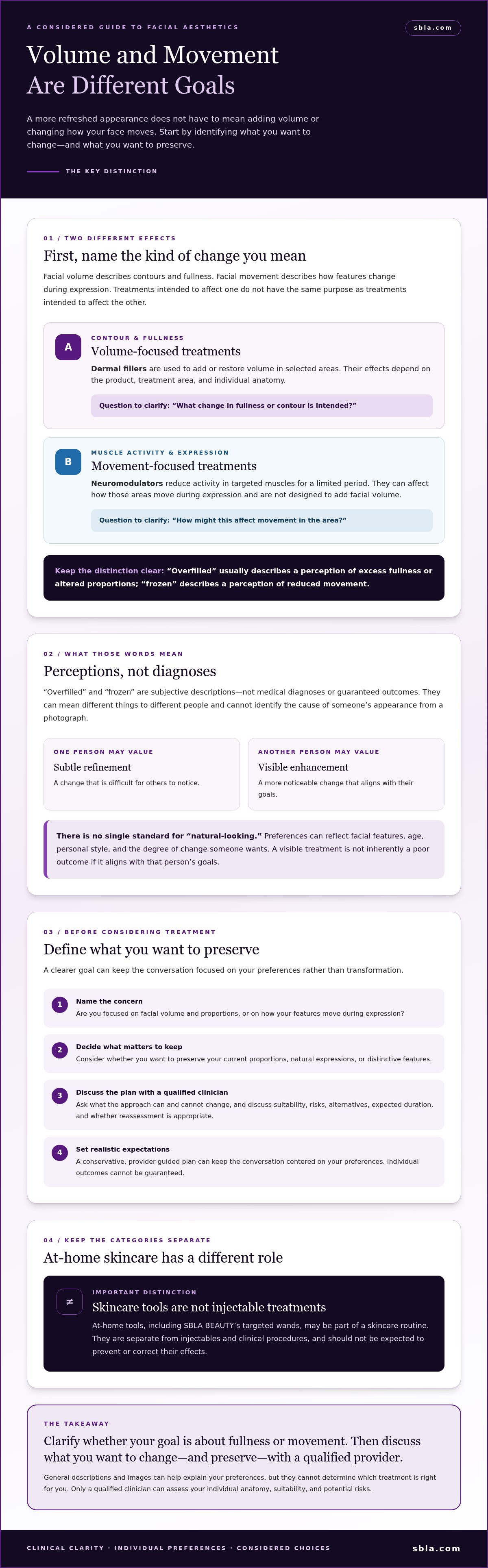
“Overfilled” and “frozen” are subjective descriptions, not medical diagnoses or guaranteed outcomes. They describe how someone perceives a face: perhaps its proportions seem less balanced, or its expressions appear less animated than expected. The terms can mean different things to different people, so they shouldn’t be used to identify a treatment or explain the cause of someone’s appearance from a photograph.
The distinction matters. Facial volume describes contours and fullness; facial movement describes how features change during expression. A treatment that adds volume has a different purpose from one that affects muscle activity. Neither a visible treatment nor a noticeable change is automatically undesirable. The right result depends on the individual’s preferences and expectations.
How volume and facial expression shape appearance
Naturalness is influenced by the whole face: proportions, underlying anatomy, age-related changes, and the way features move together. A change that looks harmonious to one person may feel too subtle or too noticeable to another. For example, someone may welcome added fullness in a particular area while wanting to retain a broad range of facial expression.
Dermal fillers are used to add or restore volume, while neuromodulators affect muscle activity. Botulinum toxin works by interfering with signals involved in muscle contraction; learn more about how botulinum toxin works. Because their purposes differ, “overfilled” usually refers to a perception of excess fullness or altered proportions, while “frozen” describes a perception of reduced movement. These are useful distinctions, not a way to determine what caused a particular person’s appearance.
Why natural-looking results mean different things to different people
There’s no single standard for a natural-looking result. One person may prefer a subtle change that’s difficult for others to notice; another may be comfortable with a more visible enhancement. Age, facial features, personal style, and the degree of change someone wants all shape that preference. A visible treatment isn’t inherently a poor outcome if it aligns with the person’s goals.
Before exploring options, consider what you want to change and what you want to preserve. Do you value your current facial proportions, movement, or distinctive features? Clear preferences can make a discussion with a qualified clinician more productive. Only a qualified clinician can assess your individual anatomy, suitability, and potential risks. General descriptions and images can help you explain your goals, but they can’t determine which treatment is right for you. For anyone focused on avoiding the overfilled or frozen look, understanding the difference between volume and movement is a useful first step, not a substitute for personalized clinical advice.
Why Can Some Cosmetic Treatments Change Facial Volume or Expression?
Cosmetic treatments don’t all affect the same aspects of facial appearance. Some are intended to alter contour or fullness; others affect how certain muscles move. Understanding this difference can help you ask more precise questions about the change you’re considering, without assuming that any treatment inevitably creates an unnatural result.
How fillers and neuromodulators differ
Dermal fillers are products used to add or restore volume in selected areas. The effect depends on factors such as the product, treatment area, and individual anatomy. The U.S. Food and Drug Administration explains the uses and potential risks of dermal fillers, including the importance of understanding the product and its risks before treatment.
Neuromodulators work differently. They reduce activity in targeted muscles for a limited period, which can affect how those areas move during expression. They aren’t designed to add facial volume. Neither category automatically produces an overfilled or frozen appearance; outcomes depend on the treatment plan and the person receiving it.
Why anatomy, treatment decisions, and expectations matter
A clinician considers facial anatomy, the area being treated, and the person’s goals when discussing whether an approach may be suitable. The desired degree of change matters, too. A plan focused on subtle refinement may differ from one seeking a more noticeable change. The clinician should explain relevant risks, alternatives, and expected duration, and discuss whether reassessment is appropriate before any further treatment.
Individual outcomes can’t be guaranteed. Results and risks vary by product, person, treatment area, and clinician, so a general description or someone else’s experience can’t predict your result. If you’re focused on avoiding the overfilled or frozen look, explain what you hope to change and what you want to preserve, such as facial proportions or expressive movement. A qualified provider can assess your individual suitability and help you weigh options without promising a particular appearance.
Injectables and at-home skincare tools are distinct approaches with different purposes and limits. If you’re exploring a non-invasive routine separately from clinical procedures, you can review SBLA BEAUTY’s at-home skincare wands as one skincare option. They aren’t substitutes for injectables or a way to prevent or correct their effects.
Injectables or Non-Invasive Skincare: Which Approach Fits Your Goal?
The right approach depends on the change you’re seeking. Injectable treatments and at-home skincare tools differ in purpose, clinician involvement, and what they can realistically achieve. Neither should be treated as a substitute for the other.
| Consideration | Injectable treatments | Non-invasive skincare |
|---|---|---|
| Intended goal | May add volume or affect targeted muscle activity, depending on the treatment. | Supports a topical skincare routine; effects depend on the specific product and its substantiated claims. |
| Involvement | Requires assessment and treatment by a qualified clinician. | At-home formulas and beauty wands are used as skincare, following product directions. |
| Realistic limits | Effects, risks, and duration vary. A clinician can explain what’s suitable and what to expect. | Not equivalent to injectables or clinical procedures, and can’t guarantee structural or facial movement changes. |
When a clinician-led injectable consultation may be relevant
If your goal involves changing facial volume or muscle movement, a consultation can help you discuss options, personal goals, contraindications, and risks. Choose a licensed, qualified professional in your jurisdiction. Ask about their credentials, the product being considered, expected effects and duration, alternatives, and follow-up. The FDA patient safety guide on dermal fillers offers additional information to review as you prepare questions.
Clear expectations matter. Describe what you hope to change and what you want to preserve, such as facial proportions or expressive movement. A clinician can assess suitability, but no particular outcome can be guaranteed.
What non-invasive skincare can and cannot offer
Topical formulas and beauty wands belong to skincare routines, not medical procedures. They may suit someone seeking a non-invasive option, but shouldn’t be expected to produce the same effects as injectables or to prevent or correct an injectable outcome. Follow the directions for the specific product, and assess its claims individually rather than assuming all tools work alike.
For a closer look at how an at-home approach is presented, read the at-home liquid facelift guide. You can also explore the microcurrent and peptide wand comparison for context on different skincare tool categories, not as evidence of equivalent outcomes. For readers considering a separate at-home routine, SBLA Beauty’s skincare wands are one option to review. A measured approach to avoiding the overfilled or frozen look begins by matching the choice to your goal and understanding its realistic limits.
How to Communicate a Goal of Avoiding the Overfilled or Frozen Look Before Treatment
A clear conversation starts with your priorities, not a treatment name. Before meeting a qualified aesthetic provider, write down what you hope to change and what you want to preserve, such as your facial proportions, familiar features, or ability to express emotion. This gives the discussion a practical focus and makes “natural-looking” more specific to you.
It can help to distinguish your goal from the method you think might achieve it. For example, note whether your concern is about fullness, movement, or both. Then ask the provider to explain which options, if any, address that concern and what their limits are.
- Define your preferences. Note the change you’re seeking, how noticeable you want it to be, and any boundaries.
- Consult and ask. Explain your goals and ask the provider to assess your individual features and suitability.
- Review options. Discuss alternatives, likely limitations, material risks, expected effects, duration, and aftercare.
- Decide without pressure. Take time to consider the information. You don’t have to agree to treatment during the consultation.
- Reassess. Follow the provider’s advice about follow-up and discuss any concerns rather than assuming further treatment is needed.
Questions to ask a qualified aesthetic provider
Useful questions help you understand both the proposed approach and the person providing it. Ask which option best matches your stated goal, what alternatives exist, and what results may be unrealistic for your features. Confirm the provider’s qualifications and ask about the product or treatment, potential risks, expected duration, aftercare, and how concerns will be handled. When avoiding the overfilled or frozen look, explain what you specifically don’t want, such as added fullness that changes your proportions or movement that feels less expressive.
Consultation checklist: “Which option fits my goal, what are the alternatives and risks, what can I realistically expect, what aftercare or follow-up is needed, and how will we address concerns?”
How to use reference photos without chasing another face
Reference images can help communicate details you like, such as a general degree of definition or a preference for subtle change. Treat them as conversation aids, not promises of an identical result. Ask the provider to explain what may be realistic for your own anatomy and which aspects of the image may not translate to your features.
Write down your personal boundaries before the appointment. For example, you might want a refreshed appearance while preserving a particular expression or facial contour. Clear limits make it easier to pause, ask for clarification, or decline if a proposed plan doesn’t feel aligned with your preferences.
If you’re considering a separate, non-invasive skincare routine, explore SBLA Beauty’s at-home skincare wands as skincare tools, not substitutes for clinician-led treatment or a way to control injectable results.
A More Measured At-Home Skincare Path with SBLA Beauty
Not every aesthetic goal calls for an injectable treatment. If you’re looking for a non-invasive option to include in a skincare routine, at-home products may be worth exploring as a separate path. They aren’t substitutes for clinician-led procedures, and shouldn’t be expected to change facial anatomy, muscle activity, or the effects of fillers.
Where an at-home wand may fit in a skincare routine
SBLA Beauty offers targeted at-home wands, including the Eye Lift Wand, Neck, Chin & Jawline Sculpting Wand, Neck, Chin & Jawline Sculpting Wand XL, and Liquid Facelift Wand. These are skincare products, not medical treatments. Before choosing one, review its current directions, ingredients, and the claims supported for that specific product. Use it only as directed, and don’t assume a device or formula will deliver the same effects as an injectable or clinical procedure.
Product directions and claims can differ, so take time to understand what a particular wand is intended to do and how it fits your existing routine. If you have a skin concern, experience a reaction, or aren’t sure whether a product is suitable for you, seek advice from a qualified clinician. An at-home routine doesn’t replace individualized medical guidance.
Explore SBLA Beauty’s non-invasive skincare options
The Liquid Facelift Wand is one at-home skincare option for readers interested in a non-invasive routine. Its name doesn’t mean it’s equivalent to a liquid facelift procedure, an injectable, or a guaranteed way to alter facial contours. Consider it on its own terms by checking the current product information, directions, ingredients, and substantiated claims before deciding whether it belongs in your routine.
A measured approach to avoiding the overfilled or frozen look means choosing options with a clear understanding of their purpose and limits. Skincare may form part of your personal routine, while questions about injectable treatments or facial movement belong in a conversation with a qualified provider. There’s no need to rush or expect one product to deliver a particular transformation.
For a calm next step, explore SBLA Beauty’s at-home skincare options and review the product details to decide whether any fit your preferences.
Choose a Path That Reflects Your Priorities
A natural-looking goal begins with clarity about the change you want and the features you hope to preserve. Facial volume and movement are distinct, so understanding which matters to you can help guide a more focused conversation with a qualified clinician. Ask about suitable options, risks, alternatives, and realistic expectations before deciding. Thoughtful communication is a practical first step in avoiding the overfilled or frozen look.
At-home skincare offers a separate, non-invasive path. SBLA Beauty provides targeted beauty wands and topical formulas through its direct-to-consumer online store. These products are skincare options, not substitutes for injectables or a way to prevent or correct their outcomes. Review current product directions, ingredients, and substantiated claims to decide whether an option fits your routine.
Whether you’re considering a provider-led approach or refining your skincare routine, take time to compare each option with your priorities and its realistic limits.
Frequently Asked Questions
What causes an overfilled or frozen look?
An overfilled appearance is a perception of excess fullness or changed facial proportions, while a frozen appearance describes reduced facial movement. They aren’t diagnoses, and a photo alone can’t reveal the cause. Fillers are intended to add or restore volume; neuromodulators affect targeted muscle activity. Treatment choices, individual anatomy, product, area, and clinician can all influence outcomes. Neither category inevitably produces these effects, and personal preferences for visible change vary.
Can Botox make your face look frozen?
Yes, a person may perceive less facial movement after botulinum toxin treatment because it reduces activity in targeted muscles. The degree of change can depend on the treatment plan, area, individual response, and clinician. It doesn’t mean every treatment causes a frozen appearance. Before proceeding, explain which expressions you want to preserve and ask a qualified provider about expected effects, limitations, risks, and duration.
Can dermal fillers change your facial expression?
Dermal fillers are used to add or restore volume, rather than directly reduce muscle activity. However, changes in fullness or contour may affect how facial features appear, and individual responses vary. If your concern is preserving expression, tell the clinician before treatment and ask how the proposed option relates to your goal. A qualified provider can assess your anatomy and discuss risks and alternatives, but can’t guarantee a particular result.
How can I tell my injector I want a natural-looking result?
Describe the change you’d like and what you want to preserve, such as your facial proportions, distinctive features, or range of expression. Be specific about how noticeable you want the result to be and what would feel like too much. Reference photos can help explain preferences, but they can’t promise an identical outcome. Ask the provider to outline realistic options for your features, and take time to decide without pressure.
Are non-invasive skincare wands an alternative to injectables?
Skincare wands may be an option for someone seeking an at-home, non-invasive routine, but they aren’t equivalent to injectable treatments or clinical procedures. They shouldn’t be expected to produce the same effects or change facial movement or structure. Check the specific product’s directions, ingredients, and substantiated claims before use. For skin concerns, a reaction, or uncertainty about suitability, seek advice from a qualified clinician.
Can an overfilled or frozen look be reversed?
There isn’t one answer because the appearance, cause, and treatment involved matter. Some effects may change over time, while options for addressing a concern depend on the product and individual circumstances. Don’t try to correct an injectable outcome yourself or assume a skincare product can reverse it. Contact a qualified clinician who can assess you, explain possible next steps, and advise whether further evaluation is needed.
What should I ask before getting facial injections?
Ask which option fits your goal, what alternatives exist, and what results are realistic for your features. Also discuss the provider’s qualifications, the product being considered, potential risks, expected duration, aftercare, and follow-up. Explain what you want to preserve, such as facial proportions or expression. You can take time to review the information and decide later. A qualified provider should address your questions and assess personal suitability before treatment.
For a non-invasive skincare option, explore SBLA Beauty’s at-home skincare tools and review the product information to decide whether a wand fits your routine.

