
Peptide vs Retinol for Anti-Aging: The 2026 Clinical Comparison
The gold standard of skincare is shifting from aggressive resurfacing to architectural precision. You likely rely on vitamin A to clear fine lines, yet your high-potency retinol might be causing chronic inflammation while ignoring the structural collapse of your jawline. Choosing between a peptide vs retinol for anti-aging is no longer a matter of preference; it's a strategic decision about whether you want to polish the surface or rebuild the foundation. In anticipation of evolving industry standards by 2026, and a heightened focus on skin barrier health, the industry is pivoting toward more sophisticated, non-invasive solutions that prioritize skin integrity.
You understand that achieving a visibly lifted neck and sculpted chin requires more than traditional serums that sit on the skin's surface. This clinical comparison explores the scientific synergy between signaling peptides and cellular-turnover retinoids to help you design a streamlined, professional-grade routine. You'll discover how advanced delivery systems bypass traditional absorption barriers to target sagging and volume loss without the redness or irritation of the past. We're moving beyond temporary fixes into an era of technological rejuvenation where structural transformation meets clinical authority.
Key Takeaways
- Identify how retinol functions as a premier resurfacing agent to accelerate cellular turnover and correct uneven skin texture.
- Learn why peptides are essential for architectural lifting and signaling collagen production specifically in the neck and jawline.
- Compare the clinical roles of peptide vs retinol for anti-aging to determine which powerhouse best supports your structural rejuvenation goals.
- Master the synergy protocol for combining these active ingredients to maximize firming results while minimizing potential skin sensitivity.
- Discover why precision delivery systems, such as SBLA wands, provide superior absorption compared to traditional topical serums.
Understanding the Biochemical Roles: Peptides vs. Retinol
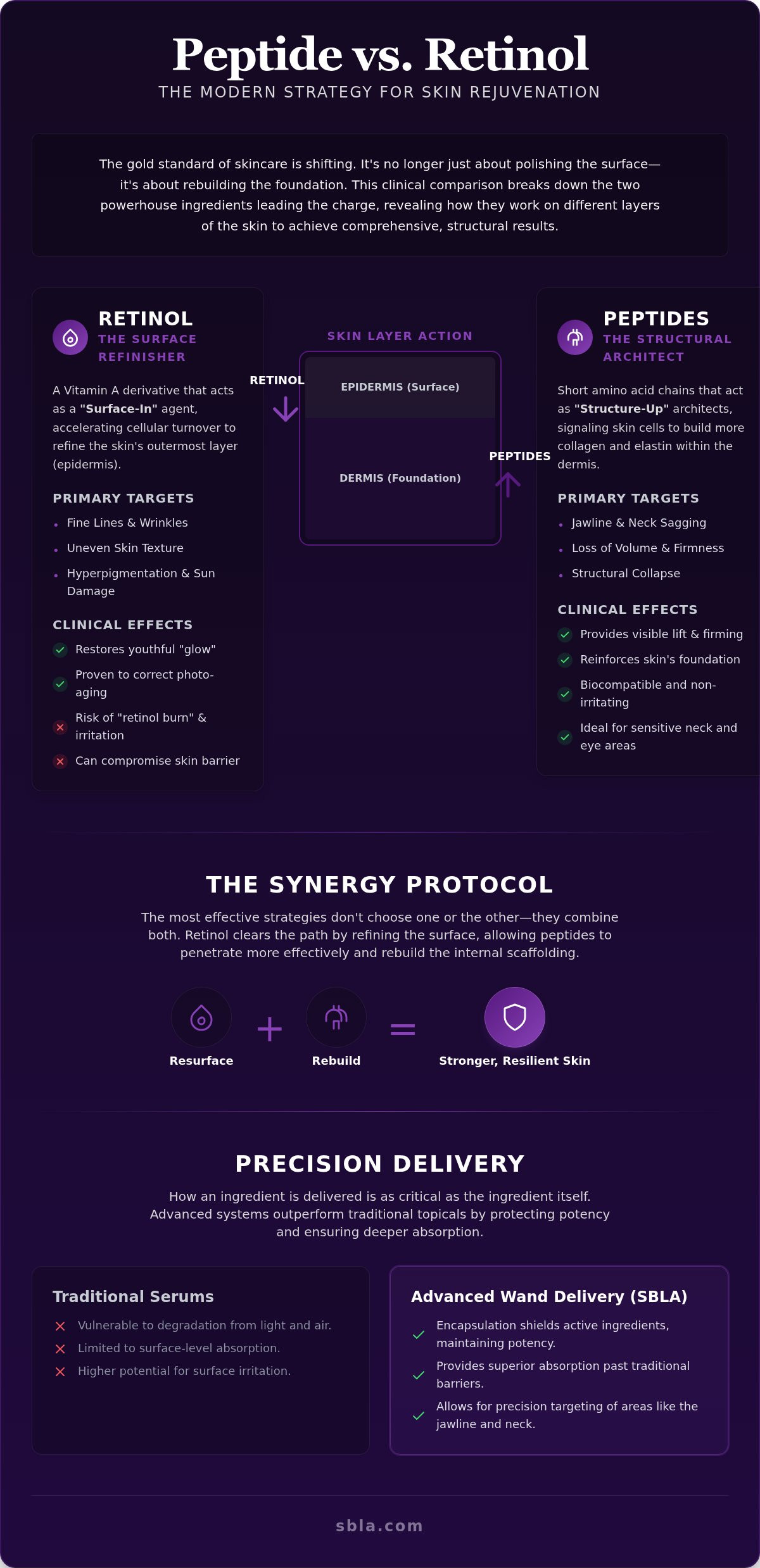
True skin rejuvenation requires a dual-layered approach that addresses both the visible surface and the underlying foundation. When evaluating peptide vs retinol for anti-aging, it's vital to distinguish between resurfacing and restructuring. Retinol acts as a "Surface-In" agent, focusing on the epidermis to refine texture and tone. Peptides function as "Structure-Up" architects, working within the dermis to restore lost volume and firmness. High-performance skincare in 2026 demands a multi-pathway strategy that utilizes both mechanisms to achieve professional-grade results without the downtime of invasive procedures.
How Retinol Resurfaces the Epidermis
Retinol is a derivative of Vitamin A that must undergo a specific enzymatic conversion within the skin to become active retinoic acid. Understanding the biochemical role of retinoids reveals how they accelerate cellular turnover, pushing fresh, healthy cells to the surface while shedding damaged ones. This process effectively minimizes fine lines and corrects stubborn hyperpigmentation. However, this rapid turnover can compromise the skin barrier. Many users experience "retinol burn," characterized by redness, peeling, and heightened sensitivity. This biological cost is why 2026 formulations focus on stabilized, encapsulated delivery systems that provide the benefits of resurfacing while mitigating the inflammatory response.
How Peptides Architect the Dermis
Peptides are short chains of amino acids that serve as biological messengers. Unlike retinoids, they don't force cellular shedding; instead, they signal the skin to repair itself. These molecules penetrate the dermis to activate fibroblasts, the cells responsible for producing collagen and elastin. This "Structure-Up" movement is essential for addressing the sagging jawlines and loss of facial volume that topical resurfacing cannot fix. Peptides are naturally biocompatible and non-irritating, making them the ideal choice for sensitive areas like the neck and eyes. By reinforcing the extracellular matrix, they provide a visible lift and a resilient, firm texture.
Modern clinical routines no longer rely on a single "miracle" ingredient. The most effective strategies combine these two powerhouses to target every layer of skin aging simultaneously. While retinol clears the path by refining the surface, peptides build the internal scaffolding necessary for a youthful, sculpted profile. This synergy ensures your skin isn't just smoother, but fundamentally stronger and more resilient against the passage of time.
Retinol: The Clinical Gold Standard for Texture and Tone
Retinol remains the most rigorously studied ingredient for correcting photo-aging and chronic sun damage. While the debate of peptide vs retinol for anti-aging often centers on sensitivity, retinol's ability to reorganize the epidermal structure is unparalleled. It works by stimulating the production of glycosaminoglycans, which are essential for maintaining skin hydration and volume. Numerous clinical studies on retinol demonstrate its proficiency in lightening hyperpigmentation and smoothing the rough solar elastosis associated with long-term UV exposure.
Retinol functions as a metabolic catalyst that accelerates mitochondrial activity within skin cells to drive the energy-intensive process of cellular regeneration. This internal acceleration is what ultimately produces the "glow" associated with youthful skin. Mature skin often suffers from a sluggish turnover rate, leading to a dull, opaque appearance. Retinol restores the light-reflective quality of the skin by ensuring the topmost layer consists of fresh, tightly packed cells.
Stability is the primary challenge for traditional retinoids. Oxygen and light exposure quickly degrade standard formulas, rendering them ineffective. Advanced encapsulation technology solves this by shielding the active molecule, allowing for a slow-release mechanism that maintains potency while reducing surface irritation. This controlled delivery ensures that the skin achieves professional-grade results without the inflammatory side effects of older, unrefined formulations.
Retinol for the Eye Area: A Delicate Balance
The skin surrounding the eyes is significantly thinner than the rest of the face, making it highly susceptible to irritation. Applying standard high-concentration serums here often leads to persistent dryness and redness. Achieving a non-invasive lift requires a specialized delivery method that balances efficacy with safety. The SBLA Eye Lift Wand utilizes a precision-engineered applicator to distribute measured doses of active ingredients. This ensures the delicate eyelid area receives the necessary stimulation for a lifted appearance without compromising the fragile skin barrier.
Managing the Retinization Process
Skin adaptation, or retinization, typically follows a predictable clinical timeline of four to six weeks. During this phase, you might experience transient peeling as the epidermis reorganizes itself. While the "sandwich method" is a common workaround, modern encapsulated formulas provide a more elegant solution by preventing the initial spike of irritation. To maintain efficacy while mitigating redness, follow a graduated approach:
- Start with twice-weekly applications to assess your skin's tolerance.
- Prioritize nighttime use to avoid UV-induced degradation of the active molecule.
- Pair the treatment with a lipid-rich barrier cream to support the moisture mantle.
For those seeking a comprehensive transformation, the Liquid Facelift Wand offers a sophisticated way to integrate these high-performance actives into a daily regimen.
Peptides: The Structural Powerhouse for Lifting and Firming
While retinol dominates the conversation regarding surface texture, peptides serve as the essential architects of skin structure. In the debate of peptide vs retinol for anti-aging, the distinction lies in structural integrity versus cellular turnover. Advanced 2026 skincare formulations classify peptides into three primary categories: signal peptides that trigger collagen synthesis, carrier peptides that stabilize trace elements, and neurotransmitter-inhibiting peptides that soften expression lines. These amino acid chains don't just resurface; they rebuild. While Harvard researchers have documented how retinoids reduce wrinkles by accelerating epidermal shedding, peptides address the deeper "sagging" factor by reinforcing the dermal scaffolding. This makes them indispensable for reversing early signs of neck aging where skin is too thin for aggressive retinization.
Signal Peptides and Collagen Synthesis
Signal peptides operate through a sophisticated biological "trick." By mimicking the natural fragments of broken collagen, they persuade the skin that it's in a state of injury, triggering a surge in fibroblast activity. This response increases dermal thickness and resilience, providing the "snap-back" quality associated with youthful skin. Unlike retinol, which can initially thin the stratum corneum, peptides strengthen the skin barrier from the inside out. This internal reinforcement is particularly crucial for the jawline and neck area, where the lack of fatty tissue makes structural collapse more visible. Consistent application leads to a denser, more resilient skin matrix that resists the downward pull of gravity.
Peptides for Lower Face Contouring
Addressing the lower face requires a strategy that moves beyond simple line reduction. Peptides offer a non-invasive "liquid lift" effect by targeting the specific proteins that hold skin to the underlying muscle. This is highly effective for improving the appearance of marionette lines before and after topical treatment, as it replenishes volume in the nasolabial folds. To achieve these results, delivery is paramount. Using a dedicated Face Wand ensures that these high-dose peptide formulas are distributed with precision, overcoming the absorption hurdles that often plague traditional serums. This targeted delivery allows the active molecules to reach the deeper dermal layers where they can effectively sculpt the chin and jawline profile.
The immediate benefits of peptide application often include increased hydration and a temporary smoothing effect. However, the true clinical value lies in the long-term cumulative impact. Over several weeks, the steady signaling of collagen production results in a visible transformation of the facial contour. By prioritizing these structural messengers, you're not just masking the signs of time; you're actively repairing the biological foundation of your skin.
The Synergy Protocol: Combining Peptides and Retinol Safely
Integrating both actives into a single regimen is the definitive strategy for 2026. While many treat the choice of peptide vs retinol for anti-aging as a binary decision, clinical evidence suggests they are far more effective when used as a coordinated system. Retinol thins the stratum corneum to clear the path for deeper ingredient penetration. Peptides then utilize this access to reinforce the dermal matrix, effectively counteracting the potential thinning or irritation often associated with aggressive retinoid use. This creates a sophisticated feedback loop of surface resurfacing and structural repair.
A clinical AM/PM strategy ensures you receive maximum benefit without overwhelming the skin's biological capacity for repair. Peptides are generally photostable and non-irritating, making them ideal for morning application to support the skin's structural resilience against environmental stressors. Retinol remains a nighttime essential, as the body's natural repair mechanisms peak during sleep and the molecule itself is sensitive to UV degradation. Proper formulation is vital to avoid ingredient "pillaging," where conflicting pH levels or reactive stabilizers neutralize the active compounds before they reach their target.
The Layering Logic: Texture First, Structure Second
Effective layering depends on understanding molecular weight and solubility. To maximize absorption, water-based formulas and smaller molecules must be applied before heavier creams or oils. The Liquid Facelift Wand simplifies this complexity by delivering a stabilized, high-dose concentration of actives through a precision delivery system. This ensures the skin receives the necessary hydration to support active ingredient efficacy, as dehydrated cells cannot effectively process signaling peptides or retinoid conversions. Texture refinement occurs at the surface, but the structural "lift" happens only when these molecules bypass the initial topical barrier.
Avoiding Over-Sensitization
The transition to a dual-active routine requires a disciplined approach to prevent chronic inflammation. Over-sensitization can lead to a compromised lipid barrier, which ironically accelerates the appearance of aging. Watch for these "red flag" signs that your routine is too aggressive:
- Persistent erythema or localized redness that doesn't subside within an hour.
- Stinging or burning sensations when applying neutral, fragrance-free moisturizers.
- A "plastic" or unnaturally shiny skin texture that feels tight and brittle.
When these signs appear, scale back your retinol frequency while maintaining peptide application to support the barrier. Incorporating barrier-supporting lipids like squalane or ceramides during the peptide-retinol cycle provides the necessary cushioning for the skin to adapt. Once the barrier is restored, you can gradually reintroduce actives to maintain your structural rejuvenation strategy. For a professional-grade solution that balances these high-performance ingredients, explore the Liquid Facelift Wand to streamline your daily routine.
Precision Delivery: Why Wands Outperform Traditional Serums
The most advanced anti-aging formulas are only as effective as their ability to penetrate the skin's biological defense system. Traditional serums often succumb to the "Topical Barrier" problem, where active ingredients remain trapped in the dead cell layers of the stratum corneum or evaporate before absorption. In the context of a peptide vs retinol for anti-aging regimen, this lack of penetration leads to wasted product and diminished clinical outcomes. SBLA wands provide a sophisticated solution by utilizing a targeted, measured delivery system that ensures high-potency actives reach the deeper dermal layers where they are most needed.
The Neck, Chin & Jawline Sculpting Wand XL serves as the pinnacle of this at-home technology. It combines biochemical precision with a mechanical benefit that traditional topical application cannot replicate. The physical action of the sculpting wand facilitates lymphatic drainage, reducing the fluid retention that often obscures facial contours. This mechanical force works in tandem with the formula to de-puff and refine the lower face profile, providing a non-invasive alternative to clinical procedures.
The Science of Targeted Application
Finger application is inherently imprecise and unhygienic. It results in significant product waste as the porous skin on the fingertips absorbs expensive actives before they ever reach the target area. SBLA wands utilize an antimicrobial applicator that ensures an even, hygienic distribution across the skin's surface. Beyond the technical efficiency, there's a psychological benefit to this structured, professional-feeling ritual. It transforms a standard skincare step into a focused clinical treatment, reinforcing the user's commitment to a long-term rejuvenation strategy.
Visible Results: What to Expect
Achieving a total transformation requires patience and precision. While surface changes, such as the refined texture and "glow" associated with retinol, can appear within the first few weeks, structural lifting is a cumulative process. You should expect a realistic timeline for different aesthetic outcomes:
- 14 to 21 Days: Visible improvement in skin radiance and surface smoothness as cellular turnover accelerates.
- 28 to 45 Days: Increased skin density and resilience as peptide signaling begins to reinforce the dermal scaffolding.
- 60+ Days: A definitive transition from sagging tissue to a stronger jawline and more sculpted neck profile.
Daily precision sculpting ensures that active ingredients are consistently delivered to the areas most prone to structural collapse. By moving away from passive serum application toward active, wand-based delivery, you're investing in a methodology that prioritizes absorption, hygiene, and visible architectural change.
Elevating Your Non-Invasive Rejuvenation Strategy
Achieving a sculpted, youthful profile requires a strategic shift from simple moisturization to targeted biochemical intervention. You've learned that the debate of peptide vs retinol for anti-aging is resolved through clinical synergy rather than a singular choice. Retinol provides the essential resurfacing needed for a radiant glow, while peptides act as the structural messengers that architect a firmer neck and jawline. By moving past traditional serums and adopting precision-engineered delivery systems, you ensure these high-performance actives bypass the topical barrier to deliver visible, structural transformation.
It's time to streamline your professional-grade home routine with tools designed for clinical precision. SBLA wands provide dermatologist-grade peptide delivery and clinically proven structural lifting without the need for invasive, needle-based procedures. This high-tech approach ensures that your rejuvenation strategy is both efficient and profoundly effective. Embrace a future where advanced biochemical technology meets high-end aesthetic excellence to reveal your most confident, refined self.
Shop the SBLA Clinical Collection for Targeted Rejuvenation and experience non-invasive, needle-free results today.
Frequently Asked Questions
Can I use peptides and retinol together in the same routine?
You can absolutely use peptides and retinol together to achieve a multi-layered rejuvenation effect. This combination is often superior to using either ingredient alone because peptides reinforce the skin's structural integrity while retinol accelerates cellular turnover. By layering these actives, you mitigate the irritation often associated with retinoids. Peptides act as a soothing scaffolding that supports the skin barrier, allowing the resurfacing power of retinol to work more efficiently.
Which is better for deep wrinkles: retinol or peptides?
Choosing between a peptide vs retinol for anti-aging strategy depends on the wrinkle's origin. Retinol is the gold standard for refining surface texture and diminishing fine lines caused by photo-aging. Peptides are more effective for addressing deep structural wrinkles and sagging by stimulating collagen and elastin production in the dermis. For the most comprehensive results, a protocol that utilizes both ingredients will resurface the epidermis while simultaneously architecting a firmer foundation.
Do peptides work as fast as retinol for anti-aging?
Retinol typically produces visible surface changes faster than peptides because it directly accelerates the shedding of dead skin cells. You might see a more radiant glow within two to four weeks of consistent use. Peptides require more time to produce measurable results because they must signal the biological production of new collagen fibers. Most clinical outcomes for structural lifting and firming become evident after eight to twelve weeks of daily, targeted application.
Are SBLA wands safe for sensitive skin?
SBLA wands are engineered for all skin types, including those with heightened sensitivity. The proprietary delivery system provides a measured, targeted dose of active ingredients, which prevents the systemic irritation often caused by slathering traditional high-concentration serums. Because the wands allow for precise application on specific areas like the neck or eyes, you can avoid reactive zones. This controlled methodology ensures you receive professional-grade potency without triggering an inflammatory response.
Can I use the Eye Lift Wand if I already use a retinol cream?
You can integrate the Eye Lift Wand into your existing routine even if you use a separate retinol cream. The wand provides a specialized, peptide-rich formula designed for the delicate eyelid area, which often requires different structural support than the rest of the face. If your current cream is highly potent, apply the Eye Lift Wand first to clean skin to ensure its signaling molecules reach the dermis. Monitor your skin for any signs of over-activity.
How long does it take to see results from a peptide-based sculpting wand?
You will notice an immediate cooling and depuffing effect due to the mechanical action of the wand's antimicrobial applicator. This initial refinement is followed by a gradual increase in skin density. Clinical structural changes, such as a more defined jawline and reduced sagging, typically manifest between four and eight weeks of consistent daily use. This cumulative effect is the result of steady collagen signaling and the manual stimulation of lymphatic drainage during application.
Should I apply my retinol wand before or after moisturizer?
Apply your retinol wand directly to clean, dry skin before your moisturizer. This sequence ensures that the active molecules can penetrate the epidermal barrier without being blocked by the occlusive lipids found in heavier creams. After allowing the formula to absorb for sixty seconds, follow with a lipid-rich moisturizer to seal in the actives and support your skin's moisture mantle. This layering logic maximizes the efficacy of the treatment while protecting the skin from dehydration.
Is the Neck, Chin & Jawline Sculpting Wand XL effective for 'tech neck'?
The Neck, Chin & Jawline Sculpting Wand XL is specifically designed to target the structural collapse and horizontal creasing known as tech neck. By delivering a high-dose concentration of peptides and collagen-infused actives, the wand reinforces the thin skin of the neck area. The mechanical sculpting action also helps to firm the submental region under the chin. Regular use helps to reverse the visible signs of repetitive folding and gravity-induced sagging in the lower face.

