
Ways to Support Skin and Reduce the Look of Jowls
Jowls can’t always be prevented, but consistent skin care and healthy habits may help delay their development and make them less noticeable. Learning how to prevent jowls from forming starts with protecting your skin from sun damage, supporting its firmness, and understanding the effects of age, genetics, and lifestyle. Jowls are loose skin and soft tissue along the jawline that soften the contour between the chin and jaw.
It’s natural to want a more defined-looking jawline, and early, realistic steps can support skin health over time. Daily broad-spectrum sunscreen with at least SPF 30, a balanced skin-care routine, and attention to posture are practical places to begin. Facial exercises may also help some people, though evidence for their effects remains limited.
This guide explains why jowls form and how to support the skin around your lower face and neck. Learn how facial exercises and skin care may affect their appearance, which everyday habits matter, and where targeted skincare devices can fit into a consistent routine.
Key Takeaways
- Jowls reflect changes in skin and underlying facial structure, with age, genetics, and lifestyle all playing a role.
- Facial exercises may support facial fullness, but evidence is limited and results can vary.
- Daily sun protection and a considered skin-care routine can help support skin firmness over time.
- Learn how targeted skincare devices may complement everyday care for the lower face and jawline.
1. Facial exercises to reduce the appearance of jowls
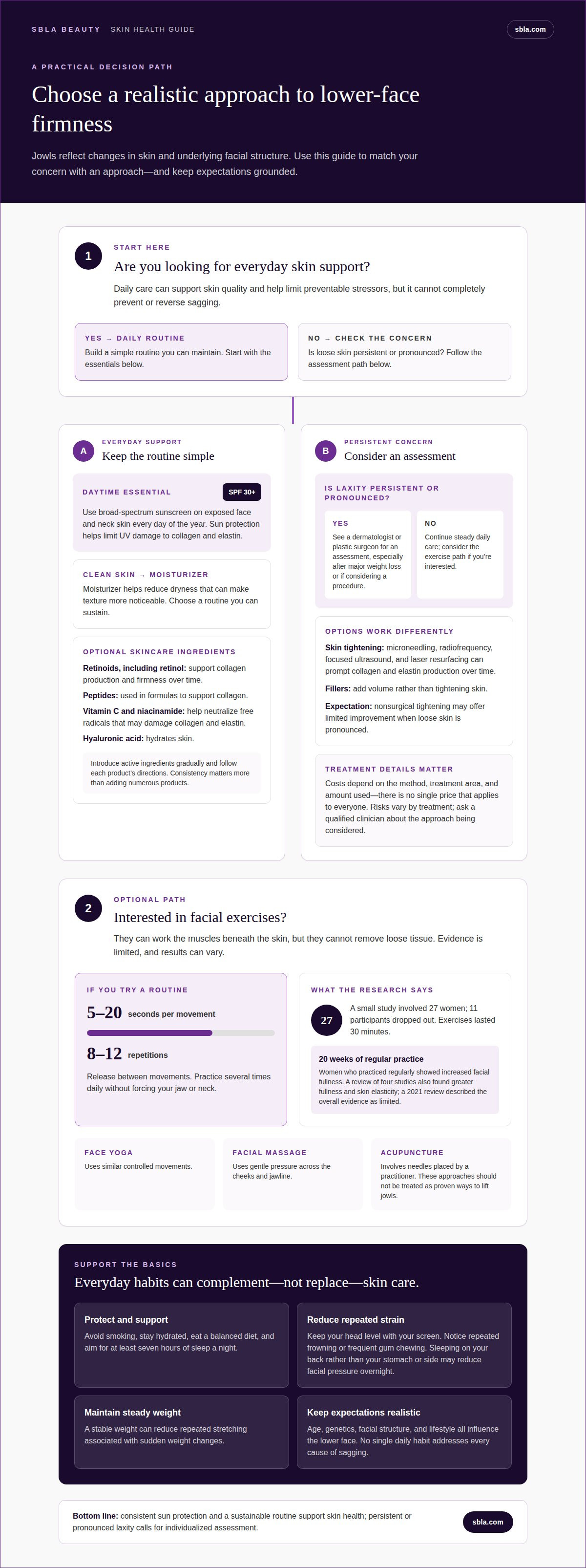
Facial exercises can work the muscles beneath the skin, but they cannot remove loose tissue. A small study involving 27 women had 11 participants drop out; exercises lasted 30 minutes. Women who practiced regularly for 20 weeks showed increased facial fullness. A review of four studies also found greater fullness and skin elasticity, while a 2021 review described the overall evidence as limited.
For a simple routine, hold each movement for 5 to 20 seconds, release, then repeat it 8 to 12 times. Practice several times daily without forcing your jaw or neck. Face yoga applies similar controlled movements. Facial massage uses gentle pressure across the cheeks and jawline, while acupuncture involves practitioner-placed needles. These approaches differ, and they shouldn’t be treated as proven ways to lift jowls.
Posture and repeated expressions can matter, too. Keep your head level with your screen instead of bending your neck down for long periods. Notice habits such as frowning or frequent gum chewing that repeatedly engage facial muscles. Sleeping on your back rather than your stomach or side may reduce facial pressure overnight.
Facial liposuction and fat transfer are procedural approaches to changing lower-face contours, not substitutes for exercise. A plastic surgeon can explain how each relates to your facial structure and goals. The U.S. Food and Drug Administration has approved dermal fillers for individuals 22 years old and older. Non-surgical treatment costs in the United States depend on the method, treatment area, and amount used, so there is no single price that applies to everyone.
Risks vary by treatment. HIFU may cause redness or mild swelling that typically subsides within a few hours to a day, while neck lifts carry risks such as scarring and infection. See a dermatologist or plastic surgeon for an assessment of persistent laxity or if you are considering a procedure, especially after major weight loss.
2. Moisturizers and antioxidant skin care
A consistent topical routine can support skin quality, though creams can’t completely prevent or reverse sagging. Retinoids, including retinol, support collagen production and skin firmness over time. Peptides are used in skincare formulas to support collagen, while vitamin C and niacinamide help neutralize free radicals that may damage collagen and elastin. Hyaluronic acid hydrates skin, and moisturizer helps reduce dryness that can make texture more noticeable. Choosing a routine you can maintain is an important part of how to prevent jowls from forming.
Keep the routine simple: apply moisturizer to clean skin, then use sunscreen during the day. Choose broad-spectrum sunscreen with at least SPF 30, and protect exposed skin on the face and neck every day of the year. Sun protection helps limit UV damage to collagen and elastin. Consistency matters more than adding numerous products; introduce active ingredients gradually and follow each product’s directions. For anyone considering how to prevent jowls from forming, daily protection is a practical starting point.
In-office procedures offer another option for people considering skin tightening. Microneedling, radiofrequency, focused ultrasound, and laser resurfacing can prompt collagen and elastin production over time. Radiofrequency uses energy to heat tissue, while microneedling creates controlled micro-injuries that encourage a repair response. These approaches address firmness differently from fillers, which add volume. Nonsurgical tightening may offer limited improvement when loose skin is pronounced, so the degree of laxity should guide expectations.
Daily habits also influence skin health. Maintaining a stable weight can reduce repeated stretching associated with sudden weight changes. Avoid smoking, stay hydrated, eat a balanced diet, and aim for at least seven hours of sleep a night. These habits support overall skin condition, but they don’t replace sun protection or address every cause of sagging. Steady care and realistic expectations can help you maintain a sustainable routine.
3. Causes of jowls
Jowls develop as skin and soft tissue lose support along the lower face. Collagen and elastin provide structure and flexibility; their gradual decline can make skin less resilient. Collagen loss begins at around age 18, then accelerates by people’s 30s. Changes beneath the skin matter, too: jawbone shrinkage and shifting deep fat pads can soften the boundary between the cheeks and jawline.
Genetics influence when these changes become visible. One person may notice jowls at age 35, while another barely sees them at age 60. Family traits, facial structure, and the distribution of fat affect how the lower face ages. Menopause can accelerate collagen loss as estrogen declines, adding another influence to the natural aging process.
Environmental exposure and daily lifestyle can also affect skin aging. Unprotected sun exposure contributes to up to 80% of signs of aging, and ultraviolet light can damage collagen and elastin. Smoking reduces blood flow to the skin, while vaping, repeated weight fluctuations, and prolonged downward head posture may also contribute. A sudden weight loss can leave loose skin, particularly when the skin has stretched substantially.
These factors interact rather than acting alone. Consistent sunscreen use and avoiding smoking help limit preventable stressors, while vitamin C can help neutralize free radicals that damage collagen. Supporting collagen formation doesn’t change inherited facial structure or reverse jawbone changes. A facelift is a surgical option for repositioning skin and tightening tissue, not a cause of jowls. The right approach depends on whether laxity, volume shifts, or underlying structure is most prominent.
4. Age-related collagen and elastin loss
Collagen gives skin structural support, while elastin helps it return to shape. As production slows, skin can become thinner and less resilient, allowing lower-face tissue to sag. Collagen and elastin formation can begin to slow in the mid-20s, and gradual changes can lay the groundwork for laxity decades before it becomes visible. Genetics influence how these changes appear across different faces.
People commonly notice lower-face laxity in their late 30s or 40s, with jowls often becoming more prominent through their 50s and 60s. Menopause can accelerate collagen loss as estrogen declines. These patterns aren’t identical for everyone, because inherited traits and environmental exposure also affect skin structure. Daily sun protection and avoiding smoking help limit factors that can contribute to collagen breakdown.
Skincare can support the skin’s surface and help address collagen changes. Topical retinol and prescription-strength tretinoin are clinically proven to stimulate collagen and elastin production and slow their breakdown. Vitamin C and niacinamide help neutralize free radicals that can damage these proteins. Introduce active products gradually, moisturize regularly, and use sunscreen as part of the same routine.
Collagen supplements are taken orally, unlike topical retinol or prescription tretinoin, which are applied to the skin. Treat these as distinct approaches, not interchangeable ones. A balanced diet, adequate sleep, and regular exercise support general health; avoiding smoking also helps preserve existing collagen. These habits don’t restore lost tissue, but they can support a considered approach to skin aging.
For a focused addition to your routine, explore targeted skincare tools designed for the face and neck.
SBLA BEAUTY
SBLA BEAUTY offers science-backed skincare devices for those looking to complement consistent skin care with targeted facial care. Its range includes the Neck, Chin & Jawline Sculpting Wand, Neck, Chin & Jawline Sculpting Wand XL, Liquid Facelift Wand, and Eye Lift Wand, with options for different areas of the face and neck.
Consider these tools as part of a broader routine, alongside sun protection and skin care habits that support skin health. They offer a way to focus on the lower face and jawline, but they don’t replace professional assessment if you’re considering a medical procedure or have concerns about your skin.
Explore SBLA BEAUTY’s targeted skincare devices to find an option that fits your skincare goals.
Make Your Next Step a Deliberate One
Learning how to prevent jowls from forming starts with choices that fit your skin, routine, and priorities. Focus on consistency rather than chasing rapid change. Choose care you can sustain, and adjust it as your skin’s needs evolve. If you’re considering a targeted skincare tool, think about the area you want to address and how it can complement your existing routine.
SBLA BEAUTY offers the Eye Lift Wand, Neck, Chin & Jawline Sculpting Wand, and Neck, Chin & Jawline Sculpting Wand XL. These options let you consider care for different facial areas without treating every concern the same way. Choose an approach that aligns with your goals, while keeping expectations grounded in what skincare can do.
Contact SBLA BEAUTY to explore the tools and identify a thoughtful next step for your routine. Small, consistent choices can help you feel more intentional and confident in your skin.
Frequently Asked Questions
What Are Jowls?
Jowls are loose skin and soft tissue along the lower cheeks and jaw, creating folds or blurring the jawline’s outline. Their appearance can range from subtle fullness near the mouth to more pronounced sagging toward the neck. They’re generally harmless, and treatment is a personal choice based on appearance, comfort, and desired changes.
Can cosmetic procedures help to firm jowls?
Yes. Options include dermal fillers to restore volume along the jawline, neurotoxin injections that relax downward-pulling muscles, and surgery to reposition skin and underlying tissue. Fillers typically last 6-18 months, while neurotoxin results commonly last 3-4 months. A facelift changes tissue position more directly, making it a different approach from injectable treatments.
How do Non-invasive Treatments Compare to Surgery for Jowl Prevention?
Non-invasive approaches such as focused ultrasound and radiofrequency encourage collagen production, but offer limited improvement when loose skin is pronounced. A facelift repositions skin, tightens muscles, and removes excess tissue along the jawline and neck. Results from jowl correction surgery can last 5-15 years, depending on technique and individual aging. The approaches differ in recovery, invasiveness, and the degree of correction.
What makes collagen and elastin so important?
Collagen provides supportive structure within the skin, while elastin helps tissue stretch and return toward its original shape. Together, they contribute to firmness and resilience. As their production slows and existing fibers break down, the lower face can lose support. This helps explain why topical skincare and procedures that target collagen address skin quality rather than changing bone structure.
What causes jowls to form as people age?
Jowls form through combined changes in skin, fat, and facial structure. Reduced collagen and elastin can weaken skin support, while shifting deep fat pads and jawbone changes alter the lower face’s contour. Genetics shape the timing and pattern of these changes. Sun exposure, smoking, and major weight fluctuations can also contribute to visible skin aging and laxity.
Can sunscreen help prevent jowls and skin sagging?
Daily broad-spectrum sunscreen with at least SPF 30 helps protect against ultraviolet damage associated with skin aging. Apply it to exposed areas, including the face and neck, as part of your morning routine, and use protective clothing when spending time outdoors. Sunscreen supports collagen and elastin preservation, but it cannot prevent every age-related or inherited change in the jawline.
