
Advanced Anti-Aging Beauty Tools for Skin Care Shoppers
At-home beauty tools can be worth considering when you choose a device for a specific skin-care goal and use it consistently. Advanced anti-aging beauty tools work in different ways, so the right fit depends on the concern you want to address and how the device fits your routine. Start by testing a small area to see how your skin responds.
It’s reasonable to want more than polished claims before investing in a device. At-home versions of professional facial tools have evolved into skin-care staples over the last 20 years, but choosing among them still calls for a clear look at their methods, intended uses and practical trade-offs.
This guide explains how common wrinkle-device options differ, what to consider when comparing prices and customer ratings, and how to decide whether a tool suits your needs. Use the framework to weigh features, routine fit, and your skin’s response before choosing.
Key Takeaways
- Match a device’s method and treatment area to the skin concern you want to address before comparing options.
- Use price and customer ratings as comparison points, alongside how a tool fits your routine and the details behind its claims.
- Start cautiously with a new device and pay attention to your skin’s response; the article also highlights a safety finding involving infrared therapy devices.
- Separate evidence for a device’s technology from proof of results for a particular at-home product.
- Explore focused options such as the Eye Lift Wand when you’re considering a tool for the eye area.
Facial devices for wrinkles and anti-aging
At-home facial devices use different technologies, so compare their intended treatment areas, methods, and practical requirements. Start with your skin’s sensitivity and the concern you want to target.
Device Suitability and Skin Sensitivity
Skin sensitivity can affect which device feels suitable and how cautiously to introduce it. Before using a new tool across your face, test a small area and observe your skin’s response. Follow the instructions on treatment frequency, contact, and products used alongside the device. Stop if the area becomes uncomfortable or visibly irritated; don’t repeat the treatment.
Consider your routine, too. A device that requires several steps may be harder to use consistently, while a targeted tool may suit a narrower concern. If you’re considering changes to your skin-care routine, discuss them with a doctor or dermatologist, especially if you already have sensitive skin.
Treatment Areas for Facial Devices
Some facial tools are designed for the cheeks and forehead, while others focus on the neck, eyes, or lips. Check the intended treatment area before buying: don’t assume a tool for the broader face is suitable for delicate skin around the eyes. A small applicator or targeted design can be useful when your concern is localized.
Technology also shapes a device’s purpose. LED masks use light across the face, while other tools may target muscle-related sensations or a smaller area. Red light is one approach used in LED devices, but the technology alone doesn’t explain how a particular model should be used. Follow the product’s treatment-area guidance.
Evidence, FDA Clearance, and Risks
Which FDA-cleared anti-aging beauty devices are available in the US? Clearance is specific to the device, so identify the exact model and intended use rather than treating all facial or LED devices as one category. A general description such as “anti-aging” doesn’t establish a device’s clearance status.
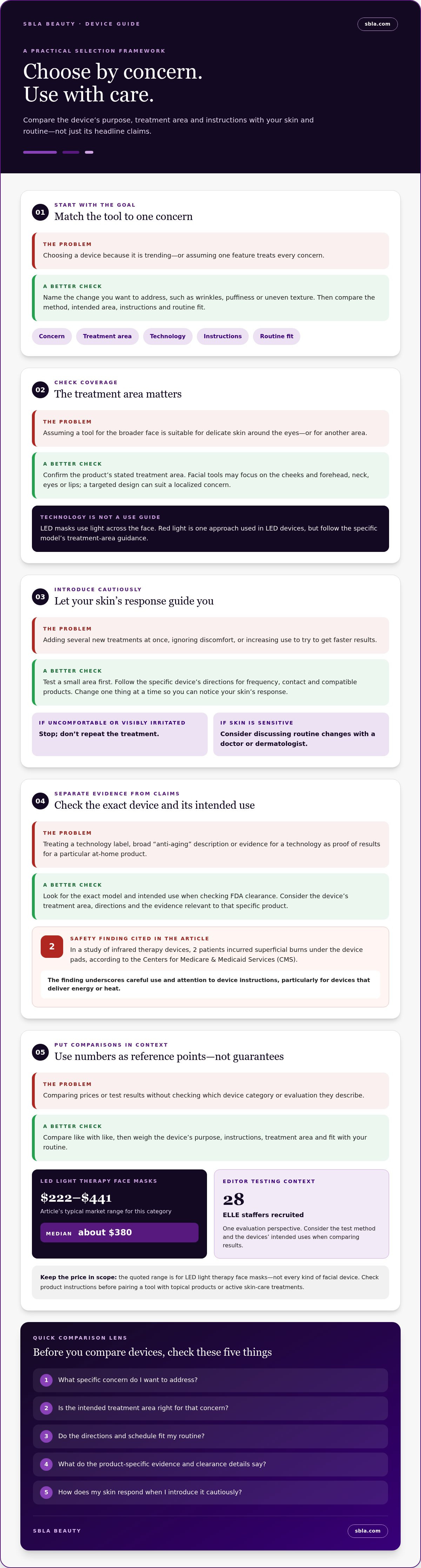
What are the risks and side effects of at-home anti-aging devices? Skin irritation and discomfort are practical reasons to stop and reassess use. In a study of infrared therapy devices, 2 patients incurred superficial burns under the device pads, according to Centers for Medicare & Medicaid Services (CMS). The finding makes careful use and attention to device instructions important, particularly for devices that deliver energy or heat.
Testing, Prices, and Skincare Pairings
Editor testing can offer a structured comparison, but the number of testers and the test method provide useful context. ELLE recruited 28 staffers to test skin-care tools. Treat that as one evaluation perspective, then compare the tested devices’ intended uses and treatment areas against your own needs.
For LED light therapy face masks, the typical market range is between 222 and 441 USD, with a median about 380. This is a market range for that category, not a price for every type of facial device. Do anti-aging beauty tools work better with specific skincare products? The device’s instructions determine whether to use it with a topical product; don’t assume a serum or treatment improves results. Check compatibility before combining a tool with active skin-care treatments.
How do I choose the best skin care tools for my needs?
Start with one concern, such as wrinkles, puffiness, or uneven texture, rather than choosing a tool because it’s trending. Then compare its treatment method, intended area, skin-care requirements, and use schedule.
Matching Tools to Skin Concerns
Write down the change you want to address before comparing devices. Someone focused on puffiness, for example, may prioritize a different treatment area and method from someone concerned about fine lines. This filter helps you look past broad marketing language and focus on what a device is designed to do.
Next, consider your skin type and sensitivity. Review the tool’s instructions, treatment area, and compatibility with products already in your routine. A red light therapy device or LED face mask may appeal if you’re exploring light therapy, while another tool may target a different concern. Don’t assume every device supports skin-renewal or collagen-related goals equally.
Use a shortlist to compare options: concern, treatment area, technology, instructions, and routine fit. If a tool addresses several goals, assess each stated function separately instead of assuming one feature treats every concern. This helps you identify which capability matters most.
Radio-Frequency Skin Tightening
Radio-frequency devices are one category to consider when exploring skin-tightening tools. Compare the intended use, treatment area, directions, and precautions. The label “radio frequency” alone doesn’t tell you whether a particular model suits your skin or routine.
Check how the tool should be applied and whether its schedule fits your existing skin-care routine. Avoid adding it while introducing several other new treatments. Changing one thing at a time makes it easier to notice how your skin responds and which step may be causing irritation.
Tool Combinations and Use Frequency
Multimodal tools combine approaches, such as light therapy with another device function. They may reduce the number of separate tools in your routine, but compare each function with your actual concern. A combination device isn’t automatically a better fit than a focused option.
How often should you use LED, microcurrent, or radiofrequency beauty tools? There’s no single schedule for every device; follow the instructions for the specific model. Treatment duration, energy settings, intended area, and recovery guidance all shape the routine. Don’t increase frequency to try to get faster results.
For a practical comparison, record the tool’s purpose, instructions, and your skin’s response after use. Change one device or product at a time, rather than combining several new treatments. If lip appearance is your focus, explore tools for targeted beauty concerns as one category-specific option.
Product prices and customer ratings
Compare a device’s price with its technology, treatment area, and included components. An LED face mask, a microcurrent tool, and a facial roller serve different purposes, so their prices aren’t directly comparable. The LED mask market range discussed earlier provides context for that category, but it doesn’t apply to other device types. First decide which function matters to your routine.
Then check what the purchase includes. A listing may specify the device, charging accessories, replacement parts, or skin-care products, all of which affect overall value. For example, compare two face masks by their intended wavelengths, coverage, controls, and care instructions. A longer feature list isn’t automatically more useful if the extra functions don’t match your goal.
Customer ratings can offer insight into how a tool fits everyday routines, but a headline score leaves key questions unanswered. Read reviews from people discussing the same device type and concern. A reviewer describing visible changes after using a roller may offer little insight into a microcurrent device. Prioritize specific comments about handling, comfort, instructions, and routine fit.
Look for repeated themes rather than relying on one dramatic review. If several face-mask users mention difficult controls, that pattern may matter to your decision. Repeated comments about an easy setup may point to simpler use. Note whether reviewers identify the exact model and explain how long or consistently they used it. Expectations vary, so treat claims of dramatic results cautiously.
Before browsing, make a short checklist: device type, treatment area, key features, included items, and review themes. Apply it to both an LED face mask and a massage tool. This keeps promotional features from distracting you from your main concern and helps separate practical advantages from claims that don’t address your needs.
Include ongoing upkeep in your assessment of value. Check whether the instructions cover cleaning, storage, charging, or replacement components, and consider the effort involved. A vibration tool may be easy to store, while a larger face mask needs suitable space. These practical details matter if you plan to use a device regularly rather than leave it in a drawer.
Finally, weigh customer feedback alongside product information. Reviews can describe comfort and usability, while specifications explain features such as wavelengths or vibration settings. Neither alone establishes that a tool will produce a particular result. Consider whether its stated function, price, and everyday demands match your priorities.
Anti-aging beauty-tool selection
A strong choice begins with a defined goal, not the newest technology. The skin-care tool market is valued at more than $76 billion and is expected to grow by 53 percent by 2030, but that scale doesn’t make every device relevant to your routine. Compare the device’s stated purpose, application area, instructions, and maintenance before deciding.
Use a practical filter. If fine lines are your priority, look for tools whose stated use addresses them. If you’re focused on puffiness, compare devices designed for the area you want to treat. A tool’s name or sleek design may catch your attention, but its intended use and routine demands matter more than whether it becomes a favorite.
- Goal: Write down the specific appearance concern you want to address.
- Technology: Compare the device’s stated method, such as led light, infrared, or microcurrent.
- Routine: Review the directions, treatment area, and care requirements.
- Material: Check details such as a silicone contact surface and cleaning instructions.
Technology labels are starting points, not complete explanations. A microcurrent device and an infrared tool use different methods, for example, so compare their instructions and intended uses rather than assuming they offer the same experience. For an LED light device, check the description of its light function and treatment area. Choose an approach that aligns with your goal.
Material and design affect how practical a device is for you. Depending on the care instructions, a silicone surface may be easier to wipe than a textured one. Consider how the tool sits against your skin, where it can be stored, and whether its shape comfortably reaches the intended area. A device that feels cumbersome to use as instructed may be harder to use consistently.
Separate “more functions” from “better fit.” A multimodal device may combine technologies, but each feature should serve a clear purpose in your routine. When comparing a single-function tool with a combination model, list the functions you’d actually use. This helps keep extra settings from dominating a decision about appearance or ease of use.
Review the instructions as part of your selection process. Note the recommended application method, frequency, and precautions, then compare them with your existing skin-care routine. Avoid changing several products and devices at once, which makes it harder to identify your skin’s response. Choose a tool whose purpose and directions you can follow as written.
What clinical evidence supports at-home anti-aging beauty tools?
Clinical evidence is most useful when it evaluates the exact device and intended use you’re considering. A study of one light-based tool doesn’t establish results for every LED mask, and findings about a professional treatment don’t automatically apply to an at-home model. Match the study’s device, treatment area, and measured outcome to the product in question.
Read the methods, not just the headline. Look for who participated, what researchers measured, how the device was used, and how long the evaluation lasted. A study of changes in skin appearance answers a different question from one measuring comfort or ease of use. These details help distinguish a measured outcome from a broad marketing claim.
Check whether the study compares device use with a suitable control or baseline. Researchers may assess participants before and after treatment or compare device use with another condition. Either way, the comparison matters: a visible change after use doesn’t by itself show that the device caused it.
Device-specific evidence matters for technology categories, too. Red light, infrared, and microcurrent describe different approaches, not interchangeable proof. In a red-light study, look for a match between the tested device and the at-home product’s specifications and instructions. A result from one configuration shouldn’t be generalized to every product using similar terminology.
Distinguish clinical studies from customer reviews and editor testing. Reviews can describe handling, comfort, and routine fit, but they don’t replace a controlled evaluation of outcomes. Similarly, a tester’s experience with an LED face mask may offer insight into usability without establishing what another model will do.
Use this evidence checklist when comparing product claims:
- Device match: Does the study evaluate the same kind of tool?
- Outcome: Does it measure the concern you care about?
- Method: Are use instructions and comparisons described?
- Relevance: Does the evidence apply to at-home use?
Finally, read the product instructions alongside any clinical claims. Confirm that the tested treatment area and method align with the product’s directions. Keep a simple record of your routine and observations to distinguish a change you notice from a claim you’ve only read.
Use evidence to set informed expectations, then choose a tool around your specific concern and routine. Explore targeted beauty tools as you compare options for focused areas.
SBLA BEAUTY: Eye Lift Wand
The Eye Lift Wand is an at-home option for shoppers considering a tool for the eye area. It may suit readers who prioritize a device designed for that specific area over one intended for broader facial use.
For areas beyond the eyes, SBLA BEAUTY offers the Neck, Chin & Jawline Sculpting Wand, the Neck, Chin & Jawline Sculpting Wand XL, and the Liquid Facelift Wand. Compare each by its named treatment area and choose based on your routine’s focus. Review the product information and directions to understand how each tool fits your skin-care approach.
Visit sbla.com to explore the available beauty tools.
Choose Your Next Step With Intention
Make your next move deliberate: identify the skin-care concern you want to focus on, then choose a device category that fits your routine. Advanced anti-aging beauty tools are most useful as part of a considered approach, not simply because a new technology has caught your attention. Keep your priorities clear and let the device’s intended focus guide your shortlist.
For a focused starting point, SBLA BEAUTY offers the Eye Lift Wand, the Neck, Chin & Jawline Sculpting Wand, and the Neck, Chin & Jawline Sculpting Wand XL. Compare their named treatment areas with your priority, then review the product details to decide what belongs in your routine.
A considered choice can make your next step feel simpler and more personal. Contact SBLA BEAUTY to explore the available options and move forward with confidence.
Frequently Asked Questions
Are at-home beauty tools worth it?
At-home tools may be worth considering if they suit your goals, habits, and expectations. Someone who prefers a guided routine, for example, may value straightforward instructions more than numerous settings. Consider whether you’ll use the tool as directed and maintain it properly. If it feels complicated or doesn’t address your priority, its features may add little value.
How do you choose the right beauty tool for you?
Name one concern and one treatment area before comparing products. “Puffiness around my eyes” is more useful than “I want younger-looking skin.” Then compare the device’s stated use, application directions, care needs, and fit with your routine. If two tools seem similar, review their instructions side by side and choose the one that best matches your intended use.
What is the difference between different beauty technologies?
Beauty technologies use different forms of energy or physical action. LED devices deliver light, microcurrent devices use electrical current, and radiofrequency devices use radiofrequency energy. A roller or massage tool works through physical contact. These categories aren’t interchangeable: compare the specific device’s technology, intended purpose, and instructions rather than assuming similar names mean similar functions.
What advanced anti-aging beauty tools are available for home use?
At-home options include LED masks, microcurrent devices, radiofrequency tools, facial rollers, and targeted skin-care wands. They range from masks worn over a broader area to handheld applicators for a focused routine. Compare products by their stated treatment area and directions. Someone prioritizing the eye area, for example, may prefer an eye-focused tool to a full-face mask.
Who should avoid microcurrent, LED, or radiofrequency beauty tools?
Avoid a specific device if its instructions exclude your circumstances or say not to use it. If you have sensitive skin, an existing skin concern, or questions about fitting a device into your routine, discuss the change with a doctor or dermatologist. Read the precautions before use, and don’t apply the device to irritated or broken skin unless its instructions specifically permit it.
How do you choose a safe and effective anti-aging beauty device?
Start by checking the exact model’s intended use, instructions, precautions, and relevant clearance information. Test a new skin-care device on a small area and observe your skin’s response before using it more broadly. Follow the application directions rather than increasing use or combining treatments on your own. For example, record the product, area treated, and any reaction to make informed decisions about your routine.

