
Anti-Aging at 60: Is It Too Late? What Skincare Can Do
Sixty is not a deadline for healthier-looking skin. If you’re wondering, “is it too late to start anti-aging at 60,” the answer is no. A useful routine supports your skin and its appearance without promising to turn back time.
It’s understandable to feel that lines, uneven tone, or dryness are already set, especially when skincare claims make dramatic results sound effortless. Skin changes with age, and some signs won’t disappear with topical products. Consistent care can support hydration, comfort, and a smoother-looking complexion, while daily sun protection helps limit further sun-related damage.
The key is to choose goals that fit your skin and introduce active ingredients thoughtfully. Mature skin may be drier or more sensitive, so a simple routine built around gentle cleansing, moisturizer, and sunscreen is a practical foundation. Targeted ingredients or cosmetic skincare tools may offer additional support, but results vary.
This article explains what skincare can realistically do at 60, which claims deserve caution, and how to build a manageable routine around your skin’s needs without chasing impossible promises.
Key Takeaways
- If you’re asking “is it too late to start anti-aging at 60,” focus on supporting skin health and appearance rather than trying to erase every age-related change.
- Age-related changes and accumulated sun exposure can shape skin, but everyone’s skin is different.
- Separate practical skincare guidance from common myths, including the idea that stronger products always work faster.
- Build a manageable routine with gentle cleansing, moisturizer, and sun protection, then introduce optional products one at a time to assess tolerance.
- Match targeted skincare to a specific concern. SBLA BEAUTY’s science-led wands are cosmetic options, not a promise of dramatic results.
Is It Too Late to Start Anti-Aging Skincare at 60? The Direct Answer
No, it’s not too late. If you’re asking, “is it too late to start anti-aging at 60,” a consistent skincare routine can still support your skin’s comfort, hydration, and visible appearance. The realistic goal isn’t to erase every line or recreate how your skin looked decades ago. It’s to care for the skin you have now, with choices that suit its needs and your priorities.
Skin reflects more than age alone. Your skin history, sun exposure, health, medications, sensitivity, and existing routine can all influence what feels comfortable and what you may notice over time. Two people who are both 60 can have different concerns and respond differently to the same product. Start from your own experience rather than assuming your skin must follow a particular pattern.
At 60, skincare can support hydration, comfort, and a healthier-looking appearance, but it can’t promise to undo every age-related change. That distinction helps set useful expectations: care can be worthwhile even when results are gradual, modest, or different from person to person.
What does ‘anti-aging’ mean when you start at 60?
“Anti-aging” is a broad category for products and routines focused on visible signs associated with age. The phrase isn’t a guarantee that skin will become younger or that natural changes can be reversed. A more practical interpretation is care directed at concerns such as dryness, rough-feeling texture, or the appearance of fine lines. For an overview of the biological processes and contributing factors, see Skin aging.
Cosmetic products may help improve the look or feel of skin, but outcomes vary with the person, the product, and its use. They don’t replace medical care. A new or changing skin concern, persistent irritation, or a reaction that worries you is a health matter, not simply an appearance goal.
Why is starting now still worthwhile?
Skincare can address your skin’s current needs, regardless of when you begin. Gentle cleansing and moisturizer, for example, can make a routine more comfortable for skin that feels dry or tight. Sun protection is also a useful daily habit. These steps don’t require a decades-long head start to have a place in your day; their value lies in consistent care now, not in reaching a particular age with a perfect record.
Progress doesn’t have to mean looking younger. You might prefer skin that feels less uncomfortable, looks more hydrated, or is easier to care for. Choose one meaningful aim, then observe how your skin responds rather than adding several new products at once. That gives you a clearer sense of what suits you and helps keep the routine manageable.
How Skin Changes Around 60, and What Skincare Can Address
Skin at 60 doesn’t follow a single script. Some people notice more dryness or sensitivity; others are chiefly concerned with uneven tone, rough texture, or lines. Genetics, health, past sun exposure, and everyday habits all contribute to how skin looks and feels. The National Institute on Aging explains common skin changes with aging, while recognizing that care needs differ between individuals.
It helps to distinguish intrinsic aging, the changes that develop over time, from cumulative environmental influences such as ultraviolet exposure. Both can affect visible appearance, but a topical routine has limits. It supports the skin’s surface and day-to-day care; it can’t reverse every underlying biological change.
Why mature skin may need a gentler routine
Dryness or sensitivity may make some routines feel less comfortable, though these concerns aren’t universal. More products or stronger formulas aren’t automatically more effective. If a new product causes persistent stinging, redness, or tightness, pause it and simplify your routine. Introduce changes one at a time so it’s easier to identify what your skin tolerates.
Which visible concerns can skincare support?
Moisturizing products can support hydration and comfort, which may soften the look of dryness-related fine lines. Some topical products may also improve the appearance of texture or uneven tone over time, depending on the formula and individual response. These are cosmetic aims, not a promise of restored youthful structure or the removal of deep folds.
Skincare can refine visible surface concerns and support comfort; it cannot promise to reverse the biology of aging. Keeping that boundary in view helps you assess claims without dismissing the value of consistent care.
- Dry or tight-feeling skin: Prioritize a moisturizer that feels comfortable, and notice whether tightness improves after use.
- Fine lines: Consider whether dryness makes them more noticeable, while keeping expectations focused on appearance rather than erasure.
- Uneven tone or texture: Evaluate cosmetic products gradually and pay attention to how your skin responds.
- New, changing, or persistent concerns: Treat these as health questions rather than assuming an over-the-counter product is the answer.
If targeted cosmetic support fits your goals, SBLA BEAUTY offers science-led, non-invasive skincare wands for areas including the face, eyes, and neck. The Eye Lift Wand, Liquid Facelift Wand, and Neck, Chin & Jawline Sculpting Wand are designed for different areas, so match the product to the concern it is intended to address. Explore targeted skincare wand options as an addition to, not a replacement for, foundational skin care. Product features and stated results don’t ensure identical outcomes for every person.
Anti-Aging at 60: Separate Useful Advice from Common Myths
Skincare advice often sounds absolute: start early, choose the strongest formula, expect visible transformation. A more useful approach is to test each claim against your concern, the product’s intended cosmetic purpose, and your skin’s response. The question “is it too late to start anti-aging at 60” doesn’t have to be answered with a promise of dramatic change. It can lead to a grounded decision about what you want your routine to do.
Myth: Starting at 60 cannot make a difference.
Reality: A considered routine may support skin comfort and improve the appearance of concerns such as dryness or dull-looking texture. The kind and degree of change depend on the concern, the product, and the individual. A cosmetic routine isn’t a way to reverse aging.
Myth: Stronger products work faster.
Reality: Higher strength or more frequent use isn’t automatically better for your skin. If a formula irritates you, it may be difficult to use consistently. Follow product directions and introduce new active products thoughtfully.
Myth: Wrinkles must disappear for skincare to be effective.
Reality: A product may support hydration or the appearance of skin without removing lines. Keeping a natural feature doesn’t mean your routine has failed.
Myth: A product claim predicts your personal result.
Reality: An ingredient list or stated performance claim describes the product, not a guaranteed outcome for every user. Skin history, sensitivity, and how a product is used can all shape the experience.
Myth: Starting at 60 cannot make a difference
This belief can make skincare feel pointless unless it delivers a dramatic transformation. That’s an unnecessarily narrow measure of value. A routine may be worthwhile if it helps skin feel more comfortable, supports hydration, or makes a particular visible concern less noticeable. The outcome should match the goal: a moisturizer is not expected to erase deep folds, and a cosmetic product cannot promise identical results for everyone.
Myth: A more aggressive routine delivers better results
Adding several active products at once can make it hard to tell which one is helping, irritating, or doing nothing noticeable. A measured approach gives you a clearer read: introduce one new product, use it as directed, and pay attention to your skin before making another change. Don’t increase strength or frequency simply because you want quicker results.
If you notice mild discomfort, pause the new product and consider simplifying your routine. Persistent, painful, or concerning reactions deserve attention from a healthcare professional rather than another skincare experiment. Useful skincare is measured by how well it serves your skin, not by how forcefully it promises to change it.
Build a Simple, Age-Aware Skincare Routine Without Overdoing It
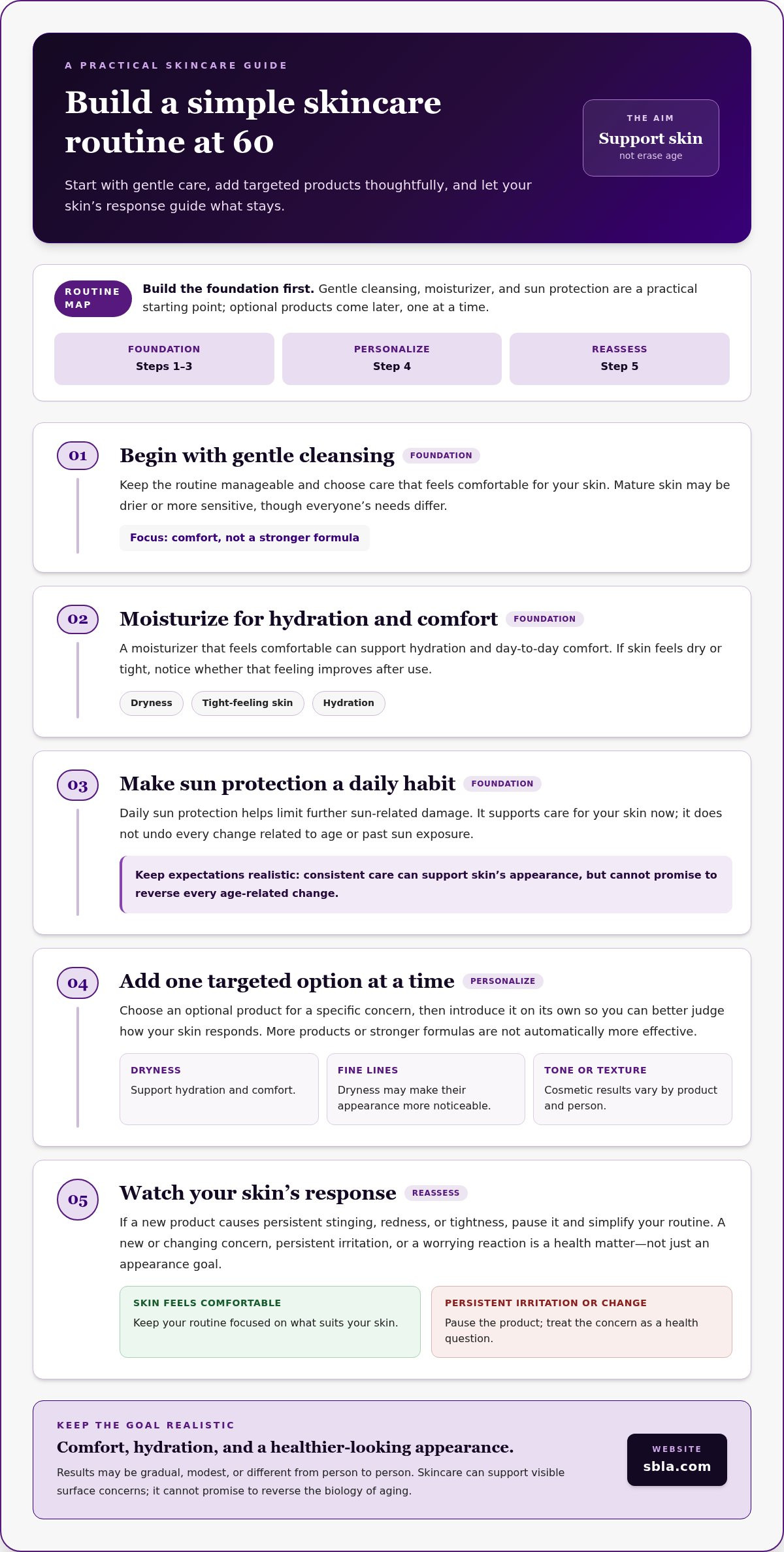
If you’re wondering, “is it too late to start anti-aging at 60,” a manageable routine is a practical place to begin. You don’t need a crowded shelf or a complicated sequence. Start with the essentials, notice how your skin feels, and add another product only when you have a clear reason to do so. Consistency and comfort matter more than the number of steps.
Start with the routine foundations
Use this simple sequence as a flexible starting point. Adjust it for dryness, sensitivity, climate, and any advice from your clinician.
- Cleanse gently. Choose a cleanser that removes everyday residue without leaving your skin feeling uncomfortably tight. If your skin feels dry, avoid cleansing more often or more vigorously than needed.
- Moisturize. Apply a moisturizer that feels comfortable and helps address tightness or dryness. Your preferred texture may change with the season or with how your skin feels on a particular day.
- Protect from the sun. In the daytime, use a broad-spectrum sunscreen according to its label. Sun protection is a foundational habit, not a substitute for the rest of your skin care, and it doesn’t require an elaborate routine.
These are adaptable basics, not rigid rules. If a cleanser leaves your skin feeling stripped, consider a gentler option; if your moisturizer feels too heavy in warm weather, adjust the texture. The best routine is one you can use comfortably and consistently. If a clinician has given you specific instructions, let those guide your choices.
Add targeted products thoughtfully
Optional products vary in purpose and tolerance. Some are intended to address the appearance of particular concerns, while others may not suit sensitive or easily irritated skin. Don’t assume that a product is right for you simply because it’s marketed for mature skin, or that a stronger formula will produce a better result.
Introduce one new product at a time and follow its labeled directions. This makes it easier to notice whether your skin tolerates it and to identify a possible cause if irritation develops. Avoid increasing how often you use it or combining multiple new active products before you understand your response. Patience makes the routine easier to assess.
If irritation persists, is painful, or concerns you, stop experimenting and seek advice from a healthcare professional. New or changing lesions and specific skin concerns also deserve medical attention rather than being treated as routine cosmetic issues.
Once your foundational steps feel comfortable, consider targeted cosmetic support for a particular area or appearance goal. SBLA BEAUTY offers science-led, non-invasive skincare wands for the face, eyes, and neck. The wands use an airless design to preserve serum potency and feature antimicrobial roller balls. Explore SBLA skincare wands as an optional addition to a simple routine, keeping in mind that individual results vary.
Choose Targeted Skincare for Your Goals, Without Expecting a Miracle
A product should earn a place in your routine by matching a concern you actually want to address, not simply because its packaging says “for mature skin.” If your priority is the look of the eye area, an eye-focused product may be more relevant than a formula intended for another part of the face. Before choosing a targeted cosmetic product, understand what it contains, how it is meant to be used, and what its claims can reasonably tell you.
How to evaluate targeted skincare claims
Look for a clearly described cosmetic concern, a complete ingredient list, directions for use, and wording that sets realistic boundaries. A brand’s description of its formula is useful for understanding what the product contains, but it isn’t the same as independently established evidence of a particular result. Nor does an ingredient list establish that a product has been tested specifically for people aged 60 and older.
Where SBLA wands may fit into a routine
SBLA BEAUTY describes its approach as science-led and non-invasive. The Eye Lift Wand contains the patent-pending SBLA66Peptide™, Niacinamide, Vitamin C (Ascorbyl Glucoside), Caffeine, Hyaluronic Acid, and Acetyl Glucosamine. These ingredients describe the formula; they don’t guarantee a particular cosmetic outcome or establish age-60-specific results. The product is intended for the eye area. Apply once in the morning, avoid getting the treatment into the eye, and avoid using other eye creams or serums with it for ten minutes. “Avoid getting the treatment into the eye; if this occurs flush the eye with lukewarm water.” “Do not sleep with product on eyelids.” For more detail, see the SBLA Eye Lift Wand clinical deep dive.
The Liquid Facelift Wand contains the SBLA Line Relaxing & Lifting Complex, Bio-Skin Renewal Peptide Blend, Cellular Filling Peptide Blend, and a 22-peptide & amino-acid system. These describe its formulation, not proof that it can reverse age-related changes. Pump one to two times and glide upward across the face, excluding the eye area. Use it once daily in the morning on clean, dry skin. “Avoid using this product on the eye area; we recommend using the SBLA® Eye Lift Wand to lift the delicate skin around the eyes.” “For best results, avoid using other skincare/makeup products for at least 15 minutes after application.” “Store at room temperature and avoid direct sunlight.” “If product gets into the eye(s), rinse well with cool water.” “Only use on clean, dry skin.” “A hot bath or shower will open up the pores of the skin so wait thirty minutes before applying product.” For product-specific context, the at-home Liquid Facelift clinical guide offers further detail.
The Neck, Chin & Jawline Sculpting Wand uses Macro-Sphere technology, an SBLA Hyaluronic Acid Complex, a Proprietary Double Peptide Blend, a Skin Repair & Brightening Blend, and Encapsulated Caffeine. Apply to clean, dry skin morning and night. “Individuals are likely to experience anything from a mild tingling sensation to a warm feeling… This is normal and will subside quickly. If the sensation becomes uncomfortable, remove with lukewarm water.” Follow the product directions and choose a wand for the area and goal you want to address.
These are optional cosmetic skincare products, not replacements for foundational care or medical treatment. Choose according to your concern, review the full directions before use, and stop if a product causes a reaction that worries you. If you’d like to explore targeted options, take a look at SBLA’s skincare wands and decide whether one aligns with your routine and expectations.
Make Your Next Skincare Step Personal
If you’ve been asking, “is it too late to start anti-aging at 60,” let your next step be guided by what you want your skin care to feel like in everyday life, not by someone else’s routine or an idealized image. Choose one priority that matters to you, such as comfort, ease, or a particular cosmetic concern. Then give yourself room to notice whether your routine fits, without treating every line or change as something that needs correcting.
A useful routine should feel sustainable. If a product doesn’t suit your skin or your expectations, adjusting your approach is a considered choice, not a failure. Your goals can also change over time; skincare doesn’t need to become a project with a finish line.
For an optional, targeted addition to your routine, explore science-led skincare from SBLA BEAUTY. Review the product details and choose what feels relevant to your own priorities.
Starting now can be an act of care, not a race against age. Let your routine support confidence on your terms.
Frequently Asked Questions
Can skincare reduce wrinkles that are already visible at 60?
Skincare may soften the appearance of some fine lines, particularly when dryness makes them more noticeable, but it can’t guarantee that visible wrinkles will disappear. If your question is “is it too late to start anti-aging at 60,” it isn’t too late to care for your skin and its appearance. Set a specific goal, such as improving how dry skin looks, and assess progress without expecting a topical product to remove deeper folds.
Is sunscreen still important if I am starting anti-aging skincare at 60?
Yes, sunscreen remains a useful part of daytime skin care, even if you’re beginning a routine later in life. Choose a broad-spectrum product and apply it according to the label, including any instructions about reapplication. If you spend time outdoors, follow the product’s directions rather than relying on a morning application to last all day. Sunscreen supports protection from ultraviolet exposure; it doesn’t erase changes that have already occurred.
Should I use retinol if I am 60 and new to skincare?
Not necessarily. Retinol is one possible active ingredient, but age alone doesn’t determine whether it suits you. If you’re considering it, read the product directions and consider your sensitivity, existing skin conditions, and other products or medicines you use. A healthcare professional can advise you if you’re unsure about suitability. Don’t begin several active ingredients together, since that can make it harder to identify what caused irritation.
How long should I try a new skincare product before judging it?
There isn’t one timeline that applies to every product or concern. Follow the label’s directions and judge the product against the goal it claims to support; a moisturizer’s immediate feel, for example, differs from a gradual change in the appearance of tone or texture. Keep your routine otherwise steady while you assess it. Stop use if you develop a reaction that is painful, persistent, or concerning rather than waiting for a trial period to end.
Can I start an anti-aging routine if my skin is sensitive?
Yes, but keep the first steps especially simple. Try one new product at a time, follow its directions, and avoid layering it with other new actives while you assess tolerance. If your skin is currently irritated, wait before experimenting with cosmetic products. Persistent sensitivity, recurring rashes, or discomfort may have causes that need medical assessment, so don’t assume every reaction is simply part of adjusting to a routine.
When should I ask a doctor about a skin change rather than use skincare?
Seek medical advice about a new or changing spot, a lesion that concerns you, or a skin problem that persists, worsens, bleeds, or causes pain. Cosmetic skincare is intended to support appearance and routine care, not diagnose or treat medical conditions. It’s also sensible to ask a healthcare professional about ongoing irritation or a reaction that doesn’t settle after you stop the suspected product. Don’t try to mask an unexplained change with more skincare.

