
How to Avoid Damaging Your Skin with Beauty Tools
A beauty tool can look gentle and still irritate skin if it is used with too much pressure, too often, or in the wrong area. Conflicting advice about technique, frequency, and hygiene can make it difficult to know how to avoid damaging your skin with beauty tools. If redness, tingling, or sensitivity appears, it may also be unclear whether to continue or pause.
Start by identifying what the tool does, then follow the directions for that specific product. A cleansing brush, suction device, needle-based tool, and skincare wand do not work in the same way. This guide explains how to assess a tool, use it as directed, and recognize when your skin needs a break.
You’ll also find a practical routine for preparing your skin, caring for reusable tools, and checking your skin afterward. The key is to avoid treating discomfort as proof that a tool is working, or assuming that instructions for one device apply to another. For topical applicators such as SBLA BEAUTY wands, follow the directions for the individual formula and the area it is intended for.
Key Takeaways
- Learn how to avoid damaging your skin with beauty tools by matching the tool’s use and intensity to your skin, rather than relying on one-size-fits-all advice.
- Persistent or worsening redness, discomfort, or sensitivity is a reason to stop and give your skin a break.
- Use a simple safety checklist: read the directions, prepare your skin and tool, use the specified technique, and reassess afterward.
- Introduce one unfamiliar tool or technique at a time so you can better identify what may be causing a reaction.
- Topical wands and powered or exfoliating devices need different approaches. For example, the Liquid Facelift Wand is for clean, dry skin and should not be used on the eye area.
How Beauty Tools Can Irritate or Damage Skin, and What to Watch For
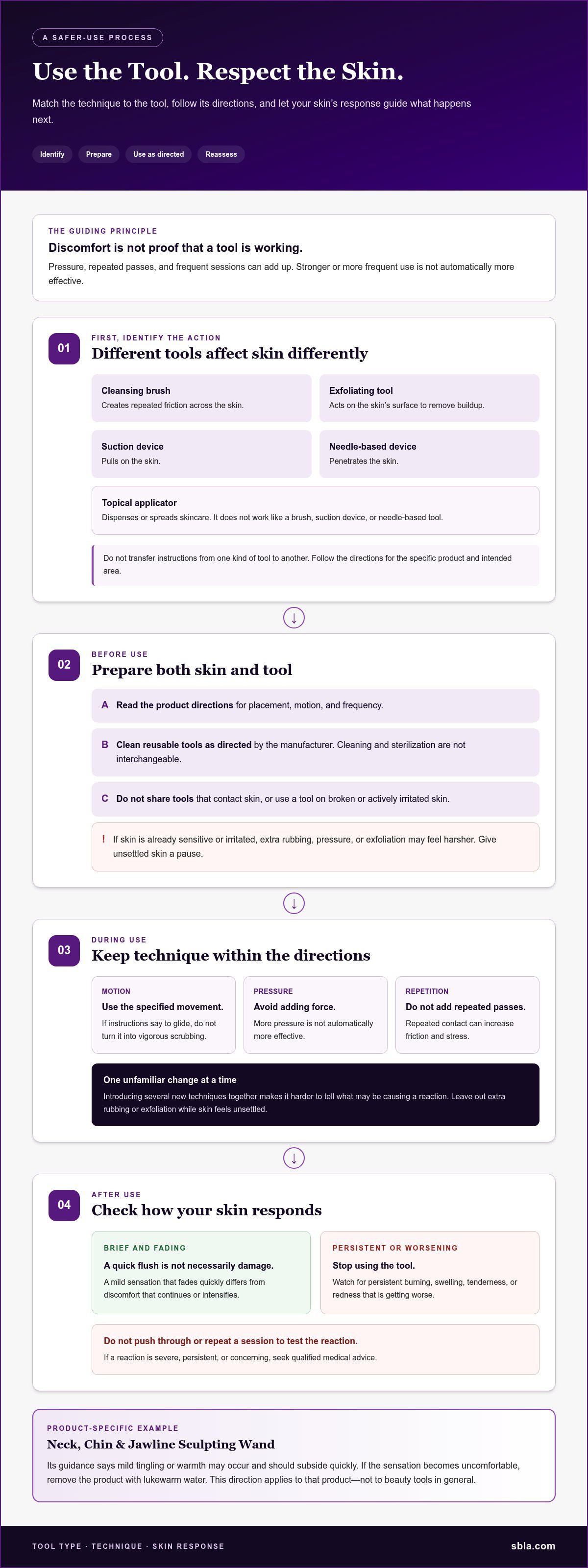
Beauty tools can stress skin in different ways. A cleansing brush creates repeated friction, an exfoliating tool acts on the skin’s surface, a suction device pulls on the skin, and a needle-based device penetrates it. Poor cleaning practices can also create problems. Using an exfoliating tool too often or with too much pressure may leave skin feeling dry, tender, or unusually reactive. A brief flush does not necessarily mean damage, but symptoms that persist or worsen deserve attention.
Over-exfoliation happens when exfoliating actions are too frequent or intense for your skin to tolerate, leaving it irritated rather than comfortable. Not every beauty tool exfoliates, and a topical applicator is different from a brush or suction device. A tool’s popularity or promise of a “deep clean” does not mean it suits every skin type, routine, or level of experience.
What skin warning signs mean it is time to stop
A mild sensation that fades quickly is different from discomfort that continues or intensifies. For example, the SBLA BEAUTY Neck, Chin & Jawline Sculpting Wand guidance says that mild tingling or warmth may occur and should subside quickly. If the sensation becomes uncomfortable, remove the product with lukewarm water. This guidance is specific to that product, not a general rule for other tools.
Stop using a tool if you experience persistent burning, swelling, tenderness, or redness that is getting worse. Don’t push through discomfort or repeat a session to see whether the reaction improves. If a reaction is severe, persistent, or concerning, seek qualified medical advice.
Why tool type and skin condition both matter
The tool’s action matters. A cleansing brush moves across the skin, an exfoliating tool is intended to remove surface buildup, a suction device pulls on the skin, and needles penetrate it. A topical applicator, by contrast, dispenses or spreads a skincare product. These tools work differently, so directions for one should not be applied to another.
Your skin’s condition also matters. If it is already sensitive or irritated, additional rubbing, pressure, or exfoliation may feel harsher. Don’t apply tools to broken skin. When considering how to avoid damaging your skin with beauty tools, account for both the tool’s function and how your skin feels that day. No single tool or technique is suitable for everyone, and a “deep clean” is not worth continuing through pain or a worsening reaction.
Why Beauty Tools Can Stress the Skin Barrier
The skin barrier is the outer protective layer that helps shield skin from everyday exposure and limit moisture loss. It can become stressed when a tool adds more rubbing, pressure, or exfoliation than the skin can comfortably tolerate. These factors can add up: repeated passes increase contact, force adds pressure, and frequent sessions leave less time between exposures.
Repeated friction and overuse can raise the risk of irritation, even when each individual session seems mild. Briefly using a brush with a light touch is different from scrubbing the same area repeatedly or combining it with another exfoliating step. Stronger pressure is not automatically more effective. A forceful social-media demonstration may also disregard the tool’s instructions and your skin’s current condition.
Pressure, repetition, and over-exfoliation
Follow the tool’s directions for placement, motion, and frequency instead of increasing intensity to pursue a “deeper” result. If the instructions say to glide, don’t turn that movement into vigorous scrubbing. Repeated exfoliation or passes over one area may leave skin raw, tight, or uncomfortable. Treat those sensations as a reason to stop, not as evidence that the technique is working.
Clean tools, intact skin, and sensible timing
Reusable tools need care, but cleaning and sterilization are not interchangeable. Cleaning removes residue from use; sterilization is a separate process intended to eliminate microorganisms. Follow the manufacturer’s cleaning directions, since unsuitable cleaners or methods may damage a tool. Don’t share tools that contact skin, and avoid using a tool on broken or actively irritated skin. A clean tool is not a reason to work over skin that needs a pause.
Keep your routine easy to assess. If you start several unfamiliar or potentially irritating techniques at once, it is harder to tell which one may be causing a reaction. Introduce one change at a time, and leave out additional rubbing or exfoliation while your skin feels unsettled. To understand how to avoid damaging your skin with beauty tools, consider the combined effect of the technique, its frequency, and your skin’s response, not just the tool by itself.
- Before use: Check the tool’s instructions and clean it as directed.
- During use: Use the specified motion and pressure. Don’t add repeated passes.
- After use: Notice how your skin feels and pause the technique if discomfort develops.
Topical applicators have different directions from powered or exfoliating tools. SBLA BEAUTY’s topical skincare wands apply skincare; they do not brush, suction, or puncture the skin. Follow each product’s placement and timing guidance instead of treating every beauty tool alike.
Beauty Tool Risks Compared: Brushes, Suction, Needles, and Topical Wands
Beauty tools are not interchangeable. A brush creates friction, a suction device pulls on the skin, and a needle-based device penetrates it. A topical wand applies skincare through a roller-ball applicator. Understanding the mechanism helps you identify the kind of contact your skin will experience and which instructions to follow.
Use the table as a general comparison, not as a substitute for the instructions supplied with a specific product. Product-specific directions take precedence over general technique suggestions.
| Tool type | Main skin stressor | Cautious-use principle |
|---|---|---|
| Cleansing brushes | Repeated contact and friction | Follow the maker’s instructions for use and cleaning; avoid extra pressure or passes. |
| Exfoliating tools | Repeated removal of surface buildup | Use only as directed and avoid combining with other exfoliating steps if skin feels uncomfortable. |
| Suction devices | Pulling force on the skin | Don’t treat stronger suction or repeated use as a route to better results. |
| Needle-based devices | Penetration of the skin | Recognize that these carry different considerations from surface-contact tools; don’t improvise invasive procedures at home. |
| Peel-off products | Adhesion and forceful removal | Follow product directions and stop if removal causes significant discomfort. |
| Topical applicator wands | Application of a skincare formula, with roller-ball contact | Follow the formula’s placement, timing, and use directions; don’t use it like a powered brush. |
Which tools deserve extra caution at home?
Microneedling devices, blackhead vacuums, and aggressive peel-off products deserve particular care because their actions differ from simply spreading skincare. Needles penetrate, suction pulls, and forceful removal can tug at the skin. These mechanisms raise different considerations from topical application. That does not mean injury is inevitable, but a social-media demonstration is not a substitute for product directions or qualified guidance. For any procedure that pierces the skin, strict hygiene and expert technique are essential, as seen with professional ear piercing providers like stellarsg.com.
How topical applicator wands differ from powered tools
SBLA BEAUTY wands are topical skincare applicators with roller balls, not powered cleansing brushes, suction devices, or needle mechanisms. All wands use an airless design to preserve serum potency, and their applicators feature antimicrobial roller balls. These features do not guarantee that irritation cannot occur, and the wands are not substitutes for other tool types. The Eye Lift Wand clinical deep dive and at-home Liquid Facelift clinical guide offer product-specific context for understanding these applicators.
For the Liquid Facelift Wand, directions specify clean, dry skin and exclude the eye area. “Topical” does not mean “use anywhere” or “use like any other tool.” To understand how to avoid damaging your skin with beauty tools, first identify the tool’s action, then follow its placement and use instructions.
How to Use Beauty Tools More Safely: A Practical Checklist
A consistent routine makes it easier to use a beauty tool carefully and notice when your skin is not responding well. Directions differ by tool, so don’t assume that a method, cleaning product, or schedule that suits one device will suit another. Use this checklist as a starting point, then follow the manufacturer’s instructions for the details.
- Read the directions first. Confirm the intended placement, motion, frequency, cleaning method, and any guidance about products used alongside the tool. Don’t substitute a social-media video for the product instructions.
- Inspect your skin. Skip tool use on broken, actively irritated, or uncomfortable skin. If your skin feels unusually sensitive that day, pause rather than working through it.
- Prepare clean hands and a clean tool. Follow the manufacturer’s preparation and cleaning directions. Don’t assume a rinse or familiar household cleaner is suitable for every tool.
- Use the tool gently and as directed. Keep to the specified placement and movement. Don’t press harder, repeat passes, or force a tool across your face to chase a stronger sensation.
- Reassess before adding anything else. Notice how your skin feels after use. Introduce one unfamiliar tool or technique at a time so it is easier to identify what may have contributed to a reaction.
Before and during use: prepare, then keep it gentle
Start with clean hands and follow the tool’s preparation steps. If it is a topical applicator, use it according to its product directions. If it is powered or exfoliating, don’t borrow movement or pressure instructions from a skincare wand. Never force a tool over an area that resists or feels sore. Stop if discomfort becomes intense, continues, or worsens instead of easing.
Frequency is not one-size-fits-all. Follow the maker’s stated schedule instead of adopting a universal routine or increasing use because your skin seemed comfortable during the first session. If the directions specify a placement or compatible-product limitation, treat it as part of the method, not an optional detail.
After use: monitor skin and simplify the routine
Give your skin time to respond before adding another tool or potentially irritating skincare step. Follow any product-specific waiting period; don’t apply timing rules from one product to another. For example, Liquid Facelift Wand directions call for clean, dry skin and advise avoiding other skincare or makeup products for at least 15 minutes after application. They also specify waiting thirty minutes after a hot bath or shower before applying.
If you notice a reaction, pause the tool and keep your routine simple while you assess your skin. Seek qualified medical advice for a reaction that is severe, persistent, or worsening. Knowing how to avoid damaging your skin with beauty tools means respecting both the product instructions and your skin’s changing response.
For a topical option with product-specific directions, explore SBLA skincare wands and follow the guidance for the individual applicator.
Using SBLA Beauty Wands with Care: Follow Product-Specific Directions
SBLA BEAUTY wands are topical skincare applicators, not substitutes for powered cleansing brushes, suction tools, or microneedling devices. Each wand has its own purpose and directions. Follow the product’s instructions for placement, timing, and use rather than borrowing techniques from another tool. These are practical ways to avoid damaging your skin with beauty tools: understand what the tool does, then respect the limits set for that product.
For the Liquid Facelift Wand, use it once daily in the morning on clean, dry skin. Pump one to two times and glide upward across the face, excluding the eye area. Avoid using other skincare or makeup products for at least 15 minutes after application. After a hot bath or shower, wait thirty minutes before applying. Store at room temperature and avoid direct sunlight.
Respect placement, timing, and eye-area warnings
The Liquid Facelift Wand guidance is explicit: “Avoid using this product on the eye area; we recommend using the SBLA® Eye Lift Wand to lift the delicate skin around the eyes.” If product gets into the eye(s), rinse well with cool water. Do not apply on broken skin, and do not sleep with product on eyelids. These instructions are specific to this product, not general advice for every skincare applicator. Only use on clean, dry skin.
The Eye Lift Wand has its own precautions. “Avoid getting the treatment into the eye; if this occurs flush the eye with lukewarm water.” Its directions also state: “Avoid using other eye creams or serums with this product for ten minutes.” Use once daily in the morning. Do not sleep with product on eyelids. Keep to the placement and spacing instructions rather than layering products or moving the formula closer to the eye than directed.
Know what to do if a product causes discomfort
The instructions for the Neck, Chin & Jawline Sculpting Wand say: “Individuals are likely to experience anything from a mild tingling sensation to a warm feeling… This is normal and will subside quickly. If the sensation becomes uncomfortable, remove with lukewarm water.” Follow that guidance for this wand only. If a reaction feels severe, persists, or worsens, stop use and seek qualified medical advice.
Product-specific precautions are part of using an applicator thoughtfully. A formula intended for one area or schedule should not be assumed suitable for every person or routine. Read the directions each time you use a product, especially if you also use other skincare. To review the applicators and their intended use, explore SBLA BEAUTY skincare wands.
Choose Your Next Step with Care
Let your skin’s response guide your routine, not pressure to keep up with a trend or add another step. Choose a tool for its intended purpose, read its directions before use, and give yourself room to decide whether it feels right for you. That steady approach is central to how to avoid damaging your skin with beauty tools: informed choices matter more than intensity.
For topical applicators, the design and product-specific instructions clarify how and where to use the formula. SBLA BEAUTY wands use an airless design to preserve serum potency and have directions tailored to the face, eye area, neck, jawline, and lips. Use those distinctions as a guide rather than assuming one application method suits every area or product.
Explore SBLA BEAUTY skincare wands and review the usage guidance for the product that fits your routine. Choose a considered approach and follow the directions for each applicator.
Frequently Asked Questions
Can beauty tools damage your skin?
Yes. Some beauty tools can irritate or damage skin if used too forcefully, too often, or against their instructions. The mechanism matters: a powered brush creates friction, suction pulls on skin, microneedling devices penetrate it, and topical applicators spread skincare. To understand how to avoid damaging your skin with beauty tools, identify how the tool works before using it. Stop if discomfort worsens, and seek qualified advice for severe or persistent reactions.
How do I know if a beauty tool is irritating my skin?
Persistent or worsening burning, swelling, tenderness, or redness can mean your skin is not tolerating the tool or technique. A brief sensation alone does not necessarily mean lasting damage, but don’t push through symptoms to finish a session. Stop using the tool and simplify your routine while you assess your skin. If the reaction is severe, persistent, or concerning, seek qualified medical advice rather than trying another technique.
Is it safe to use a facial cleansing brush every day?
Not necessarily. Daily use of a powered cleansing brush may add more friction and exfoliation than some skin can tolerate. Follow the frequency specified by that brush’s manufacturer, not a schedule copied from a different device or social-media routine. If your skin starts feeling uncomfortable or increasingly sensitive, or looks redder after use, stop and reassess before using the brush again. More frequent cleansing does not automatically produce a better result.
Can I use beauty tools on sensitive or irritated skin?
Use extra caution, and avoid tools on broken skin. There is no single rule that makes every device appropriate for sensitive skin, because brushes, suction tools, needle-based devices, and topical applicators work differently. Check the directions for the particular tool and consider how your skin feels before use. If irritation is ongoing or you are unsure how to proceed with a skin concern, seek qualified advice instead of testing multiple tools.
How should I clean my beauty tools?
Follow the manufacturer’s cleaning instructions, since a brush head, suction device, and roller-ball applicator may need different care. Clean reusable tools as directed, then dry or store them according to the instructions. Wiping a tool should not be assumed to sterilize it, and sharing may expose another person to residue from use. Stop using a tool that is damaged or has parts you cannot clean as directed.
What should I do if a skincare wand gets into my eye?
Follow the instructions for that specific product. If Liquid Facelift Wand gets into the eye(s), its directions say, “If product gets into the eye(s), rinse well with cool water.” If Eye Lift Wand treatment gets into the eye, “Avoid getting the treatment into the eye; if this occurs flush the eye with lukewarm water.” Don’t apply Liquid Facelift Wand to the eye area. If discomfort or other symptoms continue after following the product guidance, seek qualified medical advice.
Can I use a beauty tool after a hot shower?
It depends on the product. For Liquid Facelift Wand, the directions say, “A hot bath or shower will open up the pores of the skin so wait thirty minutes before applying product.” That timing is specific to this wand, not a universal rule for beauty tools. Check the instructions for your particular product, and wait to use it if your skin feels irritated or uncomfortable after bathing.

