
Does Facial Massage Actually Work for Sagging? The Science, Limits, and Alternatives
Facial massage can make skin look refreshed, but it doesn’t lift sagging skin. If you’re asking, “does facial massage actually work for sagging,” the answer depends on what you mean by “work”: massage may temporarily reduce puffiness and make contours look more defined, but it can’t reverse persistent skin laxity.
That distinction matters when online claims promise a lasting lift from a few minutes of daily massage. Gentle movement may support circulation and help shift fluid, but visible effects are generally modest and short-lived. A consistent routine can feel worthwhile, yet it doesn’t change the underlying structure of loose skin.
This guide explains what massage may realistically change, how long those effects may last, and why technique has limits. You’ll also compare massage with skincare, including options such as SBLA’s Liquid Facelift Wand, and with other non-invasive approaches. The goal is to help you set realistic expectations and choose a next step without expecting an instant or permanent lift.
Key Takeaways
- Learn what “sagging” means and how to distinguish skin laxity from temporary puffiness.
- Understand what the evidence can and can’t support about massage’s effects on circulation, fluid movement, and skin structure.
- Compare manual massage, topical skincare, and professional options by the concerns they’re designed to address.
- Find out how to try a gentle massage routine, avoid forceful pressure, and know when to stop.
- Get a clear answer to “does facial massage actually work for sagging” and choose an approach that matches your priorities.
Does Facial Massage Work for Sagging? Separate a Refreshed Look from a Lift
Does facial massage actually work for sagging? It may create a temporarily refreshed or more defined appearance, but there’s no reliable basis for treating manual massage as a lasting lift. The key is to distinguish a short-term change in appearance from a structural change in skin laxity.
Sagging generally refers to skin and underlying support tissues becoming looser or shifting over time. That gradual change differs from puffiness, which is often temporary fullness related to fluid. A face may look less puffy after gentle massage, but reducing fullness doesn’t reposition tissue or restore lost support. The biological process of aging involves changes across the body, and visible skin laxity can have more than one contributing factor.
What people may mean when they say facial massage lifted their face
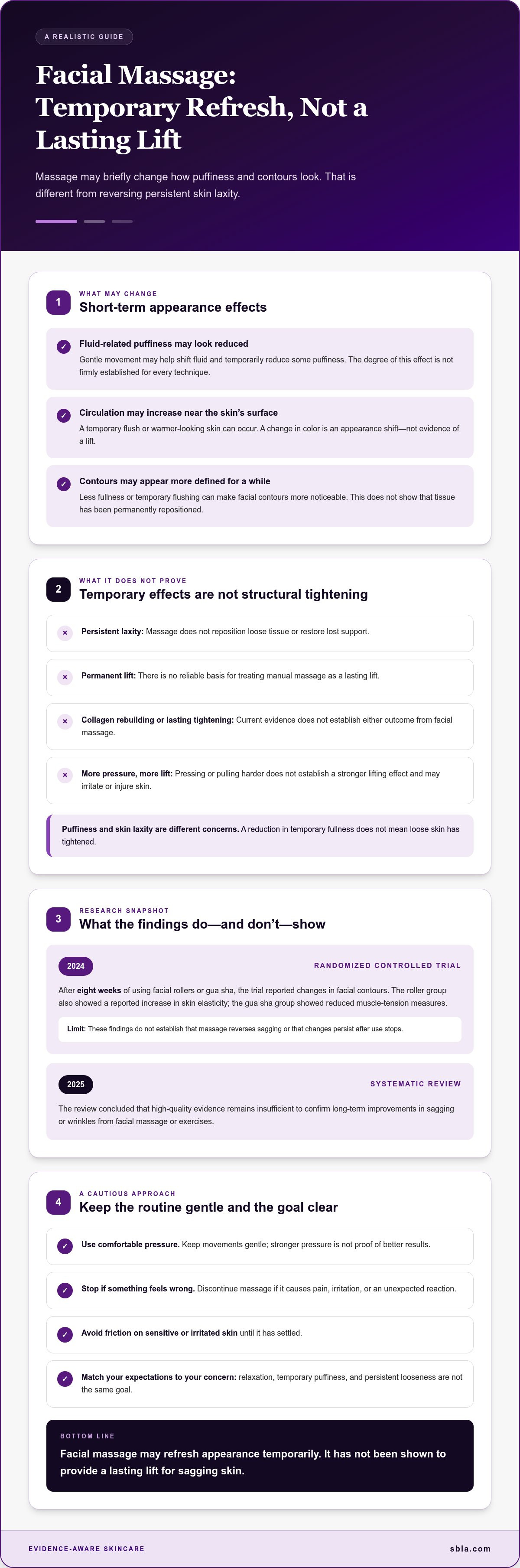
“Lifted” may describe a visible impression rather than a lasting anatomical change. Massage may briefly stimulate circulation, and gentle movement may help shift fluid-related puffiness. A less puffy face or temporary flush can make contours appear more noticeable. These are plausible short-term effects, not proof that tissue has been permanently repositioned or skin tightened.
Before-and-after photos can exaggerate small differences. Lighting, camera distance, hydration, facial expression, and time of day all affect how contours and shadows appear. For a fair comparison, use the same lighting and camera position, keep your face relaxed, and take photos at a similar time of day. An image taken immediately after massage shows a momentary appearance, not necessarily a durable result.
What facial massage cannot promise for sagging skin
Manual pressure shouldn’t be presented as a substitute for medical evaluation or procedures. There’s insufficient high-quality evidence to claim that massage rebuilds collagen, permanently tightens skin, or reverses persistent laxity. Pressing or pulling more firmly doesn’t establish a stronger lifting effect, and aggressive technique may irritate or injure skin.
What you notice also depends on the concern. Temporary puffiness, facial muscle tension, and loose skin are different issues, so the same routine won’t necessarily affect them in the same way. Technique, skin sensitivity, and other individual factors can shape the experience. If a change is sudden, one-sided, or accompanied by other symptoms, don’t assume massage is the answer. Seek medical guidance.
In brief: Massage may temporarily affect circulation, fluid-related fullness, or the appearance of facial contours. Persistent skin laxity is different, and current evidence doesn’t show that manual massage provides a lasting lift.
How Facial Massage Affects Skin: Pressure, Movement, and Realistic Limits
Massage acts on the skin and soft tissues while you apply pressure. That doesn’t mean it changes the structures responsible for persistent laxity. Evidence points to possible short-term responses, such as increased local blood flow, while claims of lasting tightening require stronger proof. Pressure, duration, and frequency may affect comfort, but no massage schedule has been established as a way to produce a durable lift.
Temporary circulation and fluid-related effects
Gentle massage can temporarily increase circulation near the skin’s surface, which may make the face look warmer or more flushed. Light movement may also help reduce some fluid-related puffiness, although the degree and mechanism of this effect aren’t firmly established for every technique. A change in color or fullness is a short-term appearance shift, not evidence that skin has lifted.
Research findings need careful interpretation. A 2024 randomized controlled trial reported changes in facial contours after eight weeks of using facial rollers or gua sha. The roller group also showed a reported increase in skin elasticity, while the gua sha group showed reduced muscle-tension measures. These findings don’t establish that massage reverses sagging or that changes persist after use stops. A 2025 systematic review concluded that high-quality evidence remains insufficient to confirm long-term improvements in sagging or wrinkles from facial massage or exercises.
Why massage does not equal structural skin tightening
Skin laxity involves changes in the skin and its support, while fluid-related fullness can fluctuate over shorter periods. These concerns shouldn’t be treated as interchangeable. Evidence of temporary circulation, contour, or muscle-tension changes doesn’t by itself show that collagen has been rebuilt or loose tissue tightened. Well-designed research would be needed to substantiate those claims over time.
Evidence summary: Current research supports the possibility of short-term changes in circulation, puffiness, or appearance, but it doesn’t establish that facial massage produces lasting collagen gains or structural tightening.
For a cautious trial, keep pressure comfortable and movements gentle. Stronger pressure isn’t proof of better results, and extended or frequent sessions haven’t been established as an ideal routine. Stop if massage causes pain, irritation, or an unexpected reaction. If your skin is sensitive or already irritated, avoid adding friction until it has settled.
Assess your response based on your goal: relaxation, temporary reduction in puffiness, or a change in persistent looseness. If you’re exploring skincare alongside massage, the Liquid Facelift Wand is a skincare option, not a manual massage treatment or a promise of structural lifting.
Facial Massage vs. Skincare and Other Non-Invasive Options for Sagging
These approaches serve different purposes. Massage is a hands-on technique; topical skincare is applied to the skin; professional interventions use clinical methods that may target tissue or volume. They aren’t like-for-like replacements. Start by identifying the concern you want to address. If your main question is “does facial massage actually work for sagging,” consider whether you want a temporary appearance change or support from a skincare routine.
| Approach | Primary purpose | Realistic scope | Commitment |
|---|---|---|---|
| Manual facial massage | Relaxation and temporary appearance effects | May temporarily affect puffiness or facial contours; not established as a lasting lift | Self-directed technique, with effects that may be brief |
| Topical skincare | Support a regular skin-care routine | Depends on the formulation and its evidence; not a substitute for structural lifting | Ongoing product use as directed |
| Professional interventions | Address concerns such as laxity or volume with clinical methods | Varies by procedure, individual suitability, and expected outcome | Requires assessment, treatment planning, and consideration of risks |
Massage compared with topical skincare
Massage involves movement and pressure. A topical formula works through its ingredients and how it’s used on the skin. SBLA BEAUTY offers peptide and retinol formulas alongside beauty devices, including the Liquid Facelift Wand. These are skincare options, not evidence of permanent tissue repositioning. For more context, SBLA BEAUTY’s at-home liquid facelift clinical guide discusses a needle-free skincare approach. Manual massage and structural lifting are separate things.
Choose according to your priority. Massage may suit someone seeking a relaxing ritual or a temporary refreshed appearance. A topical routine may be more relevant if you’re focused on ongoing cosmetic skincare. Neither should be assumed to produce the same result as a clinical procedure, and ingredient-specific expectations depend on the evidence for the actual product.
When professional assessment may be worth considering
If a change is pronounced, sudden, or concerning, discuss it with a qualified clinician rather than relying on massage or cosmetic products to explain it. For persistent concerns, a clinician can assess individual suitability and explain potential outcomes and risks of options such as energy-based treatments or injectables. These interventions differ in method and commitment, so their appropriateness depends on the concern and personal circumstances.
Think in terms of purpose, not a universal ranking. A skincare routine may support cosmetic goals; massage may offer a temporary ritual; clinical procedures involve a separate level of assessment and decision-making. Clear expectations help you choose without treating a short-lived contour change as proof of lasting skin tightening.
How to Try Facial Massage Without Overstating the Results
A careful trial should answer a modest question: does gentle massage feel comfortable, and do you notice a temporary change in appearance? It can’t establish that skin laxity has improved over the long term. There’s no proven universal schedule or pressure level for lifting sagging skin, so be wary of routines that promise guaranteed results after a set number of minutes or days.
A gentle, realistic way to assess massage
Start with clean hands and a relaxed setting. You don’t need a special tool or product to evaluate manual massage. Use light, comfortable movements, letting your fingers glide without pulling the skin. Avoid forceful pressure, repeated tugging, or areas that feel tender. The technique should feel soothing, not painful or intense.
Keep conditions consistent so your observations are more useful. Take a baseline photo using the camera position, lighting, and relaxed expression you’ll use for later comparisons. Note the time of day and whether you’re assessing comfort, puffiness, or another visible change. An immediate mirror check can be misleading: a brief flush or change in fullness isn’t the same as a lasting change in skin laxity.
- Keep the goal specific. Decide whether you’re trying massage for relaxation or to observe a temporary appearance change.
- Use comfortable pressure. Light contact is enough for a cautious trial; more force doesn’t prove a stronger effect.
- Track, don’t assume. Compare similar photos and record how your skin feels rather than relying on memory alone.
When to stop or seek medical advice
Stop if massage causes pain, irritation, bruising, or any unexpected skin reaction. Don’t try to work through discomfort or increase pressure to force a visible effect. If a reaction persists, or a change in your skin or face is sudden or worrying, seek medical advice. Massage is a cosmetic practice, not a way to diagnose or treat a medical concern.
Evaluate comfort during the routine separately from appearance afterward. You may enjoy the ritual even if you see no visible difference. If you notice a short-term change, record when it appears and whether it lasts. Don’t interpret it alone as structural tightening. For persistent concerns about laxity, a clinician can discuss possible contributing factors and appropriate next steps.
Keep expectations measured. The question “does facial massage actually work for sagging” has no one-size-fits-all answer, because the visible concern and individual response matter. A gentle trial may help you decide whether massage belongs in your routine, but it can’t confirm a lasting lift. If you’re also considering a separate topical skincare approach, explore SBLA skincare options with cosmetic support in mind, not as a substitute for structural treatment.
A More Informed Next Step: Match the Approach to Your Skin Concern
Facial massage can be a pleasant ritual and may temporarily refresh how your face looks. It shouldn’t be presented as a lasting lift or a way to reverse skin sagging. Identify the result you want, then choose an approach that fits that goal rather than expecting one technique to address every concern.
Choose an approach based on the result you are seeking
If your priority is relaxation, gentle massage can be a self-care practice—whether practiced at home or booked through wellness providers such as calmmanila.com. Treat any visible change as temporary, not proof of structural lifting. If you’re focused on a skincare routine, topical products are a separate option. Their purpose and potential benefits depend on the specific formula and the evidence behind it. Neither should be assumed to reposition tissue or provide the same effects as a clinical procedure.
SBLA BEAUTY offers peptide and retinol formulas alongside non-invasive skincare devices. These products can be considered as part of cosmetic skincare, but names and terms such as “sculpting” or “lift” aren’t evidence that a formula permanently tightens skin. If you’re comparing device categories, the microcurrent and peptide wand comparison can help clarify the distinction between approaches without treating them as interchangeable.
- For relaxation: Choose gentle massage for comfort, without expecting a lasting lift.
- For a temporary appearance change: Observe any visible difference under consistent conditions and keep expectations measured.
- For cosmetic skincare support: Focus on a routine and products that suit your preferences, without assuming they alter facial structure.
- For a persistent or concerning change: A qualified clinician can discuss individual options, suitability, risks, and expected outcomes.
Consider a targeted skincare tool without expecting a permanent lift
The SBLA BEAUTY Liquid Facelift Wand is part of SBLA BEAUTY’s non-invasive skincare range. It is a skincare tool, not a manual massage treatment, and its name shouldn’t be taken as a promise to reverse sagging or permanently lift tissue. A cosmetic skincare option can fit into a personal routine without replacing assessment or clinical intervention.
For more context on this at-home skincare category, explore SBLA BEAUTY’s at-home Liquid Facelift guide. Use it to understand the approach and set expectations, not as evidence that massage or a skincare tool can create a permanent lift.
The practical answer to “does facial massage actually work for sagging” depends on what you mean by “work.” Massage may support relaxation or a temporarily refreshed appearance, but it shouldn’t be mistaken for lasting structural change. Choose based on your priority, and let realistic expectations guide your next step.
Choose Your Next Step with Clear Expectations
The most useful routine is one that matches your goal. If massage feels relaxing, keep it gentle and enjoy it for what it is. If you’re looking for ongoing cosmetic skincare support, focus on a routine you can use consistently without expecting a permanent lift. The answer to does facial massage actually work for sagging is clearer when “work” means a temporary refreshed appearance, not a lasting structural change.
SBLA BEAUTY offers targeted devices and topical formulas for the face, neck, and eye areas, including the Liquid Facelift Wand and Neck, Chin & Jawline Sculpting Wand. These options are skincare, not proof that massage reverses sagging. Choose based on the concern you want to address and the kind of routine that feels right for you.
Explore SBLA BEAUTY’s skincare wands to find a thoughtful next step for your skincare routine. Set realistic expectations and choose an approach that fits your goals.
Frequently Asked Questions
Is facial massage effective for sagging skin?
Facial massage may briefly make the face look more refreshed, but it hasn’t been shown to create a lasting lift or reverse skin laxity. For “does facial massage actually work for sagging,” the distinction is between a short-term change in appearance and a durable structural result. What you notice can vary with your starting concern and technique. Treat claims of long-term change cautiously unless they’re supported by strong, directly relevant evidence.
Can facial massage tighten loose skin permanently?
No, you shouldn’t expect massage to permanently tighten loose skin. Repeating strokes or pressing harder doesn’t establish that skin has undergone lasting structural change, and a temporary flush or smoother appearance isn’t proof of collagen building. Claims about collagen production need appropriate research measuring relevant outcomes over time. If laxity is a significant concern, a qualified clinician can discuss your situation and explain the potential benefits, risks, and limits of relevant options. Massage may still be part of a relaxing routine, but set a separate expectation for it.
How often should you massage your face for sagging?
There’s no proven frequency or session length that reverses sagging, so don’t treat online schedules as guaranteed protocols. If you choose to try massage, keep it gentle and comfortable rather than increasing time or pressure to chase a result. Stop if your skin hurts or becomes irritated. To assess any temporary visual change, compare photos taken under similar conditions and note how long it lasts instead of assuming repeated sessions will create cumulative lifting.
Does facial massage increase collagen?
Facial massage hasn’t been established as a reliable way to increase collagen in a way that produces lasting skin tightening. A proposed biological mechanism isn’t the same as a demonstrated clinical result; a flushed face or temporarily smoother look can’t confirm collagen change. Claims of collagen production need appropriate research measuring relevant outcomes over time. Massage shouldn’t be treated as a substitute for treatments a qualified clinician may discuss for an individual concern.
Can facial massage make sagging worse?
Gentle massage isn’t automatically harmful, but painful pressure or forceful pulling isn’t a sensible way to pursue a lift. Stop if you notice pain, irritation, bruising, or another unexpected reaction, and don’t respond by increasing pressure or frequency. If a skin change persists or worries you, personalized medical advice is more appropriate than trying a stronger technique. Individual skin sensitivity and how massage is performed can affect comfort.
Is a facial massage tool better than using your hands?
Not automatically. A tool doesn’t guarantee a stronger effect or a lasting lift. Hands may offer more direct control, while a tool may simply suit your preferred routine. Choose based on comfort and ease, and avoid any method that tugs or hurts. Keep manual massage distinct from skincare devices: SBLA’s Liquid Facelift Wand is a skincare wand, not evidence that massage reverses sagging. Follow product information for any skincare tool you use.
When should I see a dermatologist about sagging skin?
Consider speaking with a dermatologist or another qualified clinician if a change is sudden, persistent, concerning, or accompanied by other symptoms. A clinician can assess your concern and explain which options may be appropriate, including their risks and expected outcomes. Don’t use massage or a cosmetic product to evaluate an unexplained change or delay medical advice. You don’t need to decide on a treatment before asking for an assessment.

