
Non-Surgical Neck Tightening at Home: RF Pros, Cons, and Alternatives
A tighter-looking neck isn’t defined by a device’s promise, but by the technology behind it. For non-surgical neck tightening at home, radiofrequency (RF) is one option. At-home devices use lower energy than professional treatments, so results are typically more gradual and may take consistent use over several weeks or months.
Comparing RF tools with microcurrent devices and skincare wands can feel confusing. Each approach works differently, and a neck-focused wand shouldn’t be mistaken for an RF device just because it’s designed for the same area.
This guide explains what at-home RF is designed to do, its potential benefits and limitations, and how it compares with microcurrent and topical approaches. You’ll also learn how the SBLA Neck, Chin & Jawline Sculpting Wand fits into a neck-care routine as a distinct skincare-tool option, so you can choose an approach that aligns with your goals and expectations.
Key Takeaways
- Non-surgical neck tightening at home includes different approaches. Results depend on the concern being addressed, not the category label alone.
- RF’s proposed collagen response doesn’t prove that every at-home device delivers visible results.
- Compare RF, topical skincare, and non-RF wands by how each works and how well it fits your routine.
- Use a simple checklist to assess your goals, device-specific evidence, and instructions before choosing an approach.
- The SBLA Neck, Chin & Jawline Sculpting Wand is a distinct at-home skincare tool, not an RF device.
What Non-Surgical Neck Tightening at Home Can, and Cannot, Address
“Non-surgical neck tightening at home” describes a range of skincare routines and consumer devices, not one standardized treatment or guaranteed outcome. It can refer to topical products, non-RF skincare tools, or at-home radiofrequency (RF) devices. Their mechanisms, supporting evidence, and intended use differ, so a claim made for one approach shouldn’t automatically be applied to another.
At-home RF uses a consumer device to deliver radiofrequency energy according to its specific design and instructions. An in-office RF procedure is performed in a professional setting using a particular clinical device and treatment protocol. The setting, device specifications, and evidence are not interchangeable. Results from a professional procedure don’t establish what a home device can achieve.
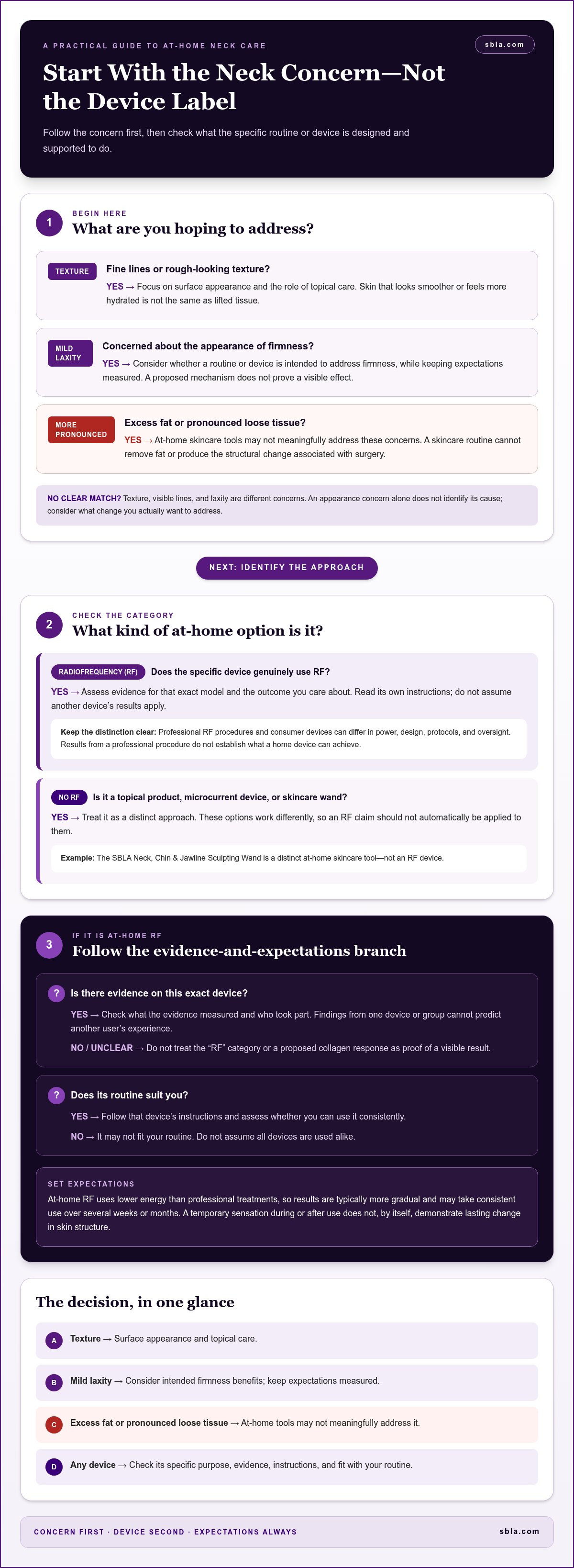
Start by identifying the concern you want to address. Fine lines, rough-looking texture, and mild laxity are different from fullness caused by excess fat or more pronounced loose tissue. A skincare routine may support the appearance and feel of the skin, but that doesn’t mean it can remove fat or produce the structural change associated with surgery.
- Skin texture: Focus on surface appearance and the role of topical care.
- Mild laxity: Consider whether a device or routine is intended to address the appearance of firmness, while keeping expectations measured.
- Excess fat or pronounced loose tissue: These concerns may not be meaningfully addressed by at-home skincare tools.
Why neck skin can look less firm over time
Collagen provides structural support in skin, while elastin helps it stretch and return toward its prior shape. Changes in these components over time may contribute to a less firm appearance, but they aren’t the only influences. Aging, genetics, and weight changes can all play a role, and an appearance concern alone doesn’t identify its cause.
Neck changes can also include texture and visible lines, not just laxity. The early signs of neck aging guide explores how these concerns may appear and why a routine should reflect the specific change you want to address.
Set a realistic goal for at-home care
Define success precisely. Skin that looks smoother or feels more hydrated is not the same as tissue that has been lifted or excess skin removed. A device’s proposed mechanism also doesn’t prove that every model produces a visible effect. Consider claims and evidence for the specific device.
Your starting skin condition, the concern you’re targeting, and whether you can follow a routine consistently may shape your experience. Compare what a product is designed to do with the outcome you want, and follow its instructions rather than assuming all devices are used alike.
At-home care can’t guarantee a particular result or replace surgery. It may suit someone seeking a measured skincare approach, but it shouldn’t be framed as a solution for every degree or cause of neck laxity.
How At-Home Radiofrequency Skin Tightening Is Supposed to Work
Radiofrequency (RF) devices deliver energy that generates heat in tissue. The biological rationale for skin-tightening treatments is that controlled heating may prompt a collagen response. Collagen helps support skin structure, so researchers have examined whether RF-related changes can affect its appearance and firmness. That rationale, however, is not proof that every consumer device produces a visible result.
Evidence from professional RF procedures cannot automatically establish the efficacy of an at-home RF device. The technologies share a broad category, but that alone doesn’t establish that they deliver the same energy, affect tissue in the same way, or produce comparable outcomes.
The difference between professional RF and home-use devices
Professional procedures and consumer devices can differ in power, design, treatment protocols, and the level of oversight during use. A clinic’s device-specific results, treatment schedule, or outcome timeline shouldn’t be transferred to a home-use tool without evidence that directly tests that tool.
For a meaningful comparison, look for clinical evidence on the exact device, including what it measured and who took part. Read the manufacturer’s instructions, too. They explain how that particular device is intended to be used; assumptions based on another model or professional procedure are no substitute.
Why results may be gradual and variable
Collagen-related changes, if they occur, are a biological process rather than an instant tightening effect. A temporary sensation during or after use doesn’t by itself demonstrate lasting change in skin structure. Useful evidence measures outcomes over time and distinguishes visible changes from the theory behind the technology.
Results may vary because devices aren’t identical, studies may involve different populations, and people begin with different skin concerns. A finding from one tested device or group can’t predict what another user will experience. Be cautious of broad promises that omit the device, study conditions, or outcome being claimed.
For practical evaluation, separate three questions: Does the device genuinely use RF? What evidence relates to that specific model and the outcome you care about? Do its instructions and routine suit you? These checks help keep “RF” from becoming a stand-in for proof. For broader context on distinguishing home care from situations that call for professional guidance, Hospital for Special Surgery discusses at-home treatments and professional help for neck care. That resource addresses neck care generally, not evidence for skin-tightening devices.
RF is only one possible approach to non-surgical neck tightening at home. SBLA’s at-home neck skincare tools are a distinct tool category, not radiofrequency technology, for readers comparing options by modality and routine fit.
At-Home RF Pros and Cons Compared With Other Neck-Care Options
Choosing non-surgical neck tightening at home starts with distinguishing technologies that may share a goal but work differently. At-home RF may appeal to someone seeking an energy-based approach, while topical formulas and skincare wands fit ingredient-led or tool-assisted routines. Don’t assume one approach reproduces the effects of another.
At-home and non-surgical don’t mean equivalent to a clinical procedure. A consumer device’s convenience doesn’t establish its efficacy, and clinical results shouldn’t be applied to it without device-specific evidence.
| Approach | Modality | Routine fit and considerations |
|---|---|---|
| At-home RF | Radiofrequency energy generates heat in tissue. | May suit someone willing to follow a device-specific schedule and instructions. Evidence, design, and claims vary by device. |
| Topical skincare | Skincare ingredients are applied to the skin; no RF energy is delivered. | Can fit into a regular skincare routine. Consider the formula and the skin concern it is intended to address. |
| Non-RF skincare wand | A skincare tool used as part of an ingredient-led routine, not RF treatment. | May suit someone who prefers a tool-based routine. Don’t assume it delivers energy or results associated with RF. |
Potential advantages and trade-offs of at-home RF
Home use can be convenient: a device may fit a personal routine without requiring an appointment. That is a practical advantage, not proof of a clinical benefit. Regular use may take commitment, while suitability and safe use depend on the device and its instructions.
Before weighing a device’s claims, look for published evidence on that exact model and the outcome measured. A study of a different RF tool, a professional procedure, or a different concern cannot establish the same result. Evidence gaps and design variation matter as much as the promise on the packaging.
How topical formulas and skincare wands differ
Topical formulas work through skincare ingredients rather than RF energy delivery. A skincare wand offers a separate tool-based format, but its name or neck-focused positioning doesn’t make it an RF device. SBLA’s Neck, Chin & Jawline Sculpting Wand is a distinct skincare tool, not an RF treatment. Compare its modality with the claims made for energy-based devices.
For additional context on how a peptide wand differs from microcurrent, the microcurrent versus peptide wand comparison clarifies why device categories shouldn’t be treated as interchangeable.
Match the option to your priority. If you’re considering RF, assess the evidence and instructions for that specific device. If you prefer an ingredient-led routine, evaluate the formula and tool separately from energy-based claims. The most useful comparison is not which category sounds most advanced, but which approach fits your concern and expectations.
How to Evaluate an At-Home Neck-Tightening Routine
A considered routine begins with a clear goal, not the boldest device claim. Use this checklist to compare options for non-surgical neck tightening at home and decide whether a tool or topical approach fits your needs, evidence standards, and daily habits.
- Define the concern. Identify the change you want to address, such as visible texture, fine lines, or mild-looking laxity. Be specific: “improve the look of texture” is different from expecting a device to lift loose tissue or change the shape of the neck.
- Compare the modality. Confirm what the product actually does. RF, microcurrent, and skincare wands are not interchangeable categories, and a topical formula works through its ingredients rather than delivering RF energy. Match the modality to your intended approach instead of relying on phrases such as “lifting technology.”
- Review evidence and instructions. Look for published evidence about the exact device and the outcome studied, rather than assuming results for another device or a professional procedure apply. Read the product directions, warnings, and intended treatment area. Check that its claims and instructions make sense for your goal.
- Assess routine fit. Consider whether you can follow the device’s directions consistently without adding unverified steps. Keep skincare basics straightforward, including regular sun protection and products suited to your skin. These support general skin care; they shouldn’t be presented as a way to tighten skin or as a substitute for device evidence.
Questions to ask before choosing an at-home device
Check whether the stated modality matches what you’re seeking and whether the instructions clearly explain use, warnings, and the intended area. Look for evidence tied to that specific device, not only broad statements about a technology category. Dramatic before-and-after images may be persuasive, but they don’t tell you how results were measured, what else was used, or whether the pictured outcome is typical.
Build a consistent routine without overcomplicating it
Follow the product’s exact directions, and don’t combine treatments or increase use beyond instructions in pursuit of faster change. A simple log can help you track whether you’re using the routine as directed and note how your skin responds. If irritation or concerning symptoms occur, pause use and seek professional advice. Consistency helps you assess your experience, but it doesn’t guarantee a particular transformation.
Review evidence for the exact device, use it only as directed, and set expectations around the outcome it can reasonably support. That keeps your evaluation grounded in evidence, safe use, and realistic goals rather than promises attached to a broad category.
If a skincare tool fits your routine better than an energy-based device, explore the Neck, Chin & Jawline Sculpting Wand as a distinct at-home skincare option.
A Distinct At-Home Option: SBLA Neck, Chin & Jawline Sculpting Wand
Choosing a neck-care tool starts with knowing what kind of tool it is. The SBLA Neck, Chin & Jawline Sculpting Wand is an at-home skincare tool, not a radiofrequency device. Its focus on the neck, chin, and jawline places it in a different category from devices that deliver RF energy. The name alone shouldn’t be read as a claim that it heats tissue or produces RF-style effects.
That distinction matters when weighing non-surgical neck tightening at home. First decide whether you want an energy-based device such as RF, a topical formula, or a skincare-tool approach. Each has a different modality, and evidence for one category doesn’t establish results for another. A wand may suit someone who prefers a tool as part of skincare, but it shouldn’t be chosen on the assumption that it performs like a clinical procedure.
When a skincare wand may fit your routine
A skincare wand may fit if you’re looking for a neck-focused tool to incorporate into your at-home care, rather than a device that delivers RF energy. SBLA’s broader offerings include collagen-infused wands and topical formulas, including peptide- and retinol-based formulas. These are product categories, not proof of a particular tightening outcome. Set your goal around the kind of routine you prefer, and review the product’s own directions and claims before use.
For broader context on non-invasive skincare approaches, the at-home liquid facelift clinical guide discusses a separate skincare category. It can help clarify how a topical or tool-based approach differs from choosing a device specifically for RF energy.
Choose the approach that matches your expectations
Keep the categories distinct: RF devices deliver radiofrequency energy; topical formulas rely on skincare ingredients; skincare wands are tools used within a skincare routine. These labels describe different approaches, not interchangeable outcomes. Before settling on one, look at evidence for the specific device or formula, follow its instructions, and consider whether you can maintain the routine. No category label guarantees a visible lift, and a skincare tool shouldn’t be presented as a substitute for surgery.
If an at-home skincare tool aligns with your preference, consider the SBLA Neck, Chin & Jawline Sculpting Wand on its own terms, without expecting RF effects. Explore SBLA’s neck, chin, and jawline skincare tools to see this distinct category alongside the brand’s broader wand and topical-formula offerings.
Choose a Neck-Care Routine That Fits Your Goals
Choose the kind of care you’re most likely to use consistently, then judge it by its own instructions and evidence. A thoughtful approach to non-surgical neck tightening at home starts with realistic expectations, not the assumption that every tool works the same way or delivers a clinical procedure’s results.
If a skincare-tool routine feels like a better fit than RF, SBLA offers the Neck, Chin & Jawline Sculpting Wand and the Neck, Chin & Jawline Sculpting Wand XL. The broader range also includes collagen-infused wands and peptide- and retinol-based formulas. These are skincare options, not RF devices, so choose them for the routine and product category you want rather than expecting radiofrequency effects.
Explore SBLA’s neck, chin, and jawline skincare tools and find an at-home approach that feels practical, considered, and aligned with your goals.
Frequently Asked Questions
Can at-home radiofrequency tighten neck skin?
It may improve the appearance of neck skin for some users, but the outcome depends on the specific device and shouldn’t be assumed. For non-surgical neck tightening at home, check whether evidence relates to the exact model and the neck concern you want to address. A change in skin appearance isn’t necessarily a structural lift. Set a modest goal, follow the device directions, and track your experience rather than relying on a promised result.
Is at-home RF as effective as professional radiofrequency treatment?
Not necessarily. A clinic treatment and a home device can differ in design, energy delivery, protocol, and oversight, so a professional result doesn’t predict a consumer device’s outcome. For example, evidence about an in-office treatment shouldn’t support claims for a home tool unless that tool was also studied. Compare the exact device’s evidence with the specific change you hope to see.
How often should you use an at-home RF device on your neck?
Follow the schedule in the instructions for your exact device; there isn’t one frequency that applies to every model. Don’t add extra sessions or extend use in an attempt to speed results. If you can’t find clear directions for the intended treatment area, pause before using the device. Stop if irritation or another concerning response develops, and seek appropriate professional advice about what to do next.
What happens if you stop using an at-home neck-tightening device?
There’s no single established outcome for stopping, because it depends on the device and any change you noticed while using it. Don’t assume that an effect will last for a set period or automatically reverse. If you discontinue use, continue basic skincare habits that suit you, and consult the device’s instructions for any maintenance guidance. General skincare upkeep isn’t evidence that a device’s results will persist.
Can you use at-home RF with neck creams or skincare wands?
Only combine them if the RF device’s directions and the other product’s instructions support that use. A cream or skincare wand doesn’t become an RF treatment by being used alongside an RF device, and combining products isn’t automatically more effective. If the device instructions specify what should be applied before use, follow those directions rather than adding another formula or tool on your own.
Is a skincare wand the same as an RF neck-tightening device?
No. A skincare wand and an RF device are distinct categories unless the product specifications explicitly state that the wand uses RF. SBLA’s Neck, Chin & Jawline Sculpting Wand is an at-home skincare tool, not an RF device. Compare its stated purpose and directions with those of an energy-based device, and choose based on the kind of routine you want rather than assuming the technologies offer equivalent effects.

