
Dermatologist's View on At-Home Devices: 2026 Guide
A polished device can promise a lot, but strong marketing isn’t proof of strong results. If you’ve searched for “what my dermatologist thinks about at-home devices,” the useful answer is a framework, not a blanket endorsement or dismissal. Your skin concern, the technology involved, and the evidence behind the claims all matter.
LED, microcurrent, radiofrequency, and topical wands are sometimes presented as if they do the same job. They don’t. Each has a different purpose, evidence base, and set of safety considerations. Judge a claim in context, not by impressive language alone.
This guide takes a dermatologist-minded approach to evaluating at-home beauty devices. You’ll learn how to distinguish marketing from meaningful evidence, assess safety and suitability, and set realistic expectations. We’ll also look at where consumer beauty tools, including targeted wands, may fit into a routine, and when a device may not be the right choice. The goal is a practical decision based on evidence, safety, and fit.
Key Takeaways
- Assess a device by its intended use, supporting evidence, safety guidance, and fit for your skin, not by the confidence of its marketing.
- To understand what my dermatologist thinks about at-home devices, focus on the specific outcome studied, the quality and duration of the research, and whether findings have been repeated.
- Compare technologies by purpose: LED, microcurrent, massage tools, cleansing brushes, and topical wands aren’t interchangeable.
- Use a practical safety checklist before adding a device, and follow its instructions without extending use beyond its stated purpose.
- SBLA BEAUTY offers the Eye Lift Wand, Liquid Facelift Wand, and Neck, Chin & Jawline Sculpting Wand as consumer beauty tools for an appearance-focused routine.
What Dermatologists Consider Before Recommending At-Home Devices
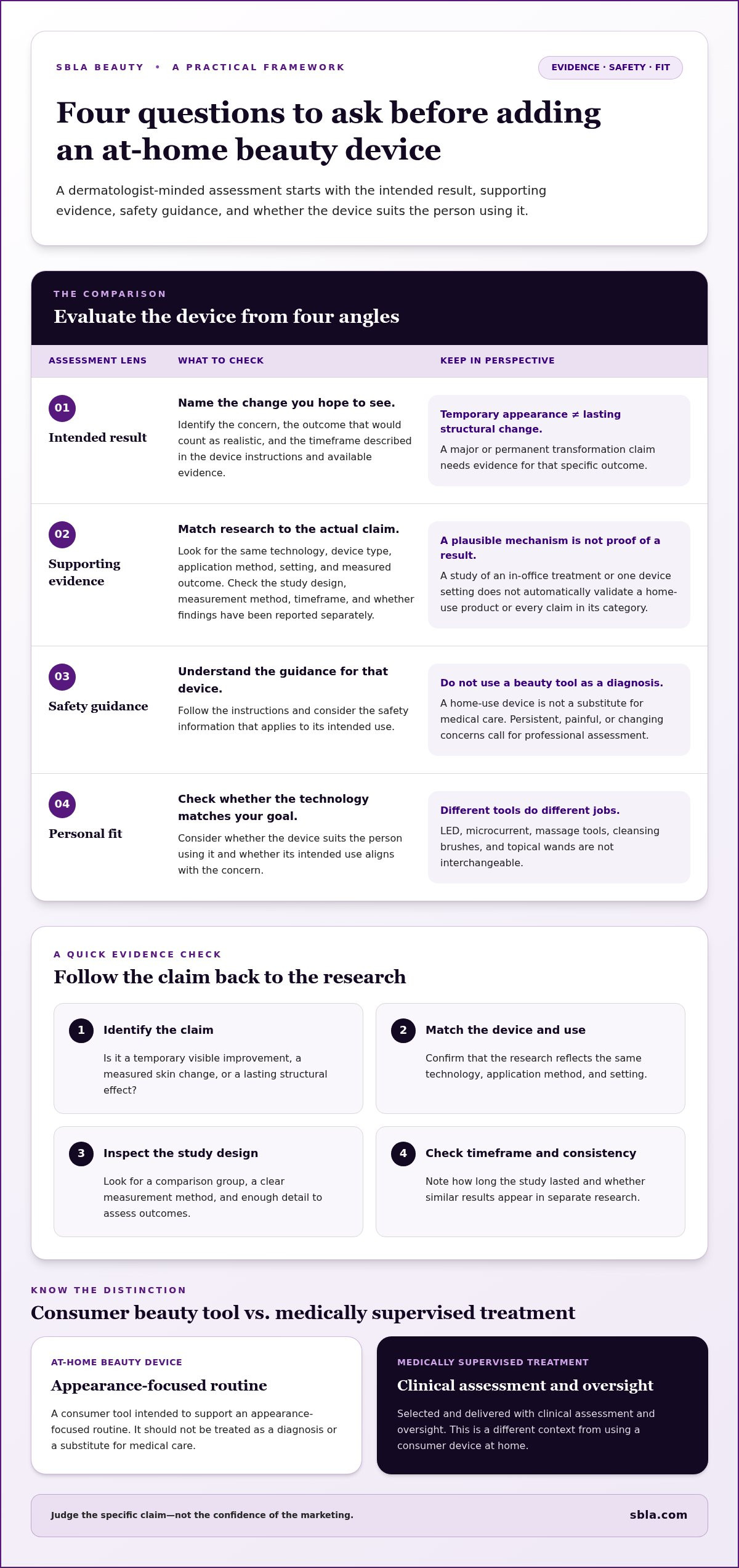
A dermatologist-minded assessment starts with four questions: What result is the device intended to deliver? What evidence supports that use? What safety guidance applies? And does the device suit the person using it? These questions offer a practical way to evaluate at-home tools without assuming that every device is effective or appropriate for everyone.
A beauty device is a consumer tool intended to support an appearance-focused routine; a medically supervised treatment is selected and delivered with clinical assessment and oversight. The distinction matters. A home-use device shouldn’t be treated as a diagnosis, a substitute for medical care, or proof that a skin concern is being properly addressed.
What “dermatologist-approved” can, and cannot, tell you
The phrase can mean different things. A dermatologist may comment on a device category, describe personal use, or discuss research. Those forms of expert commentary aren’t the same as clinical evidence for a particular product, and they don’t establish that the product is suitable for everyone. A testimonial describes an individual experience. By itself, it can’t show that a device works broadly or that the device caused the reported change.
Look for a claim tied to a clearly identified device, a specific way of using it, and an outcome that can be assessed. “Improves skin” is too broad to judge. A useful claim identifies the concern and the measured result. Also distinguish regulatory language from endorsement: FDA clearance, where applicable, is not the same as a dermatologist’s recommendation or FDA approval of every marketing claim.
Start with the concern, not the device
First, name the change you hope to see, such as less visible puffiness or a smoother-looking surface. Then decide what would count as a realistic result and over what timeframe, using the device’s instructions and the available evidence. A temporary change in appearance shouldn’t be mistaken for a lasting alteration in skin structure. If a claim promises a major or permanent transformation, the evidence should directly support that specific outcome.
Next, consider whether the technology matches the goal. Light-based devices aren’t interchangeable with massage tools or topical wands. Light therapy covers a range of applications, and a scientific rationale for a category doesn’t establish the effectiveness of a particular beauty device. Treat it as a starting point for evaluation, not proof of product-level results.
Keep foundational care in view, too. A device is one possible addition to a routine, not a replacement for sensible skincare or attention to changes in your skin. Persistent, painful, or changing concerns call for professional assessment rather than trial and error with a beauty tool. Similarly, for targeted cosmetic goals such as hair thinning or scalp health, undergoing personalised analysis with specialists like Rooted Scalp Clinic offers clear direction before committing to at-home routines. Start with the concern, check whether the device’s intended use aligns with it, and weigh the evidence and safety guidance before deciding whether it belongs in your routine.
How to Judge Evidence, Mechanism, and Realistic Results
Start by matching the promise to the evidence. A study of one light wavelength, device, or treatment setting doesn’t automatically validate another product in the same broad category. Ask what the device was designed to do, who was studied, how it was used, and whether the research measured the outcome featured in the claim. This helps answer “what my dermatologist thinks about at-home devices” without treating a category-wide explanation as proof for a specific tool.
Read the study behind the skincare device claim
Look for research on the same technology and use setting. Don’t assume a study of an in-office treatment applies to a home device. Check whether participants were compared with a control or comparison group, how many people took part, how outcomes were measured, and how long results were followed. A published study offers more detail to evaluate than a testimonial or expert quotation, but publication alone doesn’t guarantee that its design or findings support a broad claim.
Use this sequence to assess an evidence claim:
- Identify the claim. Is it about temporary visible improvement, a change in a measured skin feature, or a lasting structural effect?
- Match the device and use. Confirm that the research concerns the same technology, device type, application method, and setting as the claim.
- Inspect the study design. Look for a comparison group, a clear measurement method, and enough detail to understand how outcomes were assessed.
- Check the timeframe and consistency. Note how long the study lasted and whether similar results have been reported in separate research.
Separate a plausible mechanism from a proven outcome
A proposed mechanism can help explain how a device might act, but it can’t establish what a person will see in the mirror. Light interacting with skin, for example, is a scientific rationale; the specific benefit still needs evidence from the relevant device and use. A mechanism explains how an effect might happen; only outcome evidence can show whether that effect was observed.
Read the reported endpoint precisely. If a study records a short-term change in appearance after use, don’t recast that finding as a lasting lift or reversal of aging. Check whether assessments were made by participants, trained evaluators, or instruments, and whether the follow-up period supports claims of sustained results. When evidence is preliminary, limited to a narrow group, or not replicated, keep expectations proportionate rather than extending the conclusion to everyone.
Apply the same discipline to topical wand products: assess the specific product claim and its supporting evidence rather than assuming a device-category study proves a topical formula’s effect. If you’re exploring consumer beauty tools, you can view SBLA BEAUTY’s at-home wands and compare them with your desired outcome and the evidence available.
At-Home Device Types Compared by Purpose and Evidence
At-home devices are often grouped together in marketing, but their technologies and intended outcomes differ. Compare what each category is designed to do, what evidence supports that use, and what the tool can’t establish. No category is universally best; the right comparison depends on the concern and the claim you’re evaluating.
| Category | Common intended purpose | Evidence questions | Key limitations |
|---|---|---|---|
| LED or red light | Support appearance-focused skin goals using light at specified wavelengths. | Does research examine the same wavelength, device, use pattern, and outcome? | Results for one light-based device or use don’t automatically apply to another. |
| Microcurrent | Provide low-level electrical current as part of a facial routine. | What visible outcome was measured, for which device, and for how long? | A proposed electrical effect isn’t proof of a lasting change in appearance. |
| Massage or depuffing tools | Offer manual massage or a temporary refreshed appearance. | Was any change measured, and how long did it last? | A short-term appearance change shouldn’t be presented as structural reshaping. |
| Cleansing brushes | Assist with cleansing through a device-based brush or surface. | Was cleansing assessed against a relevant comparison, and how was it measured? | Cleansing performance doesn’t demonstrate lifting or other unrelated benefits. |
| Topical wands | Pair a wand with a topical formula for targeted cosmetic use. | Does evidence address the specific product, formula, use, and claimed result? | Evidence for LED or electrical-current devices doesn’t validate a topical product. |
Compare technologies by what they are designed to do
The table is a starting point, not a ranking. LED and microcurrent devices should be assessed according to their own technology and tested outcomes. Massage tools and cleansing brushes serve different purposes. Topical wands belong in a separate category because they pair a wand with a formula. Don’t assume evidence for one device type transfers to another. For a closer look at two distinct approaches, see this microcurrent versus peptide wand guide.
For every category, read the claim narrowly. If research measures one outcome, it doesn’t substantiate a different promise. A study of temporary depuffing, for example, wouldn’t by itself demonstrate a lasting lift. When considering what my dermatologist thinks about at-home devices, ask not just whether a technology has research behind it, but whether the evidence matches the claim you care about.
Where topical wands fit in the comparison
SBLA BEAUTY’s Eye Lift Wand is a consumer beauty wand, not an LED or electrical-current device. Evaluate its product-specific claims on their own terms, including the formula, intended use, and outcome described. The SBLA Eye Lift Wand clinical guide provides product-specific context; it doesn’t make the wand interchangeable with other technologies or establish superiority over them. Match the information to the product and the result you’re considering.
A Practical Safety and Suitability Checklist for Home Use
A device should fit your concern, your routine, and your skin’s current needs. Use this checklist before your first session. It turns “what my dermatologist thinks about at-home devices” into practical questions to answer before introducing a new tool.
- Define the concern. Name the appearance change you hope to address and set a modest, observable goal. If you’re responding to a symptom rather than an aesthetic concern, pause before treating it as a cosmetic issue.
- Read the instructions in full. Confirm the intended area, frequency, application method, and any stated restrictions. Don’t use the device on areas or for purposes beyond its instructions, and don’t increase use in pursuit of faster results.
- Review the evidence for that use. Check that the support relates to the device type and outcome you’re considering. A general claim about a technology may not answer whether a particular tool fits your goal.
- Assess personal suitability. Consider active skin concerns, past reactions to devices or topical products, and any medical history or treatment that may affect use. If you’re unsure, get individualized medical guidance before proceeding.
If you’re comparing consumer tools for a cosmetic routine, explore SBLA’s at-home beauty wands and consider how they fit your goals and suitability checklist.
Questions to answer before using a device
Before starting, make sure the instructions clearly cover where and how the device is meant to be used. Note the recommended frequency and any restrictions, then follow them as written. If the device is paired with a topical formula, review its ingredient information too, especially if you’ve reacted to skincare products before. Stop use if irritation or an unexpected reaction occurs, and seek appropriate guidance rather than trying to push through it.
When a dermatologist’s assessment matters
A cosmetic goal, such as wanting skin to look less puffy, is different from pain, a persistent rash, or a changing spot. Those concerns deserve medical evaluation, not an at-home device trial. Professional guidance is also valuable if you have an active skin condition, a prior reaction, a diagnosis, or prescribed treatment that could affect whether a device is suitable. A beauty tool can’t diagnose a concern or replace care prescribed for it.
Make the decision deliberately. If the instructions don’t fit your intended use, or your personal circumstances leave you uncertain, hold off until you have appropriate guidance. A careful pause is safer than adapting a device beyond its stated purpose.
How SBLA BEAUTY Wands Fit an Evidence-Conscious Routine
An evidence-conscious comparison can include more than devices that use light or electrical current. SBLA BEAUTY offers at-home wands alongside topical formulas, including collagen-infused wands and peptide- and retinol-based formulas. These belong to a different category from LED or microcurrent tools, so evaluate their claims on their own terms rather than borrowing evidence from another technology.
If you’re asking what my dermatologist thinks about at-home devices, apply the same questions here: What is the product intended for? What result is claimed? What evidence directly supports that result? And does the intended use fit your needs and skin? The products below are consumer beauty tools, not dermatologist-prescribed treatments or clinical procedures.
Match an SBLA BEAUTY wand category to the area of interest
The Eye Lift Wand is a beauty wand for readers interested in the eye area. Treat its name as a product identifier, not a guarantee of a particular outcome. The Liquid Facelift Wand is also an at-home beauty product; “facelift” in its name doesn’t make it a medical procedure or establish a clinical result. For readers focused on the neck, chin, and jawline, the Neck, Chin & Jawline Sculpting Wand is another consumer beauty tool in the range.
Product-specific context matters. The at-home liquid facelift clinical guide offers a focused place to consider information related to the Liquid Facelift Wand. As with any product discussion, distinguish the product’s description from evidence that directly tests a specific outcome. Claims about a formula or wand shouldn’t be treated as interchangeable with research on LED, microcurrent, or another device category.
Collagen-infused wands and peptide- and retinol-based formulas are formulation categories, not evidence of a particular result by themselves. To assess a claim, look for information specific to the product, its intended use, and the outcome being described. Don’t infer that a topical formula has the same purpose or evidence as a device that delivers light or current. This distinction keeps expectations clear and helps you compare different kinds of consumer beauty tools fairly.
Make an informed next move
Before choosing a wand, return to four points: intended use, relevant evidence, safety instructions, and personal fit. Consider whether the product addresses the appearance concern you have in mind, whether its claims are supported by relevant information, and whether you can follow its directions. If you have a skin condition or uncertainty about suitability, seek appropriate medical guidance rather than treating a beauty tool as a substitute for diagnosis or prescribed care.
For a closer look at SBLA BEAUTY’s at-home wand range and topical formulas, explore SBLA BEAUTY.
Choose Your Next Step With Confidence
Your next move doesn’t need to be a commitment to a device. Start by deciding what change you’d like to see, then consider whether an at-home tool fits that goal. If you’re still weighing what my dermatologist thinks about at-home devices, keep your standard clear: specific claims, relevant evidence, careful use, and realistic expectations.
For readers interested in topical beauty wands, SBLA BEAUTY’s Eye Lift Wand is its primary offering. The range also includes wands focused on the face, eye, neck, jawline, and lips. These consumer tools can be explored as part of an appearance-focused routine, without treating them as medical care or assuming a particular outcome.
Review the range and decide which area, if any, aligns with your personal goals. Explore SBLA Beauty’s at-home wand range and make your next choice with clarity.
Frequently Asked Questions
Does a dermatologist recommend at-home skincare devices?
Sometimes, but a recommendation depends on the individual and the specific device. A dermatologist may discuss whether a tool fits a person’s skin concern, medical history, and existing care plan. Advice for someone seeking a cosmetic routine addition may differ from guidance for someone managing a diagnosed condition. A product roundup or a dermatologist’s personal comments can offer general context, but neither is a personalized recommendation for your skin.
Are at-home beauty devices clinically proven to work?
Some have supporting research, but evidence varies by product, technology, and claimed result. When considering what my dermatologist thinks about at-home devices, start by asking whether a study tested the same kind of device for the advertised outcome. Research measuring a short-term appearance change, for example, wouldn’t establish a lasting effect. Treat testimonials and explanations of how a device might work as different from measured clinical outcomes.
Can an at-home device replace a dermatologist treatment?
No. A consumer beauty device shouldn’t replace diagnosis, prescribed care, or a professional procedure. A home tool and a clinical treatment may differ in purpose, settings, and oversight, so they aren’t automatically interchangeable. If you’re considering a device for a diagnosed condition, understand how it relates to your care plan rather than pausing or changing treatment on your own. Seek individualized medical guidance for new or changing symptoms.
How can I tell whether a skincare device claim is trustworthy?
Look for a claim that says what result was measured and what device was tested. A statement about “radiance,” for instance, is difficult to assess unless the source explains how that change was evaluated. Check whether the study identifies its participants, comparison group, and follow-up period, and whether the method matches the product’s intended use. Customer reviews can describe experiences, but they can’t establish a typical result.
Should I use a skincare device if I have sensitive skin?
Sensitive skin doesn’t automatically rule out every device, but it makes careful product review especially relevant. If the tool is used with a topical formula, consider whether you’ve previously reacted to any listed ingredients. Don’t introduce several new products or devices at once, since that can make it harder to identify what caused a reaction. If you have a diagnosed condition or a history of reactions, seek qualified medical advice first.
What should I do if an at-home skincare device irritates my skin?
Stop using it rather than repeating the session to see whether the irritation returns. Follow any immediate-care directions in the device instructions, and note when the reaction began and what you used alongside the tool. If symptoms are severe, persistent, painful, or otherwise concerning, seek medical advice. Keep the device name and any topical formula or ingredient information available, as these details may help a healthcare professional assess the situation.
Do topical beauty wands work the same way as red light or microcurrent devices?
No. These categories use different approaches and shouldn’t be treated as equivalent. A topical wand is used with a formula, while red light and microcurrent devices involve other technologies. Research on a light-based tool can’t establish the effects of a topical formula, and findings for one wand don’t automatically apply to another. Compare each product with evidence tied to its own intended use and claimed result.

