
Post-menopause Skin Rejuvenation: Skin Changes and Procedure Options
Skin can lose up to 30% of its collagen during the first five years after menopause. This shift can contribute to thinner, drier skin, reduced elasticity, and more visible lines. Post-menopause skin rejuvenation focuses on these changes with options that support collagen, refine texture, and address facial volume and contour.
It’s understandable to find that familiar skincare doesn’t address every change in firmness or facial definition. The right approach depends on the concern: topical ingredients and collagen-stimulating procedures target skin quality, while other dermatologic procedures can soften lines or restore volume. This guide explains how skin may change after menopause, how different options work, and where their benefits differ, so you can decide which approaches fit your goals.
Key Takeaways
- Match collagen-supporting approaches to your main concern, whether that’s texture, firmness, or fine lines.
- Compare procedures by how they work: peels refine the skin’s surface, while collagen-stimulating treatments target deeper changes.
- Consider how changes in underlying facial support can affect volume and contour when assessing options for a more defined appearance.
- For an at-home eye-area skincare option, explore the Eye Lift Wand alongside the procedure approaches discussed in the article.
What About Collagen-Stimulating Treatments?
Menopause is defined as 12 consecutive months without a menstrual period, according to the American College of Obstetricians and Gynecologists. The National Institute on Aging states that menopause typically occurs between ages 45 and 55 years. As estrogen declines, the dermis can thin, collagen production can fall, and skin may become drier, less elastic, and slower to repair.
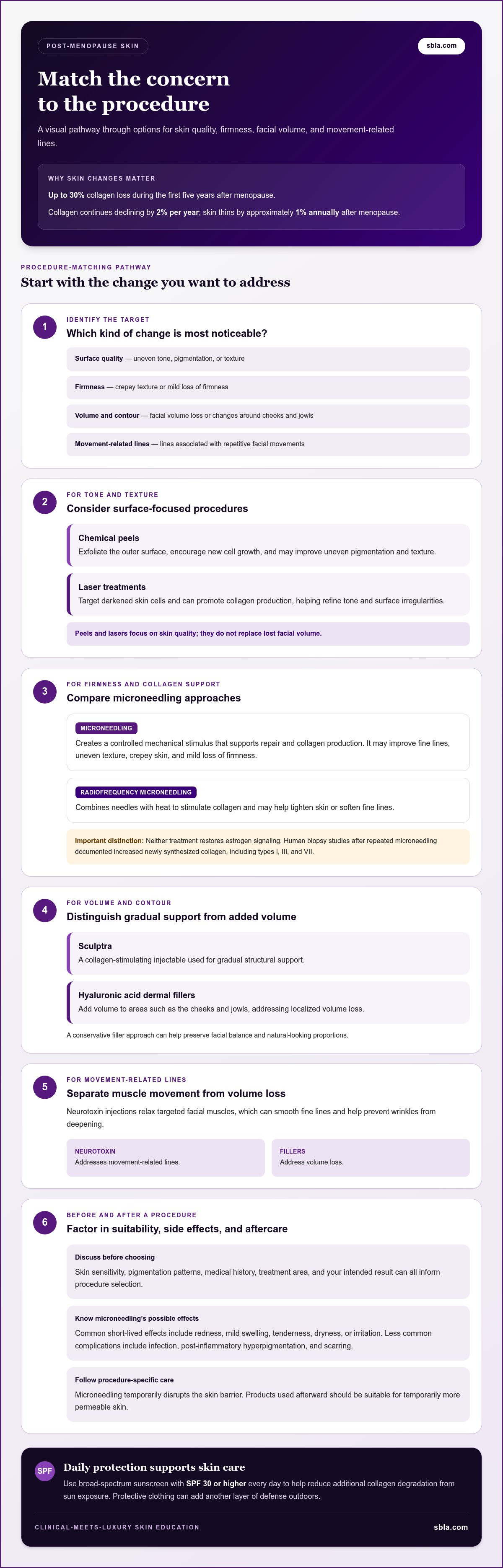
Changes build over time. Skin can lose up to 30% of its collagen during the first five years after menopause, then collagen continues declining by 2% per year. Skin also thins by approximately 1% annually after menopause. Reduced collagen and elastin support can make fine lines, crepey texture, and loss of firmness more noticeable. Thinner skin may also let moisture escape more readily, contributing to dryness and a dull appearance.
Treatment options work in different ways. Topical retinoids, peptides, and growth factors are used to support collagen production and improve elasticity and firmness over time. Radiofrequency microneedling combines needles with heat to stimulate collagen and may tighten skin or soften fine lines. Laser treatments target darkened skin cells and promote collagen production, helping improve tone and texture. Microneedling itself does not restore estrogen signaling; it creates a mechanical stimulus for repair. Human biopsy studies after repeated treatments documented increased newly synthesized collagen, including types I, III, and VII.
Before a rejuvenation treatment, tell the treating professional about your skin sensitivities, current products, and relevant medical history. Afterward, follow the procedure-specific care plan. Products applied after microneedling should be suitable for skin with a temporarily disrupted barrier.
To help limit further sun damage, use broad-spectrum sunscreen with SPF 30 or higher every day. Daily protection helps reduce additional collagen degradation from sun exposure, while protective clothing can add another layer of defense outdoors.
Dermatologic procedures for post-menopausal skin
Procedures address different concerns, so start with the result you want. Chemical peels exfoliate the skin’s outer surface, encourage new cell growth, and may improve uneven pigmentation and texture. Laser treatments target darkened skin cells and can promote collagen production, refining tone and surface irregularities. These approaches focus on skin quality rather than replacing lost facial volume.
Microneedling creates a controlled mechanical stimulus that supports skin repair and collagen production. It may improve fine lines, uneven texture, crepey skin, and mild loss of firmness. Radiofrequency microneedling adds heat and may help tighten skin. Neither treatment restores estrogen signaling. A consultation should take into account the specific concern, skin sensitivity, pigmentation patterns, and treatment goals before selecting a procedure.
Sculptra and hyaluronic acid dermal fillers serve different aesthetic aims. Sculptra is used as a collagen-stimulating injectable, while hyaluronic acid fillers add volume to areas such as the cheeks and jowls. The first focuses on gradual structural support; the second addresses localized volume loss. A conservative filler approach can help preserve facial balance rather than create an overfilled appearance.
Side effects depend on the procedure. Microneedling commonly causes short-lived redness, mild swelling, tenderness, dryness, or irritation. Less common complications include infection, post-inflammatory hyperpigmentation, and scarring. Skin condition, medical history, and treatment area help determine suitability. Aftercare also matters because microneedling temporarily disrupts the skin barrier, so products applied afterward should be appropriate for temporarily more permeable skin.
Choose according to your concern: peels and lasers address surface tone or texture, collagen-stimulating procedures target firmness, and fillers restore volume. For wrinkles, pigmentation, or laxity, the appropriate treatment depends on the depth and pattern of the change. Discussing these priorities during a consultation helps match the procedure to your intended result and recovery needs.
Facial lines, volume loss, and contour support
Estrogen-related skin changes can affect facial firmness, while volume and bone support shape facial contour. Understanding these layers can help distinguish fine lines from deeper structural changes.
Estrogen Loss and Skin Thinning
Estrogen loss is associated with reduced dermal collagen, thinner, drier skin, and slower wound repair. As the skin’s support diminishes, fine lines and crepey texture may become more visible, and minor damage can take longer to heal. These changes matter when choosing a procedure: surface texture concerns differ from laxity linked to deeper support. A treatment’s target should match the change you want to improve.
Jowls, Facial Volume, and Bone Support
Jowls can develop as facial volume and underlying support change, softening the jawline and altering contour. Changes in facial support may contribute to sagging and a crepey appearance. Facial volume loss may become more apparent during years three to four after menopause. Dermal fillers can restore volume in areas such as the cheeks and jowls, while a conservative approach helps maintain natural-looking proportions.
Neurotoxin injections relax targeted facial muscles, which can smooth fine lines and help prevent wrinkles from deepening. Repetitive facial movements may contribute to wrinkle formation. These injections address movement-related lines, while fillers address volume. Matching the procedure to the cause clarifies what it can improve.
Menopausal hormone therapy may be considered for broader health needs, but it shouldn’t be prescribed solely for skin appearance. Its use is evaluated against symptoms, medical history, risks, and treatment goals. People whose health history or risk profile makes hormone therapy unsuitable should avoid it.
Hair thinning can also accompany menopause-related changes. Minoxidil, spironolactone, and dutasteride are among the medications used to promote hair growth and help prevent further thinning or loss. Hair treatment decisions depend on the cause and individual health factors, not facial skin concerns alone.
What Happens to Your Skin in the First 5 Years After Menopause?
During the first five years, declining estrogen affects collagen, hydration, and the skin’s ability to maintain elasticity. The timing and visibility of these changes vary, but the pattern can help explain why skin may feel less firm or look less vibrant.
Changes in Elasticity and Firmness
Reduced elasticity means skin has less capacity to spring back, while lower firmness can make its surface appear looser. Skin firmness and elasticity may decline during years two to three after menopause. This matters when setting treatment goals: texture concerns differ from visible laxity, and each points toward a different approach to supporting skin health.
Menopause, Collagen, Dryness, and Skin Aging
Menopause-related estrogen decline can thin the dermis, reduce collagen production, and decrease elasticity. Thinner skin can lose moisture more readily, making dryness and a dull appearance more noticeable. Slower cell turnover can also leave the complexion looking less vibrant. These overlapping changes help explain why hydration and collagen support are central considerations in a post-menopause skincare plan.
By years four to five, cumulative changes may become more noticeable. The visible picture may include dryness, fine lines, and uneven texture, rather than one isolated concern. An advanced therapy plan should focus on the changes that matter most to you, such as hydration, surface texture, or firmness, rather than treating every sign of aging alike.
Session planning depends on the concern and its severity, as well as the treatment selected. Mild surface changes may call for topical care, while more pronounced texture or firmness concerns can lead to discussion of procedures that stimulate collagen. The number and spacing of sessions depend on the treatment and the skin’s response, not a universal schedule. The goal is to support skin health, not promise to restore it to an earlier state.
For a focused at-home routine, explore skincare tools designed for targeted care.
SBLA BEAUTY: Eye Lift Wand
The Eye Lift Wand offers a focused at-home option for eye-area skincare as part of a broader approach to post-menopause skin rejuvenation. It may suit readers who want to complement their routine with a targeted skincare device rather than seek a dermatologic procedure for deeper skin changes.
For concerns centered elsewhere, the Neck, Chin & Jawline Sculpting Wand and Neck, Chin & Jawline Sculpting Wand XL focus on a different facial region, while the Liquid Facelift Wand is another face-focused option. These devices offer an alternative category within a personal skincare routine, not a substitute for procedures such as fillers, lasers, or microneedling.
Choose based on the area you want to focus on and the role you want an at-home device to play in your routine. Visit SBLA BEAUTY to explore the Eye Lift Wand and other targeted skincare options.
Make Your Next Skincare Choice With Intention
A thoughtful approach to post-menopause skin rejuvenation starts with a clear personal priority. Decide which area you want to focus on and whether an at-home skincare tool fits your routine. This keeps the next step specific, rather than turning every visible change into a separate goal. Let your preferences guide your choices, and keep procedure decisions distinct from everyday skincare.
SBLA BEAUTY offers the Eye Lift Wand, the Neck, Chin & Jawline Sculpting Wand, and the Neck, Chin & Jawline Sculpting Wand XL. Their names help distinguish the areas each is intended to address as you consider options for your routine. Contact SBLA BEAUTY to explore options and take your next step with confidence.
Frequently Asked Questions
How Many Sessions Do Women After Menopause Typically Need?
There’s no single session count for every treatment or concern. The plan depends on the procedure, the area treated, the degree of change, and how the skin responds. For example, a clinician may consider a different course for surface discoloration than for reduced firmness. Ask how progress will be assessed and what will guide decisions about additional sessions.
What are the most effective postmenopausal skin rejuvenation treatments?
The most suitable treatment depends on the change being addressed. For skin tone and texture, options include chemical peels or laser treatments; collagen-focused concerns may lead to discussion of microneedling or radiofrequency microneedling. Fillers target volume loss, while neurotoxins address movement-related lines. A plan for post-menopause skin rejuvenation works best when each option is matched to a specific goal rather than chosen as a universal fix.
Can topical estrogen improve postmenopausal skin, and what are the risks?
Hormone therapy shouldn’t be used solely to improve skin appearance. Its use is evaluated against symptoms, medical history, risks, and treatment goals. Considerations for topical estrogen depend on the individual and the specific treatment, so discuss its intended use and potential risks with the prescribing clinician. Skin-focused alternatives include moisturizers and topical ingredients selected for concerns such as dryness or texture.
Which skincare ingredients help menopausal skin, such as retinoids, peptides, and hyaluronic acid?
Retinoids support cellular turnover and can improve skin texture; peptides are used in topical products intended to support collagen production. Hyaluronic acid is commonly included in moisturizers and serums to support hydration. Introduce active products thoughtfully, especially if dryness or sensitivity is already a concern. A simple routine can pair a gentle cleanser and moisturizer with daily broad-spectrum sunscreen.
How do laser resurfacing, microneedling, radiofrequency, and chemical peels compare for mature skin?
These procedures target different concerns. Chemical peels exfoliate the outer layer to improve uneven tone and texture. Laser treatments target darkened skin cells and can support collagen production. Microneedling creates a mechanical stimulus for skin repair, while radiofrequency microneedling adds heat to promote collagen and help tighten skin. The treated area, skin concern, and recovery needs help distinguish the options.
What are typical U.S. costs for skin rejuvenation treatments and how many sessions are needed?
Costs and session plans depend on the procedure, treatment area, and planned course of care. A peel, laser treatment, injectable, or microneedling procedure involves different methods and goals, so a single typical total wouldn’t apply across them. Compare the proposed approach, what each session addresses, and the expected follow-up plan. Those details help you understand the overall commitment without relying on a broad average.
