
How to Lift Sagging Cheeks Without Surgery: At-Home Options
Subtle changes at home can improve the appearance of sagging cheeks, but they can’t fully reverse facial sagging naturally. If you’re exploring how to lift sagging cheeks without surgery, the options range from facial exercises, skincare, and firming tools to nonsurgical procedures that target skin laxity or restore facial volume.
It’s understandable to want a visible lift without surgery while knowing what at-home methods can realistically do. This guide explains why cheeks sag and how exercises and skincare can fit into a practical routine. It also compares nonsurgical treatments, including which focus on skin quality, tightening, or cheek volume.
Key Takeaways
- Cheek sagging can begin in your 30s or 40s, and at-home methods may improve appearance without fully reversing it.
- Facial exercises offer a simple routine to try: learn the movements, holds, and repetitions that target the cheeks.
- Use skincare for skin support, not a structural lift. Firming creams can’t penetrate deeply enough to lift sagging skin, and broad-spectrum SPF 30 or higher helps protect against UV damage.
- Compare nonsurgical treatments by what they target, how long results may last, and the downtime involved.
- Explore which tools and routines may fit your goals, and where an at-home approach differs from a professional treatment.
1. Sagging Cheeks: What Causes Them & How To Lift?
Nonsurgical cheek treatments address different concerns: fillers restore volume, while ultrasound and radiofrequency target skin tightening. Short-term effects can include mild swelling that resolves within days; PDO thread lifts may cause minor swelling or bruising for 1-2 days. Side effects vary by method, so compare the expected effects of fillers, threads, ultrasound, and radiofrequency before choosing.
To understand how to lift sagging cheeks without surgery, first identify what has changed. If hollowing is the main concern, cheek fillers add volume. If loose skin is more prominent, ultrasound or radiofrequency may stimulate collagen and gradually tighten tissue. When both changes appear, treatment planning may combine approaches, with the order shaped by facial anatomy and desired results.
Match the method to your priorities. Consider the concern you want addressed, your budget, tolerance for downtime, and how quickly you want to see a change. Most non-invasive skin-tightening procedures take 1 hour or less. Radiofrequency results may become most noticeable in about 6 months as collagen develops, while some people notice results from minimally invasive radiofrequency in about 1 month. These approaches have different timelines and recovery needs.
Ultrasound and radiofrequency use energy to target tissue beneath the skin. Some people may benefit from additional ultrasound treatments. Most people have one radiofrequency skin-tightening treatment, although some may benefit from more than one. With appropriate skincare, radiofrequency results can last 2 to 3 years. Those results develop gradually, rather than creating the immediate volume change associated with fillers.
Fillers may suit someone seeking cheek definition or volume, with effects typically lasting several months to over a year. Thread lifts offer another nonsurgical option, with results typically lasting one to two years. Professional treatment may be appropriate when at-home routines don’t address the degree of laxity or volume loss you’re concerned about. Skin condition, facial structure, goals, and willingness to accept downtime all help determine suitability.
Build recovery into your decision. After a nonsurgical cheek lift, avoid intense exercise for 24-48 hours and follow the provider’s aftercare instructions. Minimally invasive skin-tightening procedures can involve a few days of downtime, while mild swelling from nonsurgical cheek treatments generally resolves within days. Compare that recovery with your schedule before committing, especially if an event is approaching. A treatment that fits your facial concern and recovery preferences is more useful than choosing solely for a youthful look.
2. Facial exercises
Cheek fillers can restore lost volume and improve definition, but they don’t train facial muscles. Their effects typically last several months, and they address volume rather than every cause of sagging.
Facial structure changes over time. From the mid-20s onward, collagen declines by about 1% per year. Elastin, which helps skin spring back, also changes with age. Facial fat can shift or diminish, while changes in bone support affect the contours beneath the cheeks. Exercises work on muscle movement, not those deeper structural changes.
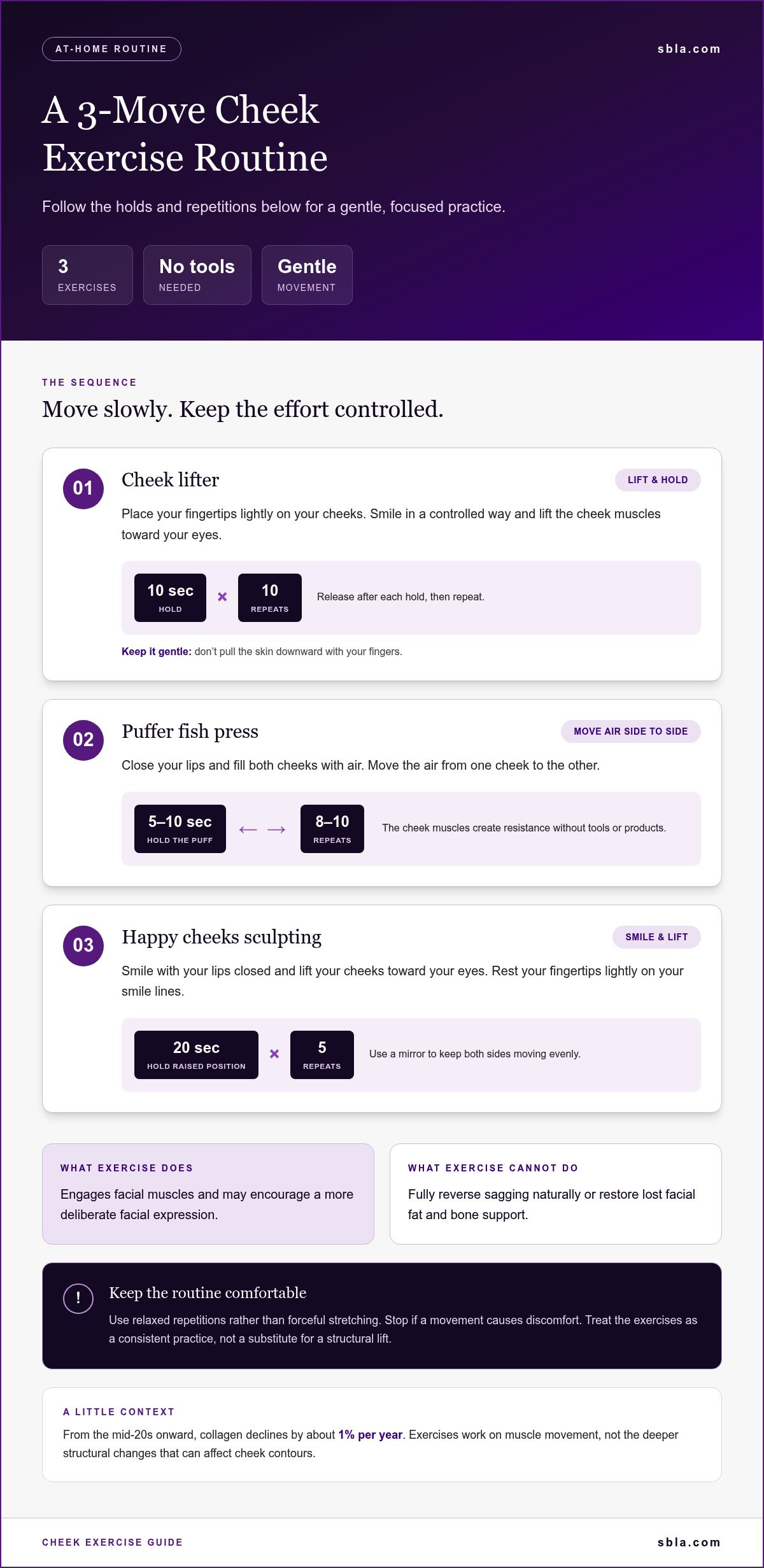
Try the cheek-lifter exercise with a controlled smile. Place fingertips lightly on your cheeks, lift the cheek muscles toward your eyes, and hold the contraction for 10 seconds. Release, then repeat 10 times. Keep the movement gentle and focused; avoid pulling the skin downward with your fingers.
For a puffer fish press, close your lips and fill both cheeks with air. Move the air from one cheek to the other, then hold the puff for 5 to10 seconds. Repeat 8 to10 times. This creates resistance through the cheek muscles without requiring tools or products.
For happy cheeks sculpting, smile with your lips closed and lift your cheeks toward your eyes. Rest your fingertips lightly on the smile lines, then hold the raised position for 20 seconds. Repeat 5 times. Use a mirror to keep both sides of your face moving evenly.
These routines may encourage muscle engagement and create a more deliberate facial expression. They can’t fully reverse sagging naturally or restore lost fat and bone support. Treat them as a consistent practice, not a substitute for a structural lift. Stop if a movement causes discomfort, and use relaxed repetitions rather than forceful stretching.
Fat injections address volume loss differently. A clinician transfers fat to the face, but the body reabsorbs some of it, so multiple sessions may be needed for optimal results. Cheek volume, definition, and tightening may improve in the first few weeks after treatment. This cosmetic option addresses contour, not muscle strength.
For a separate cosmetic goal, the Limited Edition - DOUBLE THE PLUMP Lip Plump & Sculpt is lip-focused, not a cheek-lifting method.
3. At-home skincare and skin-firming tools
Facial exercises, skincare, and lifestyle habits support different aspects of cheek appearance. Exercises engage facial muscles, while skincare supports the skin’s surface and helps limit UV damage. Neither restores lost facial volume or fully reverses sagging. Sleeping on your back can reduce pressure and skin folding across the cheeks.
Set a simple morning routine: cleanse gently, apply moisturizer, then finish with broad-spectrum sunscreen rated SPF 30 or higher. That sunscreen helps protect skin from UV damage. In the evening, cleanse again and apply moisturizer. To continue seeing any benefit from a moisturizing skin-firming product, apply it every day. Consistency supports hydration, not a structural lift.
Read product labels before choosing a firming cream or lotion. Skin-firming formulas can moisturize the surface, but they can’t penetrate deeply enough to lift sagging skin. Retinol and peptides are skincare ingredients used in facial products; the label shows whether a formula includes them. Don’t treat “firming” on a product label as proof that it can reposition cheek tissue.
Facial rollers and gua sha tools are used for gentle massage and product application. Use light pressure, move across clean skin, and stop if the motion irritates or pulls. These tools work at the skin’s surface; they don’t replace procedures that target deeper tissue. Avoid aggressive pressure, especially over sensitive areas or irritated skin.
At-home devices differ from professional ultrasound and radiofrequency treatments. Those procedures use energy to target tissue beneath the surface, while an at-home routine focuses on skincare and gentle handling. Don’t assume a consumer tool produces the same effect or collagen production as a professional procedure. Follow the device instructions and keep skin clean before use.
Choose products based on practical concerns such as dryness, sensitivity, or sun exposure. Add one new formula at a time so you can identify how each product affects your skin. Use moisturizer daily and sunscreen each morning. If you use a massage tool, keep the motion gentle and avoid dragging the skin. These steps support skin condition without promising a cheek lift.
At-home care also differs from post-procedure recovery. A skincare routine requires no procedure-related recovery period, but it cannot deliver the same tissue changes as an in-office treatment. Keep expectations aligned with the method: daily moisturizer can support hydration, and SPF 30 or higher helps protect against UV damage. Neither replaces treatment for deeper laxity.
4. Causes of cheek sagging
Cheek sagging reflects changes across several facial layers, not one isolated skin problem. Skin may lose firmness, underlying fat can shift or diminish, and facial bone support changes over time. Together, these changes can soften cheek contours and deepen folds beside the nose and mouth.
Collagen provides structural support, while elastin helps skin return after movement. Their age-related decline can make facial tissue less resilient. Cheek sagging can begin in a person’s 30s or 40s, although the timing and visible pattern differ. A person may first notice less definition along the cheekbone rather than loose skin.
Volume loss looks different from skin laxity. When facial fat diminishes or shifts lower, the midface can look flatter while tissue appears heavier near the lower cheek. Bone support also contributes to facial contours. Changes in any of these structures can alter how light and shadow define the cheeks.
Sun exposure also affects skin quality. Ultraviolet damage can affect the skin, so broad-spectrum sunscreen helps protect against it. Repeated facial expressions and gravity act on tissue over time, too. These influences vary from face to face, which is why two people of similar age can have different cheek contours.
Identify the main change before comparing treatments. If the cheeks look hollow, dermal fillers may restore volume, with effects typically lasting several months to over a year. If loose skin is the primary concern, an approach targeting tissue firmness may be more relevant. Fillers add volume; they don’t correct every cause of sagging.
Some options are minimally invasive, such as thread lifts or energy-based skin tightening. Thread-lift results typically last one to two years. Radiofrequency skin tightening can develop gradually, with results best in about 6 months as the body makes collagen. These methods address different facial structures, so their expected effects shouldn’t be treated as interchangeable.
Fat transfer offers another way to address facial volume. The body reabsorbs some transferred fat, so multiple treatment sessions may be needed for optimal results. This makes fat transfer distinct from fillers and skin-tightening procedures. The choice depends on whether the visible concern is hollowing, laxity, or both.
Understanding the cause helps set realistic goals. At-home skincare may support the skin’s surface, but it can’t fully reverse facial sagging. Surgery and nonsurgical treatments act differently, and each targets particular changes. Matching the method to your concern matters more than choosing a treatment by name alone.
5. Nonsurgical facelift options for sagging cheeks
Nonsurgical facelift options target different changes in cheek appearance. Dermal fillers restore volume, thread lifts reposition tissue, and energy-based treatments focus on tightening. These distinctions matter: adding fullness won’t address every cause of sagging, and tightening won’t replace lost volume. Match the approach to the change you want to improve.
Hyaluronic acid fillers add volume to areas such as the cheeks, helping refine facial contours. Their effects can last from six months to several years, depending on the filler and treatment. Cheek filler effects may last several months. Fillers focus on volume; they don’t stimulate collagen production throughout the skin.
Thread lifts use threads to support and lift facial tissue. Results typically last one to two years, making threads distinct from fillers and energy-based treatments. PDO thread treatment may involve minor swelling or bruising for 1-2 days. This option is minimally invasive, but it doesn’t restore cheek volume in the same way as a filler.
Radiofrequency and ultrasound use energy to target tissue and encourage tightening. Radiofrequency results can develop gradually as the body makes collagen, with the best results in about 6 months. Some research studies report gradual tightening and lifting for close to 1 year after minimally invasive radiofrequency skin tightening. These procedures focus on skin firmness rather than adding fullness.
Other procedures address surface texture or movement. Microneedling treatments may be scheduled about three to eight weeks apart, with full results taking about three to six months. Chemical peels and botulinum toxin injections may need repeating every few months; botulinum toxin results can last up to three months. These options don’t all create the same kind of lift.
Most non-invasive skin-tightening procedures take 1 hour or less. Compare treatment goals, results timelines, and recovery needs, then weigh them against your cheek concern. A hollow midface points toward volume restoration; loose skin calls for a tightening approach. Thread lifts occupy a different role by supporting tissue. The clearest takeaway: choose by target, not by the general promise of a facelift.
For an at-home device option alongside these professional approaches, explore the Liquid Facelift Wand. It’s a separate skincare-device option, not a substitute for filler, threads, or an energy-based procedure.
SBLA BEAUTY: Eye Lift Wand
SBLA BEAUTY’s Eye Lift Wand is an at-home device for the eye area. It may suit readers looking to include targeted eye-area care in a broader facial routine, but it isn’t a cheek-lifting treatment. Keep the distinction clear: exercises, skincare, and professional procedures address cheek concerns differently, while this wand focuses on the eyes.
For at-home care focused on other facial areas, SBLA BEAUTY offers the Liquid Facelift Wand and Neck, Chin & Jawline Sculpting Wand. Choose according to the area you want to address, and keep expectations aligned with each product’s focus.
For details about SBLA BEAUTY’s at-home offerings, contact SBLA BEAUTY.
Choose Your Next Step With Confidence
Let your priority guide your next step. If you’re exploring how to lift sagging cheeks without surgery, decide whether you want to continue with a consistent at-home routine or consider options that address deeper facial changes. These paths can support different goals, but an at-home device isn’t a professional procedure.
For targeted at-home care across facial areas, explore SBLA BEAUTY’s Eye Lift Wand, Neck, Chin & Jawline Sculpting Wand, and Neck, Chin & Jawline Sculpting Wand XL. Review each product’s focus and choose one that aligns with the area you want to include in your routine. A deliberate choice keeps your next step grounded in your priorities.
To learn more about these options, contact SBLA BEAUTY. A thoughtful approach can help you feel more assured as you shape a routine that suits you.
Frequently Asked Questions
2. Do You Need a Facelift or Are Non-Surgical Options Enough?
A surgical facelift isn’t automatically necessary; nonsurgical approaches can suit concerns involving modest volume changes or skin laxity. The key distinction is how much change you want and which facial layer contributes most. Fillers add volume, while tightening treatments target skin and underlying tissue. If your goal involves substantial repositioning, nonsurgical options work differently from surgery. Compare the expected change and recovery involved before choosing a path.
3. What Exercises Can Help Lift Droopy Cheeks?
Cheek-lifter, puffer fish press, and happy cheeks exercises engage cheek muscles. For a simple routine, start with the cheek-lifter, then do the puffer fish press, and finish with happy cheeks. Keep your jaw relaxed and use controlled movements rather than pulling your skin. These exercises focus on muscle engagement; they don’t replace lost facial volume or change underlying bone support. Consistent, gentle practice matters more than forceful repetitions.
4. What Is a Nonsurgical Facelift?
A nonsurgical facelift is an umbrella term for procedures that improve facial appearance without a traditional surgical lift. It can refer to distinct methods, including dermal fillers, thread lifts, ultrasound, and radiofrequency treatments. Each targets different concerns, such as volume loss or skin laxity, so the term doesn’t describe one standard procedure. Compare what a method changes, how results develop, and what recovery it involves.
5. What Is the Biological Mechanism Behind Droopy Cheeks?
Droopy cheeks develop as several supporting structures change together. Skin loses some resilience as collagen and elastin change; facial fat can shift or diminish, and bone support alters the contours beneath it. These changes affect how the midface holds volume and how skin drapes. For example, reduced cheek fullness can make folds appear more prominent, even without a major change in the skin’s surface.
6. What Non-Surgical Treatments Can Lift Sagging Cheeks?
Options include dermal fillers, thread lifts, radiofrequency, ultrasound, microneedling, and selected resurfacing procedures. Fillers address volume, threads support tissue, and energy-based treatments aim to tighten. Microneedling and peels focus more on skin texture and quality than on repositioning cheeks. Results and treatment schedules differ: thread-lift results typically last one to two years, while cheek filler effects typically last several months.
7. Can Ultrasound or Radiofrequency Treatments Lift Sagging Cheeks?
Yes. Ultrasound and radiofrequency treatments can target tissue beneath the skin to encourage tightening and lifting. Radiofrequency results develop as the body makes collagen, with results best in about 6 months. Some research studies report gradual tightening and lifting for close to 1 year after minimally invasive radiofrequency skin tightening. Energy-based methods don’t add cheek volume, so they address a different concern than fillers.
8. How Much Do Non-Surgical Cheek-Lifting Treatments Cost in the United States?
There isn’t one treatment price that applies across the United States. The total depends on the method, area treated, amount of product or equipment used, and whether the plan involves repeat sessions. A filler appointment and an energy-based procedure have different cost structures. Compare the full proposed plan, including repeat visits, rather than judging only by the initial treatment charge.

