
Pre-wedding skincare for mature skin, from routine to timing
Start pre-wedding skincare for mature skin at least six months before the wedding. This gives you time to establish a routine, introduce products gradually, and observe how your skin responds. Consistency matters more than a last-minute overhaul, especially if your skin is sensitive to sudden changes.
It’s understandable to want visible radiance for the day, but new actives or treatments too close to the wedding can bring irritation when you’d rather be keeping your routine steady. This guide maps out a six-month approach, explains which product categories to consider for concerns such as dullness and uneven texture, and covers daily broad-spectrum sunscreen with SPF 30 or higher. You’ll also learn when to pause experimentation and why sunscreen should remain part of your preparation, with careful application and reapplication, rather than being treated as an optional finishing touch.
Key Takeaways
- Build a steady routine well ahead of the wedding, introducing one new product at a time so you can observe how your skin responds.
- Plan treatments early and keep the final weeks focused on familiar, gentle care rather than last-minute experimentation.
- Use broad-spectrum SPF 30 or higher as part of your morning routine, and reapply sunscreen every 4 hours.
- Consider product categories such as gentle acids for concerns like dullness or uneven texture, choosing formulas that suit your skin and routine.
- Explore targeted skincare tools for the eye area, face, neck, chin, or jawline as a complement to consistent daily care.
1. Avoiding new treatments close to the wedding
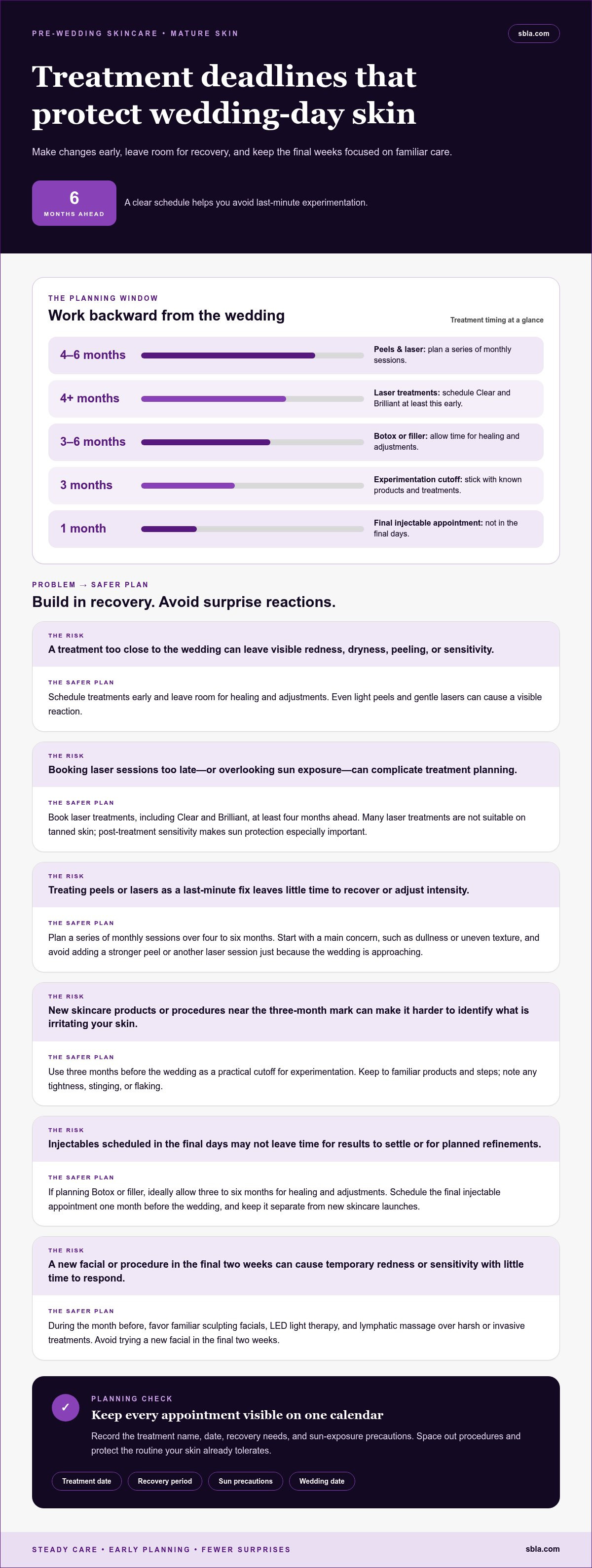
Set firm treatment deadlines before bridal plans become crowded. For pre-wedding skincare for mature skin, the safest strategy is to make changes early, then protect a routine your skin already tolerates. A new treatment can cause temporary redness, dryness, peeling, or sensitivity, which may complicate makeup application and make skin look less even. Keep a calendar with the treatment date, recovery period, and wedding date. Build in space for healing instead of scheduling procedures close together.
Schedule laser treatments, including Clear and Brilliant, at least four months before the wedding. This leaves time for your skin to settle and for adjustments if irritation occurs. Light peels and gentle laser treatments may have minimal downtime, but that does not mean there will be no visible reaction. Many laser treatments are not suitable on tanned skin, so account for sun exposure when choosing dates. A tan can affect suitability, and post-treatment sensitivity makes sun protection especially important.
Plan peels and laser treatments as a series, not a last-minute fix. Monthly sessions over four to six months can improve several skin concerns. This schedule allows time to recover between appointments and adjust treatment intensity. Start with your main concern, such as dullness or uneven texture, then follow a consistent plan. Don’t add a stronger peel or another laser session simply because the wedding is approaching.
Enhancement treatments need their own lead time. If you’re planning Botox or filler, ideally allow three to six months for healing and adjustments. For instance, if you are considering subtle enhancements like lip fillers Brighton clinics specialize in, schedule the final injectable appointment at least one month before the wedding, not in the final days. This gives the results time to settle and allows for planned refinements. Keep these appointments separate from new skincare launches so you can identify what may be causing a reaction.
Use the three-month mark as a practical cutoff for experimentation. Sarah Chapman recommends avoiding new skincare products and treatments around three months before the wedding. Don’t introduce a new active, facial, or procedure to chase a quick change. Stick with products and steps your skin already knows, and note any changes that cause tightness, stinging, or flaking. A stable routine also gives your makeup artist a familiar skin surface to work with.
During the month before the wedding, favor sculpting facials, LED light therapy, and lymphatic massage over harsh or invasive treatments. Choose familiar appointments and time them comfortably. Avoid trying a new facial or other procedure in the final two weeks. Even a gentle service can cause temporary redness or sensitivity, leaving little time to respond if your skin reacts.
Before booking, note each treatment’s name, date, recovery needs, and sun-exposure precautions. For example, schedule a Clear and Brilliant appointment at least four months ahead, then avoid experimenting with new products near the three-month mark. A clear timeline helps protect your skin barrier, support a healthy-looking finish, and reduce surprises on the wedding day.
2. A six-month pre-wedding skincare routine
Begin your routine six months before the wedding, while there’s time to establish consistent care and assess your skin’s response. Starting six to twelve months ahead is ideal; starting three months before can still bring visible improvements. Sarah Chapman also recommends beginning a bridal skincare routine at least six months before the wedding. With pre-wedding skincare for mature skin, consistency helps you identify which steps support comfort and which products cause irritation.
A simple morning routine is gentle cleansing, moisturizer, and broad-spectrum sunscreen with SPF 30 or higher. In the evening, cleanse away makeup and sunscreen, then apply a hydrating moisturizer; keep the sequence consistent while your skin adjusts.
Use the first months to establish these core steps before adding actives. If you have a pre-existing skin problem, seek medical advice about six months or more before the wedding. Once your routine feels steady, introduce only one new product at a time and observe changes such as dryness, stinging, or flaking. This makes it easier to identify the cause if your skin becomes uncomfortable.
Refine the routine gradually. AHAs at around 1 to 10 percent and BHAs at around .5-1 percent are suggested starting ranges; begin a new acid product three months before the wedding to assess your skin’s response. Exfoliating about once a week suits most skin types, but reduce or pause exfoliation if your skin feels irritated. Don’t layer several new active products at once.
To prepare mature skin for long-wearing wedding makeup, keep your morning routine hydrating and familiar. Let moisturizer and sunscreen settle before applying makeup, and avoid testing new products on the wedding day. A stable base helps you assess how foundation sits on your skin without adding last-minute variables.
For wedding photos in different lighting, prioritize even, comfortable skin instead of adding strong products for a quick glow. Test your established routine in daylight and indoors before the event. Note whether dryness, shine, or texture becomes more noticeable, then adjust your moisturizer application. This practical check can guide makeup preparation without disrupting your skincare routine.
Once your core routine is established, consider whether an at-home LED mask fits your plan. Begin twelve to six months before the wedding and use it consistently over time. You can also schedule regular facials three to six months ahead. To manage costs, focus on daily SPF, consistent home care, and one or two carefully chosen professional treatments, such as targeted clinical therapies from Skinstitute.
Prioritize a daily skincare routine that works for you, keeping the plan personal and manageable.
3. Daily sunscreen use and reapplication
Start a daily sunscreen habit six months before the wedding, not just during outdoor events. Broad-spectrum sunscreen protects against both burning and aging UV rays, making it a foundational step in bridal skin care. Choose broad-spectrum SPF 30 or higher for your morning routine, then apply it consistently to exposed skin. A reliable habit also gives you time to find a formula that feels comfortable beneath your usual moisturizer and makeup.
Reapply sunscreen regularly during wedding skin preparation, especially when spending time outdoors. If you spend time outdoors, build reapplication into your plans rather than treating the morning application as all-day coverage. Keep sunscreen accessible in your bag, and use a mirror to check that facial coverage remains even around the hairline, nose, and jaw. Consistent application matters more than saving sunscreen for sunny days.
Extend sun protection beyond your face. Apply sunscreen to your neck, ears, hands, and other exposed areas, especially with a dress that has open shoulders or a low neckline. These areas may appear in close-up portraits, and consistent application helps create a more even-looking finish. Remember the backs of your hands when driving or spending time outdoors.
Zinc sunscreen can be one option to consider. Look for broad-spectrum protection and SPF 30 or higher, then test the formula during your regular routine. Check how it feels on your skin, whether it leaves a visible cast, and how it sits beneath moisturizer and makeup. A small test on the face and neck helps you assess the finish before relying on it for a full day.
Plan sunscreen and makeup together. Some wedding guidance raises concerns about flashback in photographs, so test your chosen sunscreen under the lighting and camera conditions you expect. Ask your makeup artist to assess how it layers with primer and foundation. Don’t make the wedding day your first wear; a familiar, well-tested combination is easier to manage.
Sun protection also matters when planning skin treatments. Many laser treatments aren’t safe on tanned skin, so consider sun exposure when choosing treatment dates. Keep sunscreen in your daily routine and follow the treatment professional’s instructions for sun protection. This is especially relevant during outdoor wedding preparations, travel, or engagement-photo sessions.
For a practical check, apply your regular morning sunscreen and let it settle, then see how makeup wears over it. Repeat the test in daylight and indoor lighting. Adjust the formula or application technique well before the wedding, while keeping broad-spectrum protection in your routine. You can plan for both a smooth makeup finish and consistent sun protection.
4. Starting wedding skincare preparations well in advance
Begin wedding skincare preparation six months or more before the ceremony. This gives you time to introduce products gradually and observe how your skin responds. Starting twelve to six months ahead also allows room to consider active ingredients such as vitamin C, gentle acids, and retinoids. The goal is a radiant, comfortable complexion, not a sudden transformation in the final weeks.
Build the foundation first. Use a gentle cleanser to remove the day’s residue, then apply moisturizer while your skin still feels comfortable. Add an eye cream only if it addresses a specific concern and suits your existing routine. Keep a simple record of new products and changes in dryness, sensitivity, or texture. This makes it easier to identify which product may be behind a reaction.
Retinoids need particular care. Start a new retinoid six months before the wedding, introducing it slowly at a low concentration to help avoid irritation. Follow the product’s directions and don’t add another active at the same time. If your skin becomes persistently uncomfortable, pause the new product rather than pushing through. This gradual approach is especially useful if your routine already includes exfoliating acids.
Use the twelve-to-six-month period to assess how vitamin C, gentle acids, or a retinoid fit your skin type. Add one active ingredient, keep the rest of your routine stable, and watch for dryness or stinging. Let your skin settle before making another change. This makes each adjustment easier to evaluate and reduces the chance that several new products will disrupt your skin at once.
Address existing concerns early. Seek medical advice for pre-existing skin problems about six months or more before the wedding. Bring a list of your cleanser, moisturizer, eye cream, and active products, along with notes on any reactions. This helps make the discussion more specific than simply describing a desire for glowing skin.
As the wedding approaches, shift from experimentation to maintenance. Keep the products your skin tolerates, and don’t treat the final weeks as a time to intensify your routine. A familiar moisturizer can support comfort, while a gentle cleanser removes makeup and daily buildup without adding another active. Consistent steps are easier to manage than a new multi-product regimen.
Think of the timeline as a series of deliberate decisions: establish a base, introduce actives slowly, and preserve what works. Starting a retinoid six months ahead leaves time to assess tolerance before wedding makeup trials and photography. For mature skin, this measured preparation prioritizes a smooth, healthy-looking finish over last-minute experimentation.
5. Pre-wedding skincare products
For a hydrated, radiant look, prioritize moisturizer and a gentle, consistent routine. Vitamin C, gentle acids, retinol, and bakuchiol are options to consider, but introduce actives gradually and watch how your skin responds. Choose products for your skin’s needs instead of adding several new formulas at once.
Start with product roles, not a crowded shelf. A gentle cleanser removes makeup and daily residue; moisturizer supports comfortable-feeling skin; broad-spectrum sunscreen with SPF 30 or higher completes morning care. Keep those steps stable before adding a targeted product. This gives you a useful baseline for noticing whether a new formula improves your routine or leaves skin feeling dry or irritated.
For dullness, uneven texture, acne, or hyperpigmentation, over-the-counter AHAs and BHAs are product categories to consider. Their strengths can range between 1 and 20 percent, so read the label and introduce one formula at a time. Suggested starting ranges are lower: AHAs around 1 to 10 percent and BHAs around .5-1 percent. A gentle application schedule helps you assess comfort before making the product a regular step.
Retinol and bakuchiol also call for a measured approach. Introduce either slowly and at a low concentration to help avoid irritation. Follow the product directions, and don’t start both at once. If you already use an acid product, adding retinol to the same routine can make it difficult to identify which step is causing discomfort. Keep a brief product log with application days and any changes in sensitivity.
Read labels with your wedding timeline in mind. A product that promises a quick glow may still need to be introduced gradually. Don’t assume a higher concentration is automatically better; skin type, current products, and tolerance all matter. Test new skincare that will sit under makeup on ordinary days, then observe how moisturizer and sunscreen wear beneath foundation. This practical check can reveal pilling, dryness, or an uncomfortable finish.
Make one change, give your skin time to respond, and keep the rest of your routine familiar. If an active causes persistent stinging or visible irritation, stop adding new products and return to steps your skin already tolerates. This is more controlled than changing your cleanser, moisturizer, exfoliant, and retinol together before wedding photographs.
For a targeted beauty step beyond basic hydration and actives, consider whether a lip-plumping tool suits your routine. Explore a lip-plumping and sculpting tool from SBLA BEAUTY as an optional finishing element, while keeping your core skin care focused on gentle cleansing, moisturizer, and sunscreen.
Incorporating AHAs and BHAs can help address hyperpigmentation, dullness, acne, or textural issues, so consider them as targeted options within a measured pre-wedding skincare for mature skin routine.
SBLA BEAUTY: Eye Lift Wand
The SBLA BEAUTY Eye Lift Wand offers a targeted option for the eye area as you refine your pre-wedding routine. Consider it if you want focused care around the eyes alongside consistent cleansing, moisturizing, and sunscreen. Introduce new additions gradually, especially as the wedding approaches, so your routine remains familiar.
For other areas, the Neck, Chin & Jawline Sculpting Wand and Neck, Chin & Jawline Sculpting Wand XL target the neck, chin, and jawline, while the Liquid Facelift Wand is another option for facial care. These devices complement, rather than replace, a steady skincare routine.
Visit SBLA BEAUTY to explore the Eye Lift Wand and find the tool that fits your routine.
Make your next skincare choice with intention
The next step in pre-wedding skincare for mature skin is choosing what supports your personal routine, not adding products just to make it longer. Consider the areas you want to focus on, how your skin responds to current products, and whether a new tool fits comfortably into your established care. A considered choice keeps your preparation aligned with your needs and wedding plans.
For targeted care, SBLA BEAUTY offers the Eye Lift Wand, Liquid Facelift Wand, and Neck, Chin & Jawline Sculpting Wand, including the XL version. Explore these options for the eye area, face, neck, chin, and jawline while keeping daily skincare consistent. Choose the focus that feels relevant to you rather than changing your entire routine at once.
Explore SBLA BEAUTY’s skincare tools to see which option may complement your routine. A thoughtful approach lets you move toward the wedding feeling prepared, confident, and true to your own sense of beauty.
Frequently Asked Questions
When should you start a pre-wedding skincare routine for mature skin?
Start at least six months before the wedding; beginning six to twelve months ahead is ideal. Work backward from the ceremony date, using the early months to establish a manageable routine before introducing targeted products. If you have a pre-existing skin concern, seek medical advice about six months or more before the wedding. Starting three months ahead can still bring visible improvements, but prioritize consistency over adding multiple new steps.
Which anti-aging skincare treatments are safe to start before a wedding, and when?
No treatment is automatically suitable for every skin type. Plan a new retinoid six months ahead, introduce it slowly at a low concentration, and start a new acid product three months before the wedding to assess your skin’s response. Schedule laser treatments at least four months before the event. Monthly peel or laser sessions over four to six months can address several skin concerns, with timing and treatment choice tailored to your skin.
What are the risks of trying new skincare products or procedures shortly before a wedding?
A new product or procedure can cause redness, dryness, peeling, or sensitivity, making makeup application less predictable. Close to the wedding, there’s less time for a reaction to settle or to identify which new step caused it. Avoid trying a new facial or procedure in the final two weeks. For example, a newly introduced active that stings during a makeup trial can disrupt both your routine and the planned finish.

